
Data Structures & Algorithms Bootcamp in Bhopal

Do you have a knack for data? Then you are at the right spot - Master Data Structures & Algorithms from scratch designed for aspiring programmers in Bhopal and Madhya Pradesh. Build problem-solving skills that land jobs at top Tech Companies.

  • location

    150k+ Placements to Date

  • partnership

    600+ Hiring Partners

  • rupee icon

    76 Lakhs Hightest Annual Salary

698 reviews4.6
Calendar

Next Batch starts in January

Register Now for FREE Demo Class

Flexible Learning Modes to Fit Your Schedule

  • Interactive Classroom Sessions
    Interactive Classroom Sessions
  • Live Virtual Instructor-Led Classes
    Live Virtual Instructor-Led Classes
  • Self-Guided Online Modules
    Self-Guided Online Modules
  • Corporate Onsite Training
    Corporate Onsite Training

Build an Impressive Portfolio

Expand Your Career Opportunities

Stay Ahead with Industry Trends

Master Cutting-Edge Development Tools

Course Snapshot

Complete C++ & DSA Curriculum

DSA Course – Foundation is a comprehensive 8–12 week program designed to transform beginners into interview-ready software engineers. The curriculum focuses on building strong problem-solving skills using C++, aligned with technical interview and competitive programming requirements. Designed for students and professionals in Bhopal with extensive hands-on coding practice.

Course Details

  • Duration: 12 weeks intensive DSA training
  • Format: Live online classes + classroom training at our Bhopal center
  • Hands-On Learning: Daily coding practice, assignments & problem-solving sessions
  • Programming Language: C++ (industry standard for DSA & competitive programming)
  • Outcome: Build optimized solutions, crack interviews & compete in coding challenges

Batch Options

  • Weekday Evening Batch: Mon–Fri (7:00 PM – 9:00 PM)
  • Weekend Batch: Saturday–Sunday (10:00 AM – 4:00 PM)
  • Online Live Classes: Flexible timings with recorded sessions

Who Should Enroll

  • Beginners in Bhopal, Indore & Madhya Pradesh starting their programming journey
  • Students from IIT Indore, MANIT Bhopal, RGPV & Barkatullah University preparing for placements
  • Developers targeting roles at top tech companies with strong DSA skills
  • Competitive programmers aiming for LeetCode, Codeforces & CodeChef success
  • CS enthusiasts building foundations for AI, ML, cybersecurity & game development

Course Outcomes & Skills You Master

  • Write optimized and efficient C++ code with strong time & space complexity analysis
  • Solve complex algorithmic and data structure problems confidently
  • Crack technical interviews at Google, Amazon, Meta, Microsoft & top product companies
  • Compete effectively in coding competitions, hackathons & online contests
  • Gain deep understanding of memory management, pointers & recursion
  • Develop strong logical, analytical & system-level thinking for scalable applications

This program is your launchpad into elite Software Engineering careers.

Data Structures and Algorithm Course Curriculum in Bhopal

Master Tools, Techniques, and Real-World Applications

This course delivers a comprehensive foundation in Data Structures, Algorithms, and C++ programming—designed for beginners, interview preparing fresh Grads, and competitive coders looking for a career in Tech ecosystem. Designed specifically for learners in Bhopal preparing for technical interviews and software engineering positions at top companies.

Introduction to Programming & Problem Solving

  • Introduction to Visual Representations of Algorithms
    • Understanding how algorithms are structured and represented visually.
    • Importance of algorithm efficiency and design principles.
  • Writing Pseudocode and Flowcharts
    • Developing problem-solving skills through pseudocode.
    • Creating flowcharts to represent algorithmic logic.
  • Basics of Programming in C++
    • Overview of C++ syntax and structure.
    • Understanding variables, data types, and control flow (conditional statements and loops).
  • Operations in C++
    • Mastering fundamental operations: arithmetic, logical, and relational.
    • Practice through hands-on coding challenges.
  • Functions in C++
    • Introduction to functions: definition, creation, and function calls.
    • Understanding function parameters, return types, and scope.
    • Applying functions to modularize code and improve efficiency.
  • Arrays in C++
    • Declaring, initializing, and manipulating arrays.
    • Solving real-world problems using arrays (e.g., searching, sorting, and data storage).

Data Structures & Algorithms

  • Character Arrays and Pointers
    • Handling character arrays and string manipulation in C++.
    • Understanding pointers: memory allocation, management, and manipulation.
    • Dynamic memory allocation and deallocation (heap vs. stack memory).
  • Introduction to Data Structures and Algorithms
    • Overview of fundamental data structures (lists, stacks, queues, etc.)
    • Introduction to basic algorithms: sorting, searching, and traversal techniques.
    • Analyzing time and space complexity for algorithm optimization.
  • Algorithms and the C++ Standard Template Library (STL)
    • Utilizing STL components such as vectors, sets, maps, and priority queues.
    • Implementing common algorithms (sorting, searching) using STL for faster and more efficient coding.
  • Bit Masking and String Manipulation
    • Understanding bit masking and its applications in algorithm design.
    • Advanced string manipulation techniques: pattern matching, substring finding, and encoding.
    • Optimizing string algorithms using bitwise operations and efficient data handling.
  • Recursion and its Applications
    • Introduction to recursion and its role in problem-solving.
    • Understanding recursive function calls, base cases, and stack behavior.
    • Analyzing recursive algorithms (e.g., factorial, Fibonacci series, backtracking problems).

Recursion, Backtracking, and Dynamic Programming

  • Deep Dive into Recursion
    • Advanced recursion concepts and techniques.
    • Understanding recursive optimization strategies for solving complex problems.
    • Applications of recursion in various algorithmic scenarios.
  • Dynamic Programming
    • Introduction to dynamic programming as an extension of recursion.
    • Understanding memoization and tabulation techniques for optimization.
    • Applying dynamic programming to real-world problems (e.g., knapsack, longest common subsequence).
  • Recursion on Subsets
    • Solving subset-related problems using recursive approaches.
    • Implementing dynamic programming on subsets to optimize recursive solutions.
    • Problems involving subsets: subset sum, partitioning, and combinations.
  • Backtracking Algorithms
    • Introduction to backtracking and its problem-solving approach.
    • Implementing recursive backtracking for problems like N-Queens, Sudoku, and permutations.
    • Optimizing recursive calls by pruning unnecessary paths.
  • Time and Space Complexity Analysis
    • Understanding and analyzing algorithm efficiency using Big O notation.
    • Practical applications of time and space complexity analysis in algorithm design.
    • Comparing different algorithmic approaches to select the most efficient solution.

Searching and sorting

  • Introduction to Searching
    • Understanding the need for searching algorithms in data structures.
    • Overview of linear and binary search algorithms.
    • Linear Search: Simple search through an entire dataset.
    • Binary Search: Optimized search for sorted datasets using divide-and-conquer.
    • Practice Problems: Implementing and optimizing search algorithms on various data structures.
  • Introduction to Sorting
    • Importance of sorting algorithms in improving data accessibility and efficiency.
    • Overview of sorting approaches and their applications.
  • Basic Sorting Algorithms
    • Bubble Sort: Repeatedly swapping adjacent elements to sort the list.
    • Selection Sort: Selecting the smallest element and placing it at the beginning of the list.
    • Insertion Sort: Inserting elements into their correct position in a sorted portion of the list.
    • Merge Sort: Using the divide-and-conquer approach to recursively sort and merge subarrays.
    • Practice Problems: Sorting arrays and custom data structures using these algorithms.
  • Advanced Sorting Algorithms
    • Quick Sort: Efficient, recursive partition-based sorting algorithm.
    • Heap Sort: Using the heap data structure to build a sorted list.
    • Bucket Sort: Dividing elements into buckets and sorting each bucket individually.
    • Cycle Sort: Minimizing the number of writes to achieve in-place sorting.
    • Radix Sort: Non-comparative sorting based on digit-by-digit processing.
    • Practice Problems: Implementing advanced algorithms for large data sets.

Matrix Operations and Problem-Solving

  • Introduction to Matrices in C++
    • Understanding the concept of matrices and their representation in C++.
    • Overview of matrix operations and their significance in programming.
    • Implementing matrices using multidimensional arrays.
  • Working with Multidimensional Matrices
    • Declaring and initializing multidimensional matrices in C++.
    • Passing matrices as function arguments and handling them efficiently.
  • Matrix Operations
    • Transpose of a Matrix: Interchanging rows and columns.
    • Matrix Rotation: Rotating matrices by 90 degrees clockwise or counterclockwise.
    • Matrix Multiplication: Understanding and implementing matrix product algorithms.
  • Advanced Matrix Problems
    • Spiral Traversal: Traversing a matrix in a spiral order.
    • Snake Pattern Printing: Printing matrix elements in a snake-like pattern.
    • Practice Problems: Solving real-world problems that require complex matrix manipulation and traversal.

OOPs and Advanced Data Structures

  • Introduction to Object-Oriented Programming (OOP)
    • Understanding the principles of OOP: encapsulation, inheritance, polymorphism, and abstraction.
    • Benefits of OOP in software design and development.
  • Implementing OOP Concepts in C++
    • Creating and using classes and objects.
    • Understanding constructors, destructors, and access specifiers.
    • Implementing inheritance, polymorphism, and method overriding.
    • Practical use cases of OOP in solving real-world problems.
  • Linked Lists
    • Introduction to Linked Lists: Understanding nodes and pointers.
    • Types of linked lists: singly, doubly, and circular linked lists.
    • Implementation of operations: insertion, deletion, traversal, and searching.
    • Applications of linked lists in dynamic data management.
  • Stacks
    • Understanding stack data structure and LIFO (Last In, First Out) principle.
    • Implementing stack operations: push, pop, peek, and isEmpty.
    • Applications of stacks: expression evaluation, recursion handling, and function calls.
  • Queues
    • Understanding queue data structure and FIFO (First In, First Out) principle.
    • Implementing standard and circular queues.
    • Operations on queues: enqueue, dequeue, front, and isEmpty.
    • Applications of queues: task scheduling, buffer management, and breadth-first search (BFS).

Advanced Data Structures with C++ STL

  • Introduction to C++ STL
    • Overview of the C++ Standard Template Library.
    • Understanding key components of STL: containers, iterators, and algorithms.
  • STL Data Structures and Applications
    • Vectors: Dynamic arrays with efficient insertion and access.
    • Lists: Implementation of doubly linked lists.
    • Stacks and Queues: Pre-built data structures following LIFO and FIFO principles.
    • Sets and Maps: Efficient storage and retrieval of unique elements and key-value pairs.
    • Applications of STL in various problem-solving scenarios.
  • Implementation of STL in C++
    • Hands-on practice in using STL containers and iterators.
    • Implementing algorithms like sorting, searching, and traversal using STL.
    • Enhancing code readability and reducing development time with STL functions.
  • Practice Problems
    • Solve real-world problems and competitive programming challenges using STL.
    • Focus on optimizing solutions with STL features such as built-in sorting, priority queues, and hash maps.

Tree Data Structures

  • Introduction to Trees
    • Understanding the concept of trees and their hierarchical structure.
    • Overview of tree-based data organization and applications in areas like databases, file systems, and search engines.
  • Binary Trees
    • Introduction to binary trees and their properties.
    • Understanding nodes, parent-child relationships, and tree height.
  • Tree Traversal Techniques
    • Inorder Traversal: Left subtree → Root → Right subtree.
    • Preorder Traversal: Root → Left subtree → Right subtree.
    • Postorder Traversal: Left subtree → Right subtree → Root.
    • Level Order Traversal: Traverse nodes level by level.
    • Spiral (Zigzag) Traversal: Alternating direction traversal at each level.
    • Applications of different traversal methods in problem-solving.
  • Binary Search Tree (BST)
    • Introduction to BST and its properties.
    • Implementing search operations in BST.
    • Understanding and implementing insertion, deletion, and searching operations in BST.
  • Practice Problems
    • Solve problems involving tree traversal, height calculation, pathfinding, and balanced trees.
    • Apply concepts to scenarios such as hierarchical data representation, expression trees, and interval trees.

Matrix

  • Matrix Operations
    • Revisiting matrix operations, including traversal and manipulation.
    • Solving advanced matrix-based problems such as pathfinding and dynamic data storage.
  • Heap Data Structure
    • Understanding the concept of heaps (min-heap and max-heap).
    • Applications of heaps in scenarios like priority queues and heap sort.
    • Implementing heap operations: insertion, deletion, and heapify.
  • HashMap Implementation
    • Introduction to hashmaps (unordered maps in C++).
    • Implementing hashmaps for efficient key-value storage and retrieval.
    • Applications of hashmaps in tasks such as frequency counting, caching, and lookups.
  • Graph Data Structures
    • Understanding the fundamentals of graphs: vertices, edges, adjacency list, and adjacency matrix.
    • Implementing graph algorithms:
      • Depth First Search (DFS)
      • Breadth First Search (BFS)
      • Shortest path algorithms (e.g., Dijkstra’s, Bellman-Ford).
    • Applications of graphs in areas such as networking, route optimization, and social networks.
  • Trie Data Structure
    • Exploring the trie (prefix tree) data structure.
    • Implementing operations like insert, search, and delete for string management.
    • Applications of tries in problems such as autocomplete, dictionary storage, and pattern matching.
  • Dynamic Programming
    • Revisiting dynamic programming (DP) principles.
    • Identifying overlapping subproblems and optimal substructure.
    • Solving complex problems using DP techniques (e.g., longest common subsequence, knapsack problem, matrix chain multiplication).
  • Practice Problems
    • Solve problems using heaps, hashmaps, graphs, tries, and dynamic programming.
    • Apply concepts to real-world scenarios like scheduling, data indexing, and graph traversal.

Greedy Algorithms, Tries, and Dynamic Programming

  • Greedy Algorithms
    • Principles of Greedy Approach:
      • Selecting the locally optimal solution at each step with the aim of finding a globally optimal solution.
    • Applications of Greedy Algorithms:
      • Problems such as activity selection, coin change, job scheduling, and Huffman coding.
    • Greedy vs. Dynamic Programming:
      • Understanding when greedy algorithms provide optimal results compared to dynamic programming approaches.
    • Problem-Solving:
      • Implementing and solving problems that can be optimized using the greedy approach.
  • Trie Data Structure
    • Introduction to Tries:
      • Efficiently storing and retrieving strings, especially for dictionary or prefix-based searches.
    • Operations on Tries:
      • Insert, search, and delete operations in a trie.
    • Applications:
      • Autocomplete systems, string matching, and data indexing.
  • Dynamic Programming (Revisited)
    • Advanced DP Concepts:
      • Reinforcing principles of dynamic programming with complex scenarios.
    • Problem-Solving with Dynamic Programming:
      • Tackling real-world optimization problems like maximum profit, pathfinding, and scheduling tasks.
    • Comparative Analysis:
      • Identifying problems where DP is more suitable than greedy algorithms.
  • Practice Problems
    • Solve a variety of problems using greedy algorithms, tries, and dynamic programming.
    • Apply these concepts to optimize solutions in competitive programming and system design scenarios.

Interview Preparation and Mock Sessions

  • Common Interview Questions
    • Explore frequently asked DSA questions from top tech companies such as Google, Amazon, Microsoft, and others.
    • Topics include:
      • Array and string manipulation.
      • Searching and sorting algorithms.
      • Recursion, dynamic programming, and backtracking.
      • Tree and graph traversal algorithms.
      • Optimized solutions using heaps, hashmaps, and other advanced data structures.
  • Real-World Problem-Solving Scenarios
    • Practice solving real-world problems that require optimized solutions.
    • Focus on understanding problem requirements, constraints, and performance optimization.
  • Mock Interviews
    • Participate in mock interviews conducted by industry experts.
    • Experience the pressure of time-bound problem-solving, improving your ability to think on your feet.
    • Receive detailed feedback on your approach, coding style, and problem-solving techniques.
  • Interview Tips and Best Practices
    • Learn strategies to effectively approach coding interviews, including time management and algorithm selection.
    • Understand how to explain your thought process, optimize your code, and handle follow-up questions.

Think Like a Problem-Solver — Industry-Level DSA Projects in Bhopal

Apply your DSA concepts in real-world coding scenarios that test logic, efficiency, and optimization. Work on algorithm-driven projects inspired by real engineering challenges from top tech domains.

Essential Tools for DSA | Master the Industry’s Best

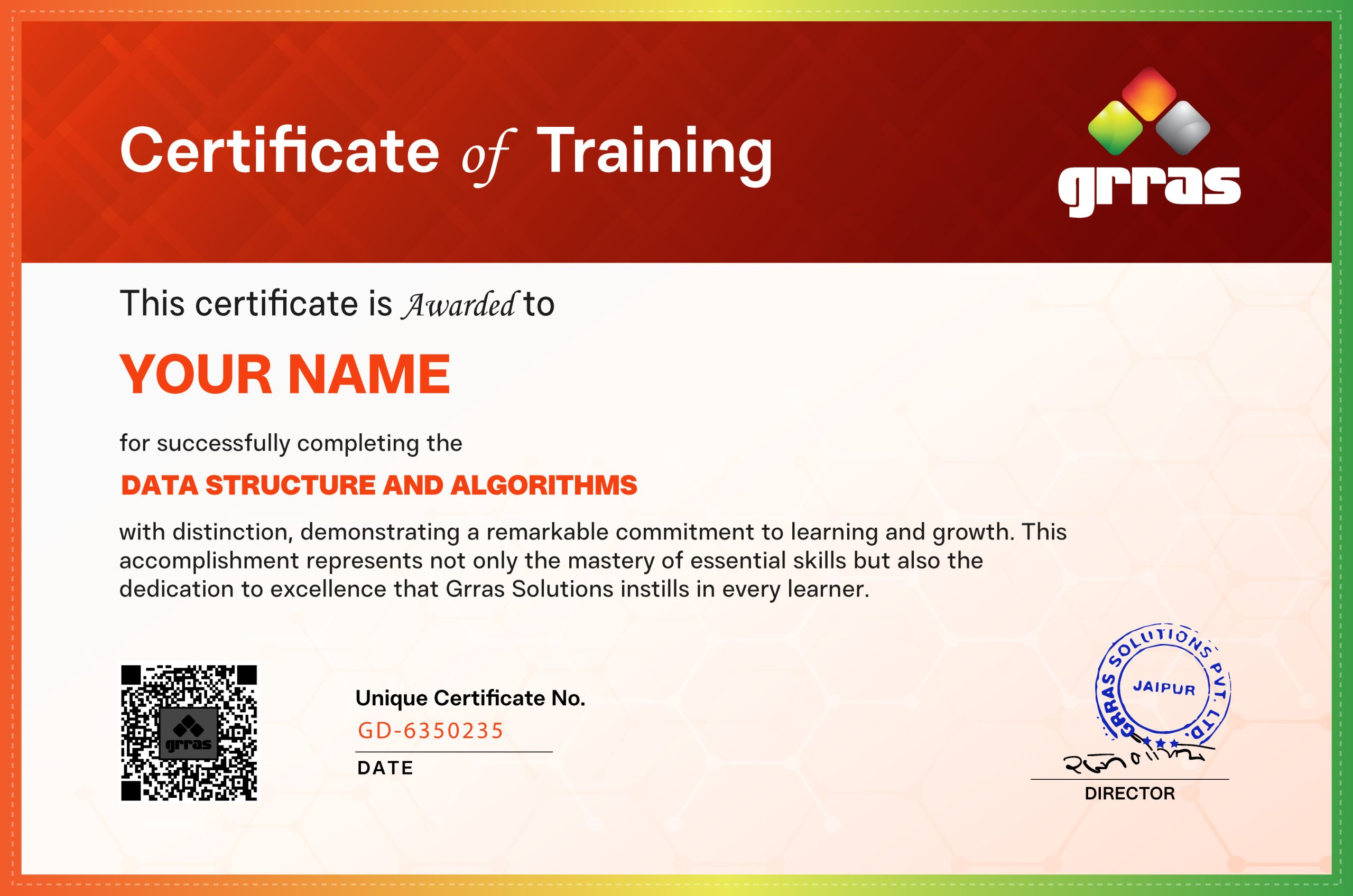
Industry Recognized DSA Certification in Bhopal

Earn an industry-recognized Data Structures and Algorithms (DSA) Certification in Bhopal that validates your expertise in problem-solving, algorithm optimization, and data structure implementation. This credential highlights your proficiency in recursion, dynamic programming, graph algorithms, and data manipulation using C++, giving you a strong competitive advantage in technical interviews and Bhopal’s growing tech market.

Whether you’re starting your tech career or aiming for senior roles, this certification proves your ability to design scalable, high-performance solutions for real-world challenges—enhancing your credibility, sharpening your problem-solving skills, and accelerating your growth as a top-performing software developer in Bhopal and beyond.

  • 20000+

    Professionals Trained

  • 20+

    Countries & Counting

  • 100+

    Corporate Served

Our Proven Track Record Shows that we Walk the Talk

Why Choose Grras Solutions?

Industry-Aligned Curriculum

Master a curriculum crafted and constantly updated by industry experts to match real-world trends, ensuring every concept and project builds job-ready, future-proof skills.

Personalized Career Support

Receive one-on-one mentorship, resume reviews, mock interviews, and complete placement assistance through our 500+ hiring partners to accelerate your tech career.

Expert Mentorship

Learn directly from certified professionals with years of hands-on experience who guide you through every module, project, and career milestone personally.

Real-World Projects

Gain practical exposure by working on live, industry-grade projects that mirror real business challenges, strengthening your technical execution and problem-solving abilities.

Proven Track Record

Join thousands of successful learners who have launched rewarding tech careers through Grras. Our consistent placement results, trusted partnerships, and alumni success stories speak for the quality of our training.

From Training to Placement A Roadmap to Success

Navigate your professional journey with a comprehensive guide that transforms learning into opportunity. Discover proven strategies to build skills, gain experience, and secure your ideal position in today's competitive job market.

Expert Training sessions123

Focus on industry-relevant skills

Hands on projects & Assignments

Real-world projects to implement learned concepts.

Performance Tracking

Weekly tests to assess progress

Mock Interviews

Mock sessions with real-time feedback from experts

Expert Sessions

Host industry experts for advanced technical guidance

Skill Refinement Tasks

Focus on problem-solving, critical thinking, and domain expertise

Effective Communication & Presentation Skills

Through interactive classes, students enhance both verbal and non-verbal communication, while also learning to present their ideas clearly, confidently, and effectively.

Aptitude & Logical Reasoning Training

Enhances students' problem-solving, analytical thinking, and numerical ability-preparing them for competitive exams and placement tests.

Step by step guidance

Help students structure professional, impactful resumes

Industry networking

* Partner with top companies for hiring pipelines
* Conduct webinars and sessions with recruiters

Placement coordination

* Connect candidates to aligned opportunities
* Organize hiring events and recruitment drives

Stress Management Techniques

Equip students to handle high-pressure interview situations

Scenario-Based Training

Prepare students for various interview formats, including case studies, coding rounds, and group discussions

Individual Sessions

* Address specific weaknesses and barriers to success.
* Develop personalized improvement plans

Our mission revolves around our learners

Promising 100% #CareerSuccess!

Download Placement Report

600+ Hiring Partners Across Industries

Transform Your Learning into a DSA-Driven Development Career

Join Our Exclusive Workshops!

Discover daily sessions covering business analytics, graphic design, Python, and more. Reserve your spot today!

Highly Recommended Course

Frequently Asked Questions

Yes, during the training, expert mentors help with coding, solving problems, and giving career advice.

Yes, students join active coding communities, hackathons, contests, and workshops to work together and learn more.

Yes, having access to resources and alumni communities for life makes sure that you keep practicing coding and getting help.

Yes, it gives students from non-technical fields the skills they need to confidently switch to careers in software and programming.

Because of expert-led mentorship, hands-on coding practice, certifications, competitive preparation, flexible formats, and a strong record of placing students.

Some of the projects are a student management system, pathfinding algorithms, search engines, and competitive programming solutions that are useful in the real world.

Yes, projects are ready for your portfolio, so you can confidently show recruiters that you know how to design algorithms and code.

Yes, students use dynamic programming to solve optimization problems in real-world projects, which helps them get better at advanced problem-solving.

Yes, coding contests and problem-solving exercises on sites like Codeforces and HackerRank are part of the training.

Yes, projects require debugging, improving algorithms, and writing efficient C++ code while under time pressure.

Yes, students can take interactive online classes or go to class, depending on what works best for them, where they live, and how they like to learn.

Yes, flexible schedules let people who work learn more about algorithms and data structures without affecting their jobs, which helps them move up in their software development careers.

Yes, all of the sessions are recorded. Learners can go back and watch recordings, read notes, and do coding assignments at any time to review what they missed or practice again.

Yes, students can access notes, problem sets, recordings, and project files for life so they can keep coding and reviewing.

Yes, throughout the program, experienced C++ professionals will give you one-on-one help, review your code, help you solve problems, and give you career advice.

You will use Code::Blocks, Visual Studio Code, and sites like LeetCode, HackerRank, and Codeforces that let you compete with other programmers to practice real-world coding problems.

Yes, the course starts with basic topics like arrays, recursion, and linked lists and then moves on to more advanced topics like dynamic programming, graph algorithms, sorting, and hashing.

Yes, students make things like student management systems, pathfinding algorithms, and small search engines while they work on competitive programming problems.

Yes, students work on BFS, DFS, shortest path algorithms, binary trees, and binary search trees by solving real coding problems.

Yes, the program has hundreds of coding challenges that will help students get ready for technical interviews at top companies.

The curriculum includes:

  • C++ fundamentals (syntax, loops, functions, pointers)
  • Arrays, Strings, Linked Lists
  • Stack, Queue, Trees, BST, Heaps
  • Recursion & Backtracking
  • Sorting & Searching
  • Graphs, Tries, Hashing
  • Dynamic Programming & Bit Manipulation
  • Real-world problem solving and code optimization

This internship is highly problem-solving driven. You will work on hundreds of DSA problems from platforms like LeetCode, HackerRank, and GFG. Each topic comes with hands-on practice and real-world challenges.

Yes. You’ll gain a solid understanding of Time & Space Complexity, including Big O notation, loop analysis, recursion depth, and optimization strategies.

All classes are live and instructor-led, ensuring real-time interaction. You will also get access to recordings and detailed notes for revision and flexibility

You’ll receive:

  • Live doubt-clearing sessions
  • One-on-one support
  • Access to mentors and dedicated doubt channels
  • Regular feedback and progress tracking

Yes, during the training, expert mentors help with coding, solving problems, and giving career advice.

Yes, students join active coding communities, hackathons, contests, and workshops to work together and learn more.

Yes, having access to resources and alumni communities for life makes sure that you keep practicing coding and getting help.

Yes, it gives students from non-technical fields the skills they need to confidently switch to careers in software and programming.

Because of expert-led mentorship, hands-on coding practice, certifications, competitive preparation, flexible formats, and a strong record of placing students.

Some of the projects are a student management system, pathfinding algorithms, search engines, and competitive programming solutions that are useful in the real world.

Yes, projects are ready for your portfolio, so you can confidently show recruiters that you know how to design algorithms and code.

Yes, students use dynamic programming to solve optimization problems in real-world projects, which helps them get better at advanced problem-solving.

Yes, coding contests and problem-solving exercises on sites like Codeforces and HackerRank are part of the training.

Yes, projects require debugging, improving algorithms, and writing efficient C++ code while under time pressure.

Yes, students can take interactive online classes or go to class, depending on what works best for them, where they live, and how they like to learn.

Yes, flexible schedules let people who work learn more about algorithms and data structures without affecting their jobs, which helps them move up in their software development careers.

Yes, all of the sessions are recorded. Learners can go back and watch recordings, read notes, and do coding assignments at any time to review what they missed or practice again.

Yes, students can access notes, problem sets, recordings, and project files for life so they can keep coding and reviewing.

Yes, throughout the program, experienced C++ professionals will give you one-on-one help, review your code, help you solve problems, and give you career advice.

You will use Code::Blocks, Visual Studio Code, and sites like LeetCode, HackerRank, and Codeforces that let you compete with other programmers to practice real-world coding problems.

Yes, the course starts with basic topics like arrays, recursion, and linked lists and then moves on to more advanced topics like dynamic programming, graph algorithms, sorting, and hashing.

Yes, students make things like student management systems, pathfinding algorithms, and small search engines while they work on competitive programming problems.

Yes, students work on BFS, DFS, shortest path algorithms, binary trees, and binary search trees by solving real coding problems.

Yes, the program has hundreds of coding challenges that will help students get ready for technical interviews at top companies.

The curriculum includes:

  • C++ fundamentals (syntax, loops, functions, pointers)
  • Arrays, Strings, Linked Lists
  • Stack, Queue, Trees, BST, Heaps
  • Recursion & Backtracking
  • Sorting & Searching
  • Graphs, Tries, Hashing
  • Dynamic Programming & Bit Manipulation
  • Real-world problem solving and code optimization

This internship is highly problem-solving driven. You will work on hundreds of DSA problems from platforms like LeetCode, HackerRank, and GFG. Each topic comes with hands-on practice and real-world challenges.

Yes. You’ll gain a solid understanding of Time & Space Complexity, including Big O notation, loop analysis, recursion depth, and optimization strategies.

All classes are live and instructor-led, ensuring real-time interaction. You will also get access to recordings and detailed notes for revision and flexibility

You’ll receive:

  • Live doubt-clearing sessions
  • One-on-one support
  • Access to mentors and dedicated doubt channels
  • Regular feedback and progress tracking

Need Help? Talk to us at +91-8448-448523 or WhatsApp us at +91-9001-991813 or REQUEST CALLBACK
Enquire Now