In today’s fast-moving technology landscape, organisations must release software faster, maintain stability, and scale efficiently. Traditional manual processes can no longer support modern application delivery demands. This is the reason mastering the DevOps automation framework design becomes essential.
A well-structured automation framework enables continuous integration, seamless deployments, infrastructure scalability, and well-grounded monitoring. It transforms the way development and operations teams get together and deliver value.
This guide explains how to design a production-ready DevOps automation framework, the essential components involved, best practices to follow, and how professionals can lead this tech-trending skill.
What is DevOps Automation and Why It Matters in a DevOps Course?
DevOps automation is the procedure of automating tasks across the software development lifecycle. It reduces manual intervention and ensures consistent, repeatable workflows.
Automation commonly includes:
Code integration and builds
- Automated testing
- Infrastructure provisioning
- Configuration management
- Application deployment
Monitoring and alerting
The primary goal is to improve speed, reliability, and collaboration while reducing errors.
Why is Automation Framework Design Essential in DevOps Training?
Automation alone does not guarantee success. Without proper architecture and planning, pipelines can become complex, insecure, and difficult to maintain.
A well-designed automation framework check:
- Faster and more reliable software releases
- Consistent environments across development, staging, and production
- Reduced operational costs
- Improved scalability
- Better system visibility
It provides a structured approach in which one and all component works seamlessly within an integrated system.
Core Components of a DevOps Automation Framework
A robust DevOps automation architecture is made of various interconnected layers.
1. Version Control System
Every automation drive begins with version control. Git is the best practice tool used to manage source code and track changes efficacy. Platforms like GitHub and GitLab enable collaboration, code reviews, and integration with automation pipelines.
Version control ensures traceability, collaboration, and rollback capabilities.
2. Continuous Integration
Continuous Integration (CI) automatically builds and tests code when developers push changes to the repository. Jenkins is one of the most widely used automation servers for building CI pipelines.
Continuous Integration helps in:
- Detecting bugs early
- Maintaining code quality
- Preventing integration conflicts
3. Continuous Delivery and Deployment
Continuous Delivery makes sure that applications are always ready to be deployed. Continuous Deployment takes it a step further by automatically releasing code to production after passing quality checks.
Kubernetes is commonly used for automated deployments and managing containerised applications at scale. It supports rolling updates, scaling, and self-healing capabilities.
4. Containerisation
Docker allows applications to run in lightweight containers that package all dependencies together. This eliminates environment-related issues and ensures consistency across systems.
Containerisation enables:
- Faster deployments
- Portability across environments
- Simplifying dependency management
5. Infrastructure as Code
Infrastructure as Code (IaC) allows infrastructure to be defined and managed using code rather than manual processes. Terraform is a globally used tool for provisioning cloud infrastructure.
Using IaC ensures:
- Repeatable infrastructure setup
- Lower configuration drift
- Faster environment provisioning
- Better documentation of system architecture
6. Configuration Management
Configuration management tools automate server setup and system configurations. They ensure all systems are configured regularly and securely.
This layer helps manage packages, users, permissions, and application settings without manual intervention.
7. Monitoring and Observability
Monitoring is a hypercritical part of any automation framework. Prometheus collects metrics, while Grafana provides visual dashboards for analyzing system performance.
Monitoring allows teams to:
- Detect issues early
- Analyse performance trends
- Improve reliability
- Reduce downtime
Observability ensures that systems are safe and responsive under production workload.
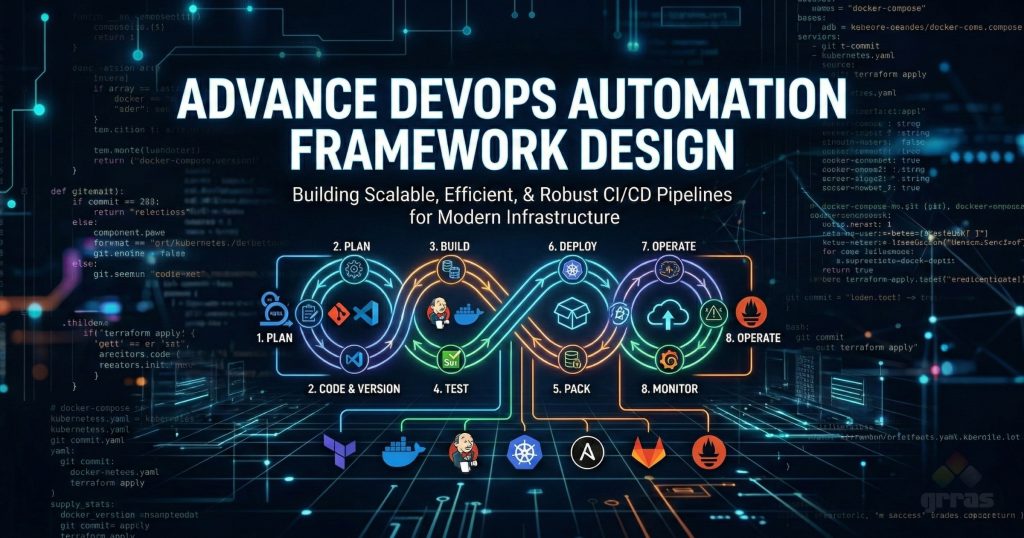
Step-by-Step Approach to Designing a DevOps Automation Framework
Designing an effective DevOps automation system requires careful planning and structured execution. Here is the clear approach to design automation. One can gain hands-on experience with a DevOps course or by working in DevOps roles. Let’s start step by step.
Step 1: Define Workflow and Strategy
Begin by identifying:
- Branching model
- Deployment environments
- Testing requirements
- Approval processes
A clearly defined workflow ensures smoother automation implementation.
Step 2: Build a Modular CI/CD Pipeline
An effective CI/CD pipeline includes:
- Code commit
- Automated build
- Unit testing
- Integration testing
- Security scanning
- Container build
- Infrastructure provisioning
- Deployment
- Monitoring
Each stage should be independent and automated to avoid bottlenecks.
Step 3: Implement Infrastructure as Code
Define infrastructure configurations in reusable modules. Automating service provisioning, networking, storage, and Kubernetes clusters using Terraform.
This approach ensures scalability and repeatability across multiple environments.
Step 4: Automate Container Deployment
Containerise applications and deploy them to Kubernetes clusters. Enable features like auto-scaling, load balancing, and rolling updates to keep up high availability.
Step 5: Integrate Security
Security must be integrated throughout the automation process. This includes:
- Static code analysis
- Dependency vulnerability scanning
- Secure configuration policies
- Access control management
Integrating security early reduces risks and improves compliance.
Best hands-on practices for DevOps Automation Framework Design include those by Grras Solutions DevOps Program
To build a production-ready framework, follow these best practices:
Keep Pipelines as Code
Store pipeline configurations in version control to ensure transparency and version tracking.
Use Reusable Modules
Create reusable infrastructure modules and pipeline templates to save time and keep consistency.
Automate Testing Through
Incorporate multiple testing stages, including performance and security testing.
Implement Safe Deployment Strategies
Use techniques like blue-green or canary deployments to minimise downtime and risk.
Monitor Continuously
Establish the dashboards and alerts to proactively identify and resolve issues.
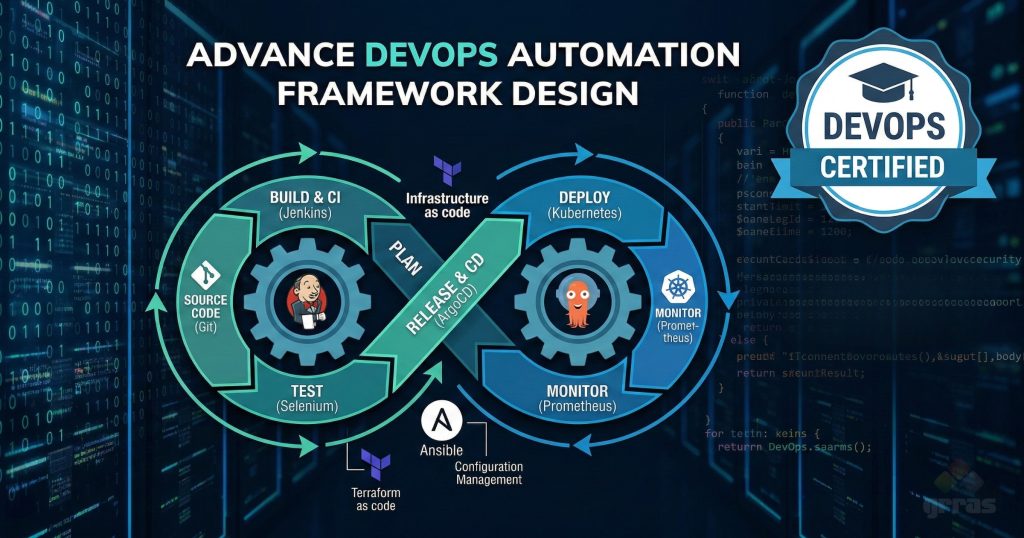
Real-World Implementation Example of DevOps Automation
Consider an organisation facing frequent deployment failures and downtime due to manual processes.
After implementing an automation framework:
- Code integration became automated
- Infrastructure provisioning was standardised
- Deployments were handled through container orchestration
- Monitoring dashboards provided real-time visibility
- The organisation experienced faster release cycles, improved reliability, and decrease operational stress.
This instance highlights how structured automation reshapes operational efficiency.
Skills Required to Design Automation Frameworks
Professionals aiming to design DevOps automation systems should master:
- Linux fundamentals
- Shell scripting
- Git workflows
- CI/CD pipeline design
- Docker and Kubernetes
- Infrastructure as Code tools
- Cloud platforms
- Monitoring systems
Practical exposure to real-time projects is important for gaining confidence and expertise.
Career Scope opened after DevOps Automation Training
DevOps automation skills open doors to roles such as:
- DevOps Engineer
- Site Reliability Engineer
- Cloud Architect
- Automation Engineer
- Platform Engineer
Organisations across industries rely heavily on automation experts to manage scalable cloud-native applications.
The demand for DevOps Engineers skilled in automation framework design continues to grow globally.
The Future of DevOps Automation
The future of automation is evolving rapidly. Emerging trends include:
- AI-driven pipeline optimisation
- GitOps practices
- Serverless deployments
- Platform engineering
- Zero-trust security integration
Modern enterprises are shifting toward fully automated, cloud-native ecosystems where resilience and scalability are built into the system architecture.
Start Your DevOps Training with Grras Solutions
The DevOps automation framework design is more than just integration. It is about building a structured, scalable, and secure system that supports continuous innovation.
A well-designed framework ensures:
- Reliable deployments
- Infrastructure consistency
- Faster time-to-market
- Improved collaboration
- Reduced operational risks
As digital transformation accelerates, professionals with strong automation architecture skills will remain highly valuable.
Mastering DevOps automation framework design equips you with the expertise required to build production-ready systems and advance your career in modern IT environments.
If you are looking to master DevOps automation framework design with real-time projects, learn DevOps from Grras Solutions. We offer industry-focused DevOps training in India designed for both freshers and working professionals.
Whether you are a fresher or a working professional looking for an online DevOps course or classroom DevOps training, our program helps you become job-ready with practical exposure.
👉 Talk to our counsellor today and start your DevOps career.






 Whatsapp us
 Call us
 Enquire Now