


AI for Everyone: Learn the Future
1st Jul, Mon
12:00 AM - 07:28 PM
1458 registered
ISO-certified
AI Powered


Master containerization with hands-on Docker training designed to make you job-ready for modern DevOps roles. Learn to build, run, manage, and troubleshoot Docker containers, images, volumes, and networks through real-world labs and practical use cases used in production environments.

150k+ Successful Placements

600+ Hiring Partners

Up to 76 Lakhs Highest Annual Package

Next Batch starts in February




Build an Impressive Portfolio

Expand Your Career Opportunities

Stay Ahead with Industry Trends

Master Cutting-Edge Development Tools
Our Docker Containers Training program delivers a complete, job-ready learning experience designed to help you master containerization in real-world environments. Through immersive, hands-on training, you will gain practical expertise in building, running, managing, and troubleshooting Docker containers used in modern application deployment.
The course focuses on real production scenarios, combining guided labs with practical use cases to prepare you for DevOps, cloud, and container-focused roles.
 Timeline: Instructor-led intensive Docker training Format: Interactive live sessions with practical Docker labs Platform: User-friendly online learning environment with guided demonstrations Coverage: Docker architecture, images, containers, volumes, networking, and container lifecycle management Approach: Hands-on learning using real-world container deployment scenarios Aspiring DevOps engineers starting with container technologies System administrators transitioning to containerized environments Developers looking to containerize applications Cloud and platform engineers working with modern deployment models IT professionals seeking job-ready Docker skills Docker Fundamentals: Understand containerization concepts and Docker architecture Container Operations: Build, run, manage, and troubleshoot Docker containers Image Management: Create, optimize, and manage Docker images using Dockerfile Storage and Networking: Configure Docker volumes and container networking Docker Expertise: Apply Docker best practices for development and production environments
Build a strong foundation in Docker containerization with a curriculum that covers the complete container lifecycle—from image creation and container management to storage, networking, and troubleshooting. Each module blends core Docker concepts with hands-on practice, ensuring you gain real-world skills to deploy, manage, and scale containerized applications in modern DevOps environments.
Build real industry experience by working on production-grade Docker projects. Each project strengthens your skills in container creation, image management, storage, networking, and troubleshooting—helping you become job-ready and confident in deploying containerized applications in real-world environments.
Skills: Role Management, Video Integration, Secure APIs, Payment & Subscription ModelsTools/Tech Stack: MongoDB, Express.js, React.js, Node.js, JWT, Stripe/PhonePe API Description:E-learning is growing quickly all over the world, and creating an LMS shows that you know MERN at a professional level. In this project, students will develop a platform where instructors…
Skills You'll Gain: System monitoring & observability Centralized logging & visualization Alerting & notifications Performance optimization Description:For this final project, students will set up monitoring and logging systems for a production-grade system. They will use Prometheus to gather system metrics, and Grafana to show them in detailed dashboards. The ELK…
Skills You'll Gain: Dynamic reactive forms from JSON schemas Query builder and runtime reporting Data visualization with charts & grids Export pipelines (CSV, XLSX, PDF) Monorepo & modular deployment with NX Description:Make an analytics suite that can be changed so that admins can set up datasets and form schemas that…
Receive a globally valued certification that validates your skills, practical knowledge, and job-ready expertise. This certification enhances your credibility, strengthens your resume, and helps you stand out to employers in competitive industries worldwide.

Professionals Trained

Countries & Counting

Corporate Served



















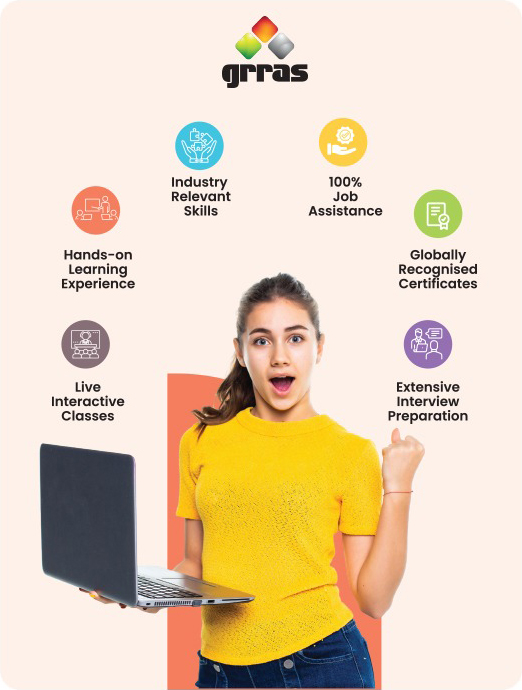
Build industry-ready skills with practical learning, expert guidance, real-world projects, and career-focused support. Our programs are designed to help you stay ahead of industry trends and confidently prepare for your professional journey.
Master a curriculum crafted and constantly updated by industry experts to match real-world trends, ensuring every concept and project builds job-ready, future-proof skills.
Receive one-on-one mentorship, resume reviews, mock interviews, and complete placement assistance through our 500+ hiring partners to accelerate your tech career.
Learn directly from certified professionals with years of hands-on experience who guide you through every module, project, and career milestone personally.
Gain practical exposure by working on live, industry-grade projects that mirror real business challenges, strengthening your technical execution and problem-solving abilities.
Join thousands of successful learners who have launched rewarding tech careers through Grras. Our consistent placement results, trusted partnerships, and alumni success stories speak for the quality of our training.
Navigate your professional journey with a comprehensive guide that transforms learning into opportunity. Discover proven strategies to build skills, gain experience, and secure your ideal position in today’s competitive job market.
 Building Strong Foundation
Focus on industry-relevant skills

Real-world projects to implement learned concepts.

Weekly tests to assess progress

 Sharpening Interview Readiness
Mock sessions with real-time feedback from experts

Host industry experts for advanced technical guidance

Focus on problem-solving, critical thinking, and domain expertise

 Communication & Aptitude Skill Development
Through interactive classes, students enhance both verbal and non-verbal communication, while also learning to present their ideas clearly, confidently, and effectively.

Enhances students' problem-solving, analytical thinking, and numerical ability-preparing them for competitive exams and placement tests.
 Resume building masterclasses
Help students structure professional, impactful resumes

 Bridging the Gap
* Partner with top companies for hiring pipelines * Conduct webinars and sessions with recruiters
* Connect candidates to aligned opportunities * Organize hiring events and recruitment drives
 Advance interview boot camp
Equip students to handle high-pressure interview situations
Prepare students for various interview formats, including case studies, coding rounds, and group discussions
 Personalized 1:1 guidance
* Address specific weaknesses and barriers to success. * Develop personalized improvement plans

Focus on industry-relevant skills
Real-world projects to implement learned concepts.
Weekly tests to assess progress
Mock sessions with real-time feedback from experts
Host industry experts for advanced technical guidance
Focus on problem-solving, critical thinking, and domain expertise
Through interactive classes, students enhance both verbal and non-verbal communication, while also learning to present their ideas clearly, confidently, and effectively.
Enhances students' problem-solving, analytical thinking, and numerical ability-preparing them for competitive exams and placement tests.
Help students structure professional, impactful resumes
* Partner with top companies for hiring pipelines * Conduct webinars and sessions with recruiters
* Connect candidates to aligned opportunities * Organize hiring events and recruitment drives
Equip students to handle high-pressure interview situations
Prepare students for various interview formats, including case studies, coding rounds, and group discussions
* Address specific weaknesses and barriers to success. * Develop personalized improvement plans

Our extensive network of hiring partners spans various industries, offering diverse opportunities to kickstart your career.





















Explore our top courses designed to build in-demand tech skills. Learn from expert trainers with practical training and industry-relevant curriculum.
This course teaches Docker containerization, images, volumes, and orchestration. It helps students build, ship, and run applications in a consistent way in different environments.
Anyone who wants to learn how to use containers to deploy and scale modern applications should take this course. This includes developers, system administrators, DevOps engineers, testers, and IT professionals.
No, you don’t need to know anything about Docker before you start. It helps to know a little bit about Linux, the cloud, or scripting, but everything is taught one step at a time.
If you work for a company that uses containerization technologies, you could be a DevOps Engineer, Site Reliability Engineer, Cloud Engineer, Release Engineer, or Infrastructure Specialist.
Yes, it helps students and graduates learn how to use containers in real life, work on projects, and get certifications, which makes them more likely to get jobs in DevOps and cloud computing.
Yes, students get a Docker certification that is recognized by the industry. This shows that they know how to use containers and makes them more likely to get a job in DevOps and cloud computing.
Yes, employers value Docker certifications as proof of real-world knowledge of containerization, deployment, and DevOps, which greatly improves your chances of getting a job.
People who have passed the certification exam can work as Cloud Engineers, Site Reliability Engineers, Docker Engineers, or DevOps Specialists.
Yes, placement support includes help with writing a resume, getting ready for interviews, making the most of LinkedIn, and getting to job portals.
Yes, Docker is very popular in the DevOps, cloud, and software industries. This makes containerization one of the most sought-after IT skills in the world.
You will learn the basics of container orchestration, GitHub, and cloud deployment tools, as well as Docker CLI, Docker Hub, Docker Compose, and Docker Swarm.
Yes, the training starts with the basics of containers and moves on to multi-container apps, orchestration, security, and advanced Docker networking.
Yes, students work on projects like deploying microservices, setting up CI/CD pipelines, making applications that run in containers, and connecting to orchestration platforms.
Yes, students learn the basics of Kubernetes for orchestration and practice using Docker Compose and Swarm to manage applications with multiple containers.
Yes, the course talks about how to use Docker with Jenkins, GitHub, and CI/CD pipelines to automate deployments.
Yes, you can choose either option. Depending on what works best for them, students can either attend live online classes or go to classes in person.
Yes, flexible schedules let professionals learn new skills while still doing their jobs, which helps containerization and DevOps practices grow steadily.
Yes, every session is recorded. Students can go back and review or redo missed topics at any time by listening to recordings, reading notes, and doing assignments.
Yes, students will always have access to project files, notes, and recordings, which will help them keep learning and improving their skills.
Yes, certified DevOps experts help students learn by showing them how to use Docker commands, work on projects, fix problems, and plan their careers.
Some of the tasks are putting applications in containers, managing microservices, setting up CI/CD pipelines, and putting solutions on cloud platforms.
Yes, every project is ready for your portfolio, showing employers that you know how to use containers and DevOps in real life.
Yes, students use Docker containers to deploy and manage microservices applications, which is like how DevOps works in the real world.
Yes, you will connect Docker to Jenkins and GitHub to make automated pipelines.
Yes, projects include putting containerized apps on AWS or Azure.
Yes, expert mentors can help with projects, give you advice on the best ways to do things, and help you with your career.
Yes, students join communities, webinars, and workshops to meet professionals and make connections.
Yes, having access to learning materials and alumni networks for life means you will always have help.
Yes, it gives professionals the containerization skills they need to make career changes go smoothly.
Because of experienced trainers, hands-on projects, recognized certifications, help with finding a job, and proof of student success.
This course teaches Docker containerization, images, volumes, and orchestration. It helps students build, ship, and run applications in a consistent way in different environments.
Anyone who wants to learn how to use containers to deploy and scale modern applications should take this course. This includes developers, system administrators, DevOps engineers, testers, and IT professionals.
No, you don’t need to know anything about Docker before you start. It helps to know a little bit about Linux, the cloud, or scripting, but everything is taught one step at a time.
If you work for a company that uses containerization technologies, you could be a DevOps Engineer, Site Reliability Engineer, Cloud Engineer, Release Engineer, or Infrastructure Specialist.
Yes, it helps students and graduates learn how to use containers in real life, work on projects, and get certifications, which makes them more likely to get jobs in DevOps and cloud computing.
Yes, students get a Docker certification that is recognized by the industry. This shows that they know how to use containers and makes them more likely to get a job in DevOps and cloud computing.
Yes, employers value Docker certifications as proof of real-world knowledge of containerization, deployment, and DevOps, which greatly improves your chances of getting a job.
People who have passed the certification exam can work as Cloud Engineers, Site Reliability Engineers, Docker Engineers, or DevOps Specialists.
Yes, placement support includes help with writing a resume, getting ready for interviews, making the most of LinkedIn, and getting to job portals.
Yes, Docker is very popular in the DevOps, cloud, and software industries. This makes containerization one of the most sought-after IT skills in the world.
You will learn the basics of container orchestration, GitHub, and cloud deployment tools, as well as Docker CLI, Docker Hub, Docker Compose, and Docker Swarm.
Yes, the training starts with the basics of containers and moves on to multi-container apps, orchestration, security, and advanced Docker networking.
Yes, students work on projects like deploying microservices, setting up CI/CD pipelines, making applications that run in containers, and connecting to orchestration platforms.
Yes, students learn the basics of Kubernetes for orchestration and practice using Docker Compose and Swarm to manage applications with multiple containers.
Yes, the course talks about how to use Docker with Jenkins, GitHub, and CI/CD pipelines to automate deployments.
Yes, you can choose either option. Depending on what works best for them, students can either attend live online classes or go to classes in person.
Yes, flexible schedules let professionals learn new skills while still doing their jobs, which helps containerization and DevOps practices grow steadily.
Yes, every session is recorded. Students can go back and review or redo missed topics at any time by listening to recordings, reading notes, and doing assignments.
Yes, students will always have access to project files, notes, and recordings, which will help them keep learning and improving their skills.
Yes, certified DevOps experts help students learn by showing them how to use Docker commands, work on projects, fix problems, and plan their careers.
Some of the tasks are putting applications in containers, managing microservices, setting up CI/CD pipelines, and putting solutions on cloud platforms.
Yes, every project is ready for your portfolio, showing employers that you know how to use containers and DevOps in real life.
Yes, students use Docker containers to deploy and manage microservices applications, which is like how DevOps works in the real world.
Yes, you will connect Docker to Jenkins and GitHub to make automated pipelines.
Yes, projects include putting containerized apps on AWS or Azure.
Yes, expert mentors can help with projects, give you advice on the best ways to do things, and help you with your career.
Yes, students join communities, webinars, and workshops to meet professionals and make connections.
Yes, having access to learning materials and alumni networks for life means you will always have help.
Yes, it gives professionals the containerization skills they need to make career changes go smoothly.
Because of experienced trainers, hands-on projects, recognized certifications, help with finding a job, and proof of student success.



Copyright © 2026 GRRAS Solutions Pvt. Ltd.







 Whatsapp us
 Call us
 Enquire Now