In view of the growing importance of digital transformation, the need for faster software delivery has become one of the leading issues. Traditionally, software delivery was done manually through complex processes with long release times and high chances of mistakes by developers and operators. To address these problems, many firms have started using CI/CD systems that automate the process of delivering software from its creation till its deployment on target machines. The benefits of such systems include both improved productivity and speedier delivery of updates to end-users. Thanks to such solutions, organizations gain greater agility when dealing with market changes.
The use of CI/CD pipeline architectures has proven to be beneficial, as they enable fast feature releases while maintaining application stability and reliability. This technology is an integral part of modern DevOps culture because CI/CD systems are widely used in DevOps processes. Professionals wishing to pursue a DevOps engineer certification will find it necessary to learn about the basics of CI/CD architectures and their role in ensuring rapid application releases. Apart from the ability to speed up the process of software delivery, CI/CD architectures help increase collaboration among different departments and provide various other benefits.
Understanding CI/CD Pipeline Architecture
CI/CD Pipeline refers to a well-defined sequence of activities involved in building, testing, validating, and deploying software applications. Such an architectural system links various activities aimed at guaranteeing that each code update undergoes several stages of verification in order to get into production. Automation greatly lowers the risk of software errors occurring during the deployment stage. Also, by performing repetitive tasks without the help of people, CI/CD makes development faster and guarantees reliable operation of software in different environments. With the increasing complexity of software products, such architecture becomes crucial for companies to deliver high-quality software solutions.
In an enterprise setting, CI/CD architecture includes numerous tools such as source code control systems, automated testing systems, security validation systems, artifact storage systems, deployment platforms, and monitoring systems. People who participate in a DevOps course online with placement usually receive practical knowledge related to all mentioned above tools since they are integral parts of contemporary software ecosystems. In particular, they facilitate finding bugs and vulnerabilities at the early stages of application development and help to ensure the flawless performance of software in production environments.
Key Components of a Modern CI/CD Pipeline
Every successful CI/CD pipeline starts with a combination of interdependent components which are utilized in order to automate the whole process of delivering software. This combination provides consistency and ensures the scalability and reliability of all processes involved while reducing any manual intervention.
Typical components used within production-quality CI/CD pipelines include the following:
- Source Code Management (Git, GitHub, GitLab)
- Build Automation Systems
- Automation Testing Frameworks
- Artifact Repositories
- Deployment Automation Systems
- Monitoring & Observability Solutions
- Security & Compliance Tools
Real Production Deployment Example: E-Commerce Platform
In large e-commerce firms, the business is operated under very competitive conditions, and any disruption of even a few minutes may result in losses for the organization. In order to maximize system availability and continuous deployment, such firms adopt highly effective automation CI/CD pipelines as well as cloud-native solutions. Most deployments are made without affecting client engagements and business transactions. The ability to deploy updates without impacting customer engagements is a crucial competitive advantage that organizations have within the highly competitive environment of the Internet. Furthermore, the adoption of automated processes assists organizations in keeping services reliable at peak traffic times such as sales during holidays, flash sales, and promotions.
The general procedure followed when deploying an e-commerce application is first by committing the code changes to the version control repository. The automated pipelines automatically build the codes, test them, conduct security scans, package applications as containers. Individuals interested in learn azure DevOps will work with such deployment processes due to Azure DevOps providing extensive automation capabilities when deploying software in the pipeline. Upon successful validation of all deployment tasks, the deployment process will gradually roll out the application through methods like canary and blue-green deployments. Monitoring and tracking of application performance and client experiences are done throughout the process.
CI/CD Architecture in Financial Services
One of the types of companies that have the most stringent requirements for application deployment are financial companies, owing to their high levels of regulation and responsibility for data protection. All the updates have to go through many verification stages before they are deployed in the production environment. Any problems or disruptions caused by an inadequate deployment process can cost such companies a lot of money and harm the reputation of both employees and company executives, who are held accountable for any data leaks.
Thus, there is a great need to introduce a CI/CD pipeline that incorporates all these measures for financial companies. This way, teams that decide to take part in the cloud DevOps training are able to observe the deployment processes and gain an understanding of the balance between automation and rigorous compliance checks in such pipelines. Such pipelines also provide a detailed history of any code changes, which allows for more efficient audits and reporting on compliance with laws and regulations.
Infrastructure as Code and Deployment Automation
The concept of Infrastructure as Code (IaC) has changed the manner in which organizations provision and manage their infrastructure resources. Instead of manually configuring servers, storage devices, and network devices, organizations define their infrastructure using code, which can be easily tracked via versioning and can be automatically deployed. Organizations that have adopted Infrastructure as Code achieve consistency and minimize overhead costs associated with managing their infrastructures. The concept has made it possible for organizations to avoid any configuration drift by ensuring that all environments are alike during different phases, such as the development, testing, and production phases.
In today’s CI/CD pipeline, Infrastructure as Code has been incorporated within the deployment process, where the infrastructure can undergo validation before approval. The understanding of such tools like Terraform, CloudFormation, and Ansible is crucial to DevOps engineers since they rank among the most important tools to learn for DevOps. The automated provision of infrastructure resources enables organizations to rapidly deploy infrastructures and quickly recover from any disaster.
Kubernetes-Based Production Deployments
There is an opinion that Kubernetes is the best orchestrator for containerized application deployments. By means of the CI/CD pipelines in Kubernetes, professionals have the ability to create, manage, execute deployments, and scale applications. Such an automation system helps companies update their software regularly without affecting their operations. Moreover, Kubernetes offers various features, such as self-healing and load balancing that make sure the high availability of applications in order for companies to deliver containerized applications.
One of the methods that are widely spread nowadays is GitOps. The principle behind this method lies in keeping the configuration data required for deploying applications in version-control repositories and making them consistent with Kubernetes clusters. In case people search for the best DevOps training institute, one should pay attention to the programs involving practices in Kubernetes deployments because this skill is very important for DevOps. GitOps makes it possible for people to monitor all the changes and cooperate within teams as well as roll back their changes easily.
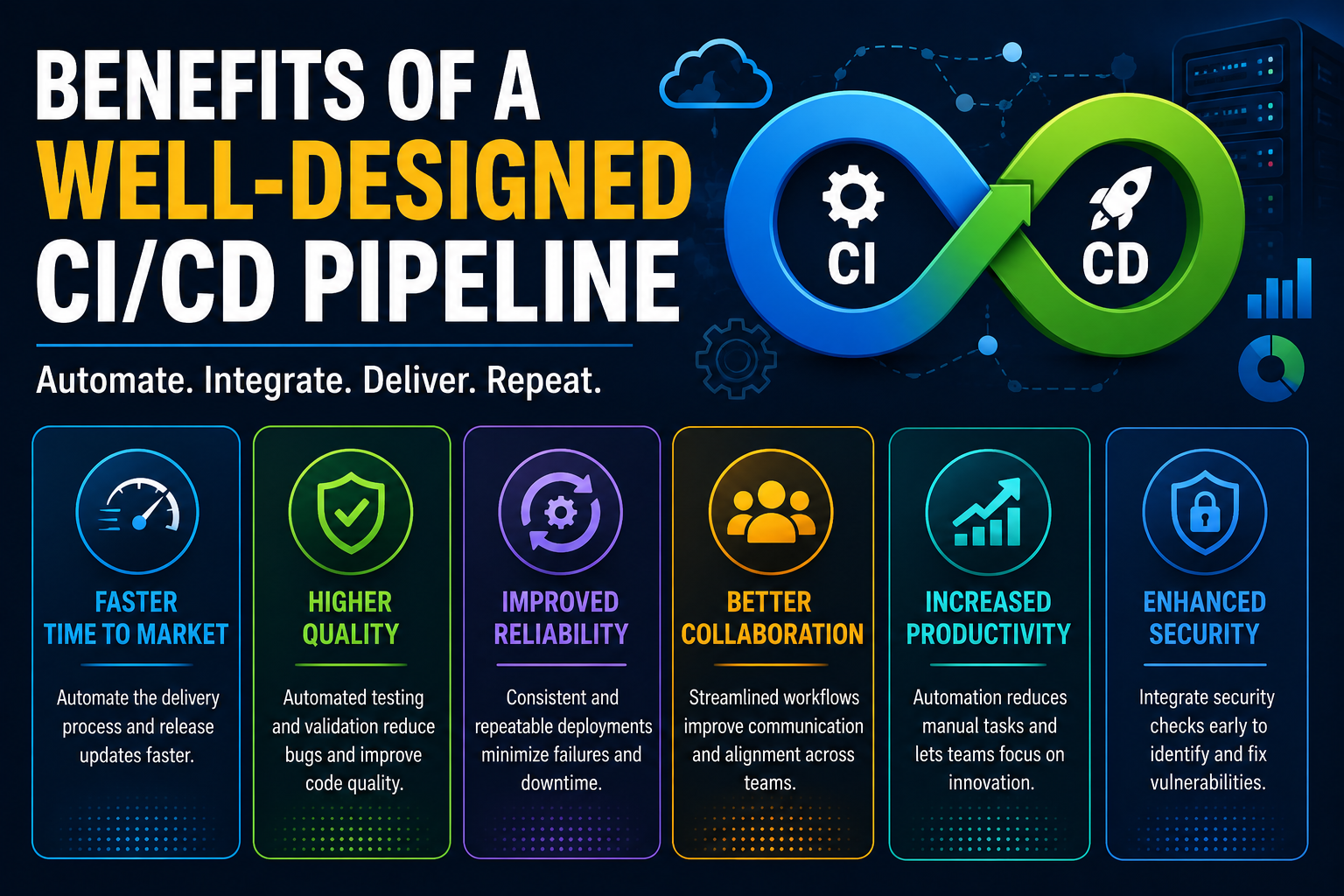
Benefits of a Well-Designed CI/CD Pipeline
The effective CI/CD pipeline yields definite business and technical benefits to organizations. Through automation and implementation of quality measures, organizations can achieve higher efficiencies in software deployment and software quality.
Some important benefits that can be derived are:
- Smooth software delivery
- Less failure during deployment
- Better code quality
- Efficient collaboration among teams
- Efficient security testing
- Consistent deployment process
- Faster incident resolution
Challenges in Real Production Environments
Despite having many benefits, deploying production-ready pipelines can be quite difficult. As an organization scales its software application and other infrastructure, such pipelines tend to become increasingly complicated, calling for more governance, security features, and monitoring tools. Proper management of these aspects calls for technical and strategic skills. Also, teams need to ensure that the deployment process remains efficient and meets all the necessary performance and security requirements. Pipeline complications can otherwise delay deployments and cause operational risks.
One other issue that organizations face when working on their pipelines is dealing with legacy applications. Such applications may not be compatible with new methods of automation. Therefore, an organization has to update its applications incrementally while still running its business. Most DevOps certification course take into account such challenges and give solutions. In many cases, organizations end up using the hybrid approach to solve problems of legacy applications.
Building a DevOps Career Through CI/CD Expertise
The growing investments in automation as well as cloud technologies have made the demand for efficient DevOps practitioners higher. Engineers skilled at creating scalable CI/CD architectures, automating the processes of infrastructure management, and completing production deployments are highly sought after in today’s market. Nowadays, it becomes increasingly essential for businesses to hire personnel who are capable of doing such work. Rising adoption of cloud applications, microservices, and automation programs has led to many openings in the DevOps industry for individuals with insight into deployment methods.
Those who wish to establish careers in DevOps have to be acquainted with version control programs, automation technologies, cloud computing services, containerization platforms, and monitoring tools. In case of choosing DevOps course fees, potential applicants must make sure that their courses involve practical information rather than theoretical one. Just like this, any quality DevOps course for fresher must involve hands-on practice with deployment via CI/CD pipelines. Getting actual experience of deploying applications would allow learners to better understand how to perform deployment and get themselves a lucrative position.
DevOps Best Practices for CI/CD Success
CI/CD can only be successful when more than just choosing the right tools is involved. There should also be a focus on creating processes that will promote automation, consistency, security, and continual improvement within the entire software delivery process. Using methodologies that have been tried and tested will enable the team to remain reliable even as things become more complex. A good CI/CD strategy will guarantee that the organization always gets software releases that are predictable and scalable.
There are several key DevOps best practices which teams can adopt for success. These practices include automating all processes that are repetitive, integrating security testing from the beginning, using Infrastructure as Code, monitoring everything and analyzing the performance metrics of deployments. Teams which embrace these best practices are more likely to see increased efficiency, reduced release times, and a lower number of failures. With continuous feedback and analysis of performance, teams will continue to improve their processes and increase efficiency.
Conclusion
The architecture of a CI/CD pipeline has become a crucial component of the software delivery process. With automation of code integration, code testing, code deployment, and monitoring activities, organizations can become more innovative and maintain very high-quality standards. In all industries, companies such as e-commerce organizations and financial firms use CI/CD to facilitate digital transformation projects. Such workflows allow organizations to minimize deployment risks, develop more efficiently, and react more effectively to the changes in the market. In the evolving field of software delivery and automation, CI/CD is likely to remain an important aspect in years to come.
It is important for DevOps engineers to see examples of production deployments in action to understand how leading organizations design their pipelines. Since the cloud continues to be a growing area of IT, becoming skilled in CI/CD pipeline architecture may become the most important thing for someone who wants to be successful in DevOps. People willing to learn DevOps can gain much from real-life examples of CI/CD deployment and automation workflows because of how useful they are. By mastering infrastructure automation and deployment, one becomes a valuable asset for organizations.





 Whatsapp us
 Call us
 Enquire Now