Each DevOps or cloud engineer who has ever worked with Kubernetes has committed the same rookie mistake — putting a password, an API token, or a database login into some place where they absolutely shouldn’t be. It seems convenient at the time, but secret leaks in Kubernetes setups are one of the most frequent reasons for cloud security compromises in production infrastructure in 2026. Learning how to manage secrets in Kubernetes properly is far from being a sophisticated technique, available only to security experts. It is one of the most basic knowledge each engineer, who works with container-based platforms, has to have before going to production. This is your full framework of best practices in managing secrets in Kubernetes.
What Are Kubernetes Secrets and Why They Are Critically Important
Secrets are a reliable tool for the handling of confidential information including passwords, API keys, DB credentials, SSH keys, OAuth tokens, TLS certificates, and so forth. When using conventional software development methodologies, developers use to store all such data in the source code or configurations, whereas in Kubernetes, you can create dedicated objects containing this type of information and then include them in the application. In that manner, the applications are kept safe from leaks of secret data and become more convenient. That is why knowing how to handle secrets in Kubernetes is an essential skill of any modern cloud engineer or DevOps engineer by taking best online course for devops.
With the adoption of microservices architecture, applications use tens of different services that require secure credentials. Each database, each cloud API, any third-party integration, and each communication between the services of the applications uses secrets. Should this secret information be exposed, the intruder will be able to gain access to the production systems and compromise the applications as well as sensitive data of customers. Secret management will protect applications from this problem and support secure Cloud Computing Architecture, thus becoming an integral part of each Kubernetes environment.
Effective management of secrets has become an important professional skill in order to get certified kubernetes administrator or another kubernetes certifications. Whatever your aims are whether you prepare for the cka exam or estimate cka certification cost, the management of secrets is included in the list of the tasks because of its impact on the production environment. It supplements cloud computing knowledge obtained during obtaining the Cloud Computing Certification.
The Biggest Secrets Management Mistakes DevOps Teams Make
The vast majority of security vulnerabilities occur not because of some complex attack vectors but due to trivial errors in application development and deployment. The desire to launch applications faster causes developers to embed passwords and other credentials in source code, recycle them across environments, and store unencrypted secrets in Git repos. This can speed up the coding process, but these practices become security vulnerabilities as soon as applications go live.
Kubernetes Secrets Management Common Mistakes
- Embedding passwords, API keys, or tokens in application source code.
- Keeping Kubernetes Secrets in public or unprotected Git repositories.
- Using Base64 encoding instead of encryption.
- Providing too many permissions to users and service accounts.
- Recycling the same credentials for development, testing, and production environments.
- Neglecting to change secrets once they were deployed or employees changed their roles.
- Maintaining unused or out-of-date secrets in Kubernetes clusters.
- Overlooking monitoring and auditing of secret access in cloud environments.
Preventing the mentioned mistakes takes secure coding and automation efforts as well as continuous monitoring. Those who take part in DevOps Training Online, DevOps Training and Placement, or the best online course for devops have to focus on secrets management since it became an integral DevSecOps practice. The ability to protect sensitive information becomes an indispensable quality of engineers working with Kubernetes.
How to Manage Secrets in Kubernetes — The Right Way From Day One
The best practice for cka certification security will involve setting up the proper secrets management right at the start instead of dealing with any security issues that may arise later on. Many firms tend to add security measures once the applications have already been deployed in production. Knowledge of Kubernetes right from the start will allow developers to create a robust and secure cloud-native app environment without sloswing down the pace of development.
The best way to manage secrets will involve ensuring that sensitive information does not get mixed up with application code. The credentials should never find their way to source code repository, configuration file or container image. Instead, the use of Kubernetes secrets should go together with external secrets management techniques and deployment pipelines. This method will ensure that the apps receive credentials just when they need them and minimize any chances of exposure. Such practices are now industry standards in organizations practicing Cloud Computing Architecture.
Anyone interested in becoming a certified Kubernetes administrator or another type of kubernetes certifications expert should learn such practices as they have now become production essentials. Regardless of whether you are preparing for cka exam, analyzing cka certification cost or studying certification kubernetes, this knowledge will demonstrate your professional skills to potential employers.
Encrypting Secrets at Rest — The Layer Most Teams Skip Completely
A lot of DevOps experts believe that saving secrets in Kubernetes is equal to protecting them from any breaches. Kubernetes, in its turn, keeps Secret resources in etcd, and in the absence of encryption at rest, this sensitive information can be easily obtained by any party gaining access to the database. As for Base64 encoding, it only changes the data representation format, without any encryption or protection applied to it. This issue is one of the most common security vulnerabilities found during the Kubernetes security checks.
Best Practices for Kubernetes Secrets Encryption
- Turn on Encryption at Rest for all the Secret objects used in Kubernetes.
- Encrypt etcd datastore.
- Keep encryption keys safe with the help of reliable key management systems.
- Integrate Kubernetes with secret management solutions outside of the system whenever possible.
- Rotate encryption keys regularly to reduce security risks.
- Limit administrative access to the files of encryption configurations.
- Audit secret storage and encryption configurations continuously.
- Test procedures of backup and disaster recovery of the system to make sure that encrypted secrets will stay safe.
Encrypting secrets at rest is an extra security measure that works in case when there is unauthorized access to cluster storage. With the combination of right access control, monitoring, and deployment measures, the use of encryption becomes even more effective. Cloud Computing Architecture, DevOps Training Online, or the best online course for devops should include such methods since data protection is an essential condition for working with Kubernetes today.
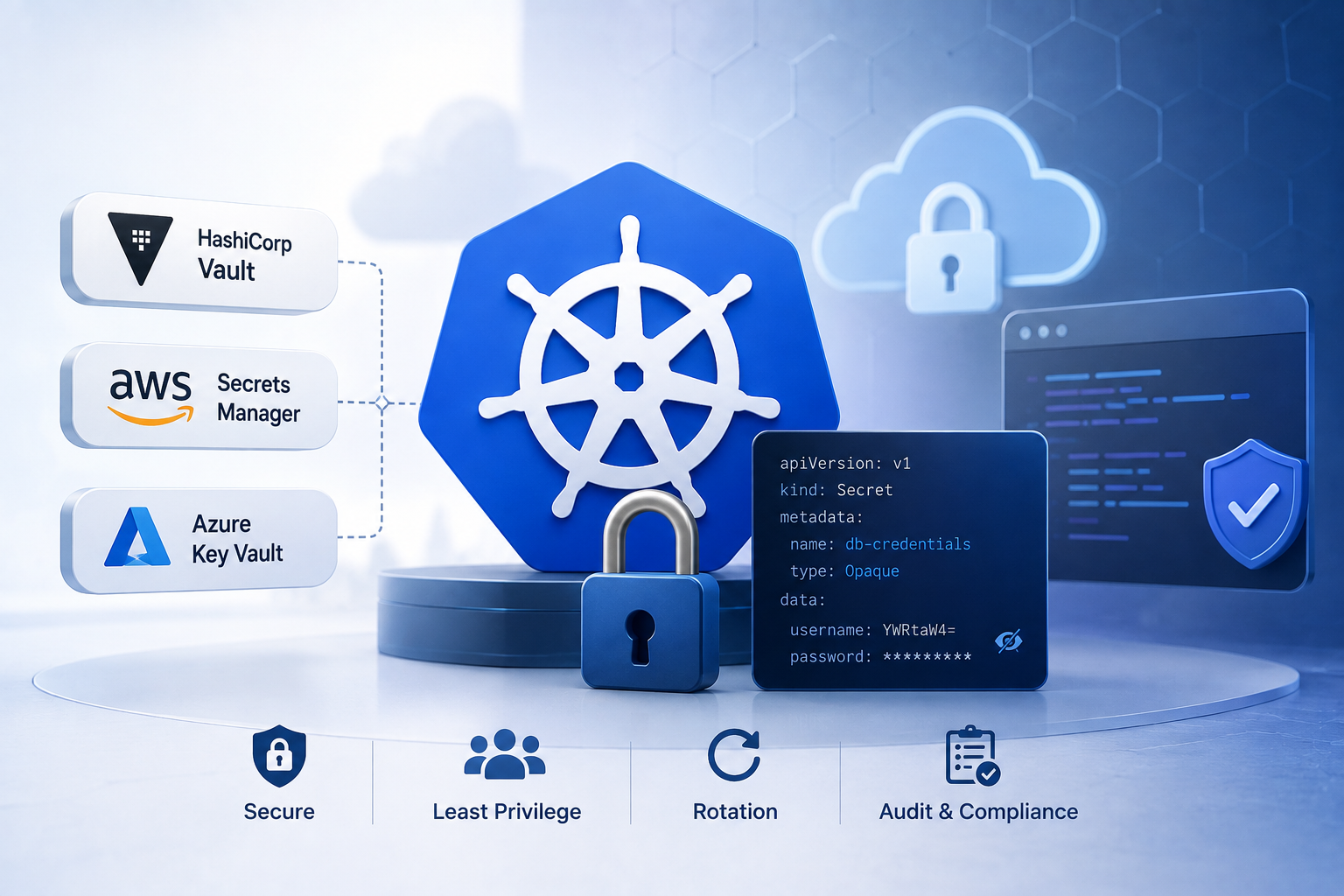
HashiCorp Vault, AWS Secrets Manager and Azure Key Vault — Which One to Use
When it comes to Kubernetes deployment, increasing the complexity and size might mean that using only native Kubernetes Secrets will not be enough for ensuring enterprise security standards. With thousands of credentials in clusters, clouds, and different applications, one needs to use a solution for the management of secrets centrally. There are more opportunities for the external secrets management solutions, including secret rotation, encryption, auditing, enforcing policies, and integration into CI/CD pipelines. The selection of the best secrets management solution depends on the specific infrastructure, compliance requirements, and cloud strategy without meaning that only one system should be used.
HashiCorp Vault is a widely used solution that is implemented in the multi-cloud and hybrid cloud environment, since it enables cloud-agnostic secrets management. AWS Secrets Manager is a good solution that can be integrated with AWS services and is useful for the management of secrets in the cloud-native workload on Amazon Web Services. Azure Key Vault is a popular solution for those developers, who build their applications in Microsoft Azure. All these solutions help to strengthen Cloud Computing Certification by getting rid of hard-coded credentials.
For those who are planning to obtain a cka certification credential or advanced kubernetes certifications, understanding these platforms’ benefits is necessary as enterprises implementing Kubernetes use at least one of the mentioned systems for secrets management. If you plan to pass the cka exam, consider the cka certification cost and the certification kubernetes learning path.
RBAC and Least Privilege — Controlling Who Can Access Your Secrets
Controlling access to secret information is crucial not only because of their safe storage, but also because of controlling access to them. RBAC in Kubernetes allows defining necessary permissions for particular identities such as users, service accounts, and applications. Instead of providing administrative privileges, RBAC guarantees that each identity gets the minimum required set of permissions that are enough to perform its actions.
Effective usage of RBAC in Kubernetes starts with responsibility separation among teams and services. Developers need to have access only to development resources while production secrets will be accessible only to certain service accounts and administrators. An application needs access only to particular secrets but not to every Secret object in the namespace. Permissions reviews, audit logs, and policy enforcement can help to enhance Kubernetes security and meet security policies.
Implementing RBAC is one of the most valuable best practices for engineers studying how to manage secrets in Kubernetes. When a professional wants to get Cloud Computing Certification, azure developer certification or DevOps Training Online, he needs to know how to use identity management for safe Kubernetes usage. Along with encryption, external secrets management, and monitoring, RBAC provides several layers of protection.
Secrets Rotation, Auditing and Compliance Best Practices
The topic of protecting kubernetes certifications secrets does not finish when secrets are securely stored. Credentials may get compromised with the passage of time due to employees’ changed roles, accidental exposures, vulnerabilities in software, or security breaches. Secrets rotation is performed to ensure that even if the credentials were leaked, they will be useless for attackers since they would be rotated before the attacks could be done. Besides, secrets rotation along with auditing are used to track how secrets are accessed and used in Kubernetes clusters, which is important for organizations striving for secure handling of production environment and compliance with current standards of security.
Best Practices for Secrets Rotation and Compliance
- Secrets rotation (rotation of passwords, API keys, certificates, tokens)
- Automated secrets rotation using Kubernetes compatible tools for managing secrets
- Detailed audit log for all access and modification operations with secrets
- Periodical review of user permissions and removal of unnecessary access
- Monitoring of Kubernetes clusters for suspicious activity with secrets
- Implementation of compliance policies for organization
- Verification of backup and disaster recovery procedures for encrypted secrets
- Periodical security assessment
Continuous auditing and automated secrets rotation make the lifecycle of secrets protection in Kubernetes complete and secure. Those engineers who know how to handle secrets in Kubernetes know that security is a continuous process and not only configuration once. If you are getting ready for cka exam or cloud computing certification or DevOps training online, then learning secrets management in Kubernetes will help you come closer to your target.
Learn Kubernetes Security the Right Way at Grras Solutions
The process of learning Kubernetes security notions is not only about the acquisition of additional knowledge about the subject matter, but rather obtaining practical experience on how to use this technology in a real-life situation. Increasing popularity of Kubernetes solutions leads to the need for specialists who would be able to manage the workloads securely and deal with sensitive data. Practicing skills in this area now opens great career opportunities in the future.
At Grras Solutions, learners receive practical experience in live cloud labs, real Kubernetes clusters, enterprise projects and mentorship. No matter whether one is preparing to become certified kubernetes administrator or getting ready for cka exam, discovering certification Kubernetes or taking DevOps Training and Placement course, here the learner will practice practical implementation of skills rather than just studying theoretical aspects. Cloud-related skills can be further improved thanks to Cloud Computing Certification, and azure developer certification as well. The most important part is creating the path of learning that will help one to become a professional based on actual industry demands – that’s why there is best online course for devops at Grras Solutions.
If one wants to succeed in his/her career in Kubernetes, cloud computing and DevSecOps sphere, it’s high time to start learning in practice. Learn how to manage secrets in Kubernetes, practice cloud-native projects, acquire production security skills and get prepared for global DevOps Training Online course with the help of Grras Solutions. It’s the engineers of today who will create a secure Kubernetes environment of tomorrow.
Strong Kubernetes security doesn’t begin with encryption—it begins with engineers who make security a habit in every deployment.





 Whatsapp us
 Call us
 Enquire Now