In terms of cloud computing and the development of container orchestration, the role of a DevOps engineer has dramatically changed as well. Enterprises no longer look for professionals who can automate deployments. Now they need specialists who can work with the operating system which forms the basis for most of cloud infrastructure. It means that having decent Linux skills is now one of the key prerequisites for entering the area of DevOps, cloud engineering or platform administration. No matter whether your app runs on AWS, Microsoft Azure, Google Cloud or even Kubernetes clusters, the chances are that your infrastructure is based on Linux.
All of the mentioned cloud technologies require the profound knowledge of Linux to operate correctly. Configuring servers, automating processes, securing and troubleshooting production – whatever you do, the knowledge of Linux is involved in all of the steps of working with the app. The professionals who have deep knowledge of Linux are better at deploying apps, automating their work and resolving infrastructure problems than the specialists who just use graphical interfaces.
It seems scary to the beginners due to the diversity of technologies that are to be mastered but Linux knowledge will ease your way of learning cloud platforms, Kubernetes, automation tools and CI/CD workflows. Instead of trying to remember everything, it’s better to understand how Linux operates and how it fits into the contemporary cloud environment.
This guide covers the reason why Linux continues being the core of cloud computing and Kubernetes, the essential skills that every DevOps engineer should obtain and how mastering Linux knowledge can be helpful in the long run.
Why Linux Is the Foundation of Cloud and Kubernetes
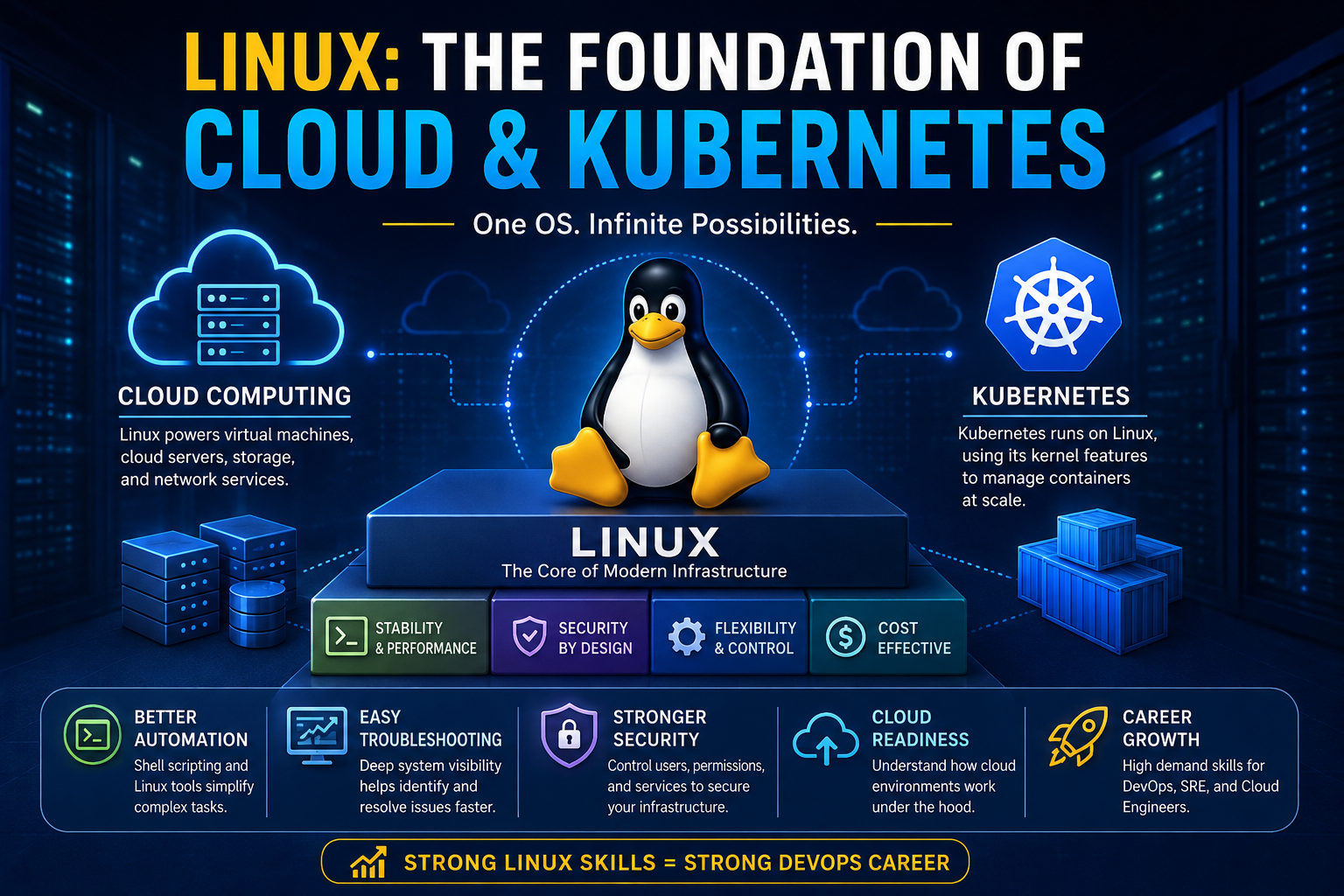
A great portion of cloud infrastructure is powered by Linux. Public cloud providers, company’s datacenters, Kubernetes, and other cloud native tools use Linux because of its reliability, security, flexibility, and good performance. Therefore, individuals who interact with cloud technologies every day do it with Linux without even knowing about it.
In order to deploy an application in the cloud, one needs to run it on virtual machines and containers that are implemented using Linux. Entire Kubernetes clustering technology is built around namespaces, cgroups, process isolation, and other concepts of Linux. The knowledge will help you to troubleshoot and optimize your application.
For those who have decided to become a specialist in IT domain, the best recommendation is to take a Linux course for beginners in order to proceed with studying advanced cloud technologies. Knowledge related to file systems management, users administration, network configurations, permission management, shell scripting, and process management will assist you to comprehend containerization and orchestration.
One more thing about using Linux as an operating system is its consistency. Irrelevant whether you administer on-premises server, cloud virtual machine, or Kubernetes node, the concepts of Linux administration will stay the same. Thus, one can minimize the learning curve when working with cloud technologies.
Individuals who know Linux well will be able to adopt to the new technologies as they know how to work with the operating system through application. In other words, one will not need to learn everything from the beginning.
Linux and Kubernetes: A Powerful Combination
In the present day, Kubernetes is considered the ultimate choice for the orchestration of containerized applications, but it is required to have a good knowledge of Linux, because all Kubernetes clusters run on Linux nodes and application runs there. Thus, without knowledge of the fundamentals of Linux, troubleshooting of Kubernetes problems is going to be much more difficult.
Although a professionally constructed kubernetes course gives you knowledge about basic notions of Kubernetes such as Pods, Deployments, Services, ConfigMaps, and managing of clusters, it is extremely important to know how everything happens under the hood. In this case, you will be able to analyze resource usage, solve networking problems, check system logs, work with storage and tune your containers.
This approach is especially effective for problem solving in a production environment, as you should not only examine Kubernetes’ CLI commands, but also the underlying operating system in order to find out what causes the problem.
Thus, by learning either Linux first and then Kubernetes or vice versa, you will build a powerful skillset that is highly demanded in modern DevOps world.
Why Every DevOps Engineer Needs Strong Linux Skills
Automation, collaboration, and continuous delivery – all core concepts of DevOps – would be impossible without a stable OS. The lion’s share of cloud servers, containers, and enterprise applications run on Linux. That’s why DevOps engineers devote a large part of their time to Linux environment.
The main benefit of Linux education is automation. Shell scripts help automate system administration processes, manage server configuration, automate deployment, take care of backups, and even carry out system maintenance without manual intervention. This improves efficiency and minimizes human factor impact.
Linux education contributes to better troubleshooting skills. In case of problems with applications, DevOps engineers have to analyze system logs, system processes, file permissions, and system resource usage to find the root cause of an issue. Understanding how Linux operates in such cases helps solve the problem.
That’s why many professionals prefer to combine Linux education with Cloud Computing Training. Not only does it allow them to practice working in a cloud infrastructure, but it also helps understand how Linux servers behave in AWS, Azure, and Google Cloud infrastructure. As more and more companies migrate their applications to the cloud infrastructure, DevOps engineers with good Linux skills become even more desirable.
Building Cloud-Ready Skills with Linux
The development and delivery of applications has been completely changed due to the innovation of cloud computing. Instead of building and managing data centers, modern business needs scalable cloud infrastructures which provide computing power as needed. While cloud computing has made managing infrastructure easier, Linux still plays an important role in cloud.
The use of Linux in most cloud-based virtual machines, container services and application servers is based on its stability, robustness and flexibility. Engineers with solid Linux knowledge will have an easy time working with cloud computing and will be able to manage infrastructure easily.
Also, having the knowledge of Linux makes understanding of such concepts of cloud computing like virtual machines, storage management, networking, security groups, load balancing easier. All of these technologies help in achieving availability and scalability of applications.
There are several cloud computing programs which have a structured approach and teach Linux Administration. Such programs understand the importance of Linux in the world of cloud computing and that it is not a completely separate thing.
Developers with cloud-ready Linux skills can take part in infrastructure automation, application deployment, disaster recovery planning and systems optimization. Some of the reasons why they become an integral part of DevOps and Cloud Engineering teams.
Practical Linux Skills Employers Look For
Employers are looking for engineers who have not only theoretical but practical Linux skills. Specifically, employers expect that candidates will be able to manage systems, troubleshoot problems in production, and automate some tasks.
The following are the most valuable Linux skills:
- User management and permission control.
- Knowledge about the Linux file system.
- Shell scripting and automation experience.
- Networking configuration and troubleshooting.
- System resource management including monitoring of CPU, memory usage, disk space and other performance aspects.
- Service management and booting processes.
- Ability to read and analyze logs.
- Linux server security and protection according to best practices.
In combination with cloud and Kubernetes experience, all the listed skills will add much value to your CV. The thing is that instead of being an expert in one technology, candidates become familiar with operating systems and how it interacts with cloud infrastructure and Kubernetes.
In recent years, employers have started preferring those candidates who are able to switch between technologies without necessity for long-term training period. And here, Linux fundamentals become a great foundation for learning new DevOps technologies.
Certifications That Strengthen Your Cloud and DevOps Career
Learning practical skills of Linux operation is always your main priority; however, certain certification will also help to demonstrate your ability to follow industry standards and try to increase your professional profile. This will show potential employers your desire to develop yourself and all required knowledge and skills needed to get entry-level position in IT. Meanwhile, with your practical experience, such certification will help to increase your confidence during the interview process and improve your CV.
If your specialization is Kubernetes, then it is important to pass Certified Kubernetes Administrator exam which is well-known by IT professionals. Preparation for the CKAexam helps engineers to comprehend cluster architecture, networking, storage, security, workload scheduling, and debugging of issues much better. As you already know, this test is performance-based one, which means that you should have great practical skills.
However, this does not mean that you should learn only for the test. You can do a lot of your projects, deploy apps on Kubernetes and work with Linux servers.
Linux specialists who are knowledgeable about Kubernetes and cloud administration are always in demand in the industry.
Choosing the Right Learning Path
Given the amount of tutorials, videos and information available on the internet, it gets difficult for one to identify the exact point from which one should start. Even though self-study is an effective method of acquiring knowledge and skills, a well-designed study plan guarantees that one learns all the necessary professional skills in the right sequence.
The best starting point would be the best Linux course, which entails labs, shell scripting, network and administration before learning anything about cloud technologies and Kubernetes. This is because one is able to build his/her confidence and guarantee his/her knowledge about Linux before moving to other areas.
With the acquisition of all the necessary knowledge and skills regarding Linux, one is now in a position to learn from the cloud computing courses with placement which not only covers Linux administration but cloud technologies, containerization, automation and projects.
As much as there may be different methods of learning, the most important thing in being successful in one’s studies is being consistent. This is accomplished by ensuring that one experiments with one’s Linux lab, works on cloud platform, uses containers and troubleshoots.
Conclusion
At the present moment, Linux remains a core of the modern-day cloud infrastructure and Kubernetes technology. Regardless of whether it concerns cloud server management, deployment, systems’ security, and dealing with production problems, the mastery of Linux will simplify almost any task that a DevOps engineer should perform on the modern-day market. People who are going to spend time improving their Linux knowledge will find it easy to learn cloud systems, container orchestration, automation, and other cloud technologies.
There are many different aspects that you can contemplate before you start studying, including such things as CKAcertification costs and others. However, a proper learning program can provide you with much more value than just the concern about certification costs.
If you are eager to gain practical skills in Linux, cloud technologies, and Kubernetes, you might try out the courses of Grras Solutions that will help you get practical skills in cloud technologies and Kubernetes and make yourself ready for the job.
Through dedication and acquisition of experience and knowledge, you will receive all necessary skills for success in cloud computing, Kubernetes, and DevOps industry.





 Whatsapp us
 Call us
 Enquire Now