CI/CD pipeline is the fastest way from code to deployment – and by 2026, this will be one of the most attacked surface areas in any cloud infrastructure. One unsecured pipeline step – leaked secret, unscanned dependency, incorrectly configured trigger – can bring vulnerabilities straight to the production environment in the exact same way and with the exact same level of automation as CI/CD pipeline security requires proper handling. The engineers who know how to secure CI/CD pipeline security don’t only protect their company’s infrastructure, but also place themselves among the most sought-after professionals in any DevOps team across the market. Here is the complete step-by-step guide on how to build security into your CI/CD pipeline.
Why CI/CD Pipeline Security Is Now a Core DevOps Skill
Rapid adoption of cloud-native apps has brought about the transformation of software development and deployment processes in many organizations. These days companies push code several times per day with the help of automated CI/CD pipelines. While speed provides businesses with an opportunity to be innovative and to deliver their products faster, it brings about certain security challenges as well. Each automated stage including code commit, downloading dependencies, building containers, and deployment of software in production can become a security entry point when security is not introduced at each stage of the CI/CD pipeline upfront. This is why CI/CD pipeline security has become one of the most important duties of DevOps specialists.
In old times security measures were performed by dedicated security specialists who had to manually review all the software before its release. The situation is different now when deployments happen constantly. Modern organizations are moving towards the implementation of DevSecOps pipeline security. It means that security measures will be automatically checked together with development and deployment processes. Security is no longer an approval stage but an integrated process which verifies code, infrastructure, dependencies, containers, and cloud assets. Such an approach allows reducing risks and at the same time does not slow down development.
With the increase in automation, cloud computing, and Kubernetes, there is an ever-increasing need in DevOps specialists who understand CI/CD security principles and have the necessary knowledge and skills in addition to traditional DevOps ones. Those who enroll into DevOps certification course, use a devops certification roadmap, and prepare for aws devops certification training should pay much attention to pipeline security.
Understanding the CI/CD Threat Landscape Before You Fix It
Knowing vulnerabilities of modern CI/CD pipeline becomes crucial before introducing corresponding security controls. Every stage of the pipeline is interacting with many different systems such as source code repository, build server, package manager, cloud providers, container registry, deployment system, production environment. Attackers exploit these systems for the purpose of introducing malicious code or any changes in an automatic manner in production environment. It is important to understand vulnerabilities of CI/CD pipeline before learning about how to secure them.
Threats to CI/CD Pipeline
- API keys, passwords, and cloud credentials exposed in the repository.
- Vulnerable third-party libraries and software dependencies.
- Misconfigured CI/CD workflows with high permissions.
- Compromised container images in the pipeline.
- Unauthorized access to the source code repository and build server.
- Supply chain attack on the open-source packages.
- Insecure Infrastructure as Code in the context of Cloud Computing Architecture.
- Vulnerabilities of Kubernetes cluster configuration in kubernetes certification course environment.
It is necessary to understand CI/CD pipeline threats to take steps for the improvement of the process instead of responding to threats after they have been introduced. Such actions as strong authentication, automated vulnerability scanning, proper secrets management, least-privilege access control, and continuous monitoring should be part of every pipeline. Knowing CI/CD pipeline threats is important while preparing for aws cloud developer certification, azure developer associate course, or taking a DevOps upskilling course at the best devops training institute.
Shift-Left Security — The Foundation of Every Secure Pipeline
Another crucial concept in DevSecOps pipeline security is known as Shift-Left Security. As opposed to finding out about any vulnerabilities only at the final phase of development, Shift-Left Security implies that developers get feedback on security while writing code – thus, potential issues are resolved at an early stage of software development lifecycle. It not only saves money spent on fixing bugs but helps to enhance software quality and deployment pace.
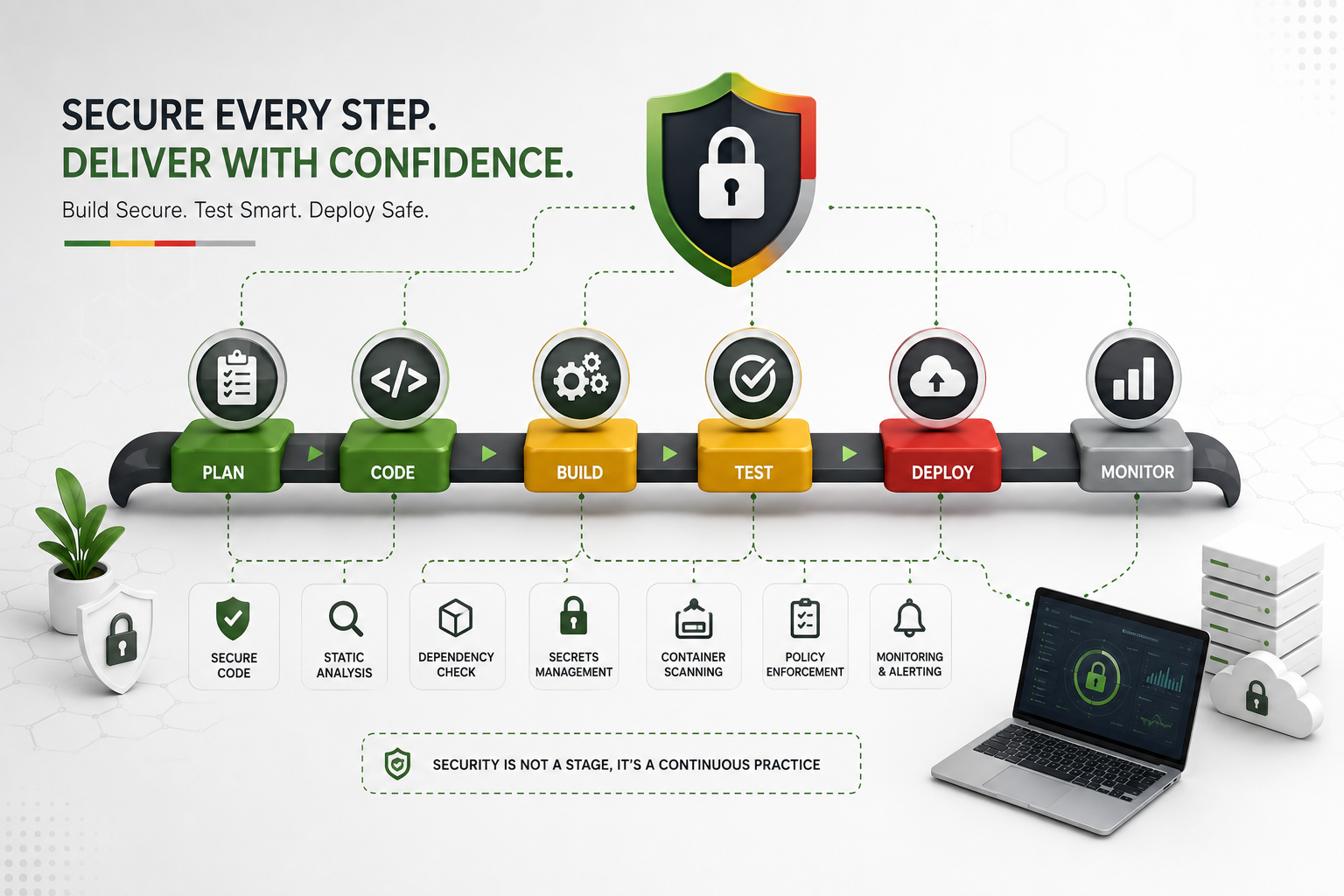
CI/CD environment in the modern era integrates security into coding, testing and build phases. Source code scanning, validation of dependencies, Infrastructure as Code analysis, and policy enforcement are some of the automatic security actions that take place prior to moving apps further in the pipeline. The integration allows delivering continuously without compromising on security and became one of the CI/CD security best practices implemented in cloud-native organizations. Security is integrated into daily routine of development process, instead of being an external task performed by another team.
In case one needs to learn how to secure CI/CD pipeline environments, Shift-Left Security serves as the starting point for other DevSecOps techniques. One can refer to a devops certification course, devops certification roadmap or even AWS DevOps certification training to understand what kind of integration takes place already in the very first code commit. Organizations tend to hire engineers who know how to create a development environment that is secure.
SAST, DAST and SCA — Three Security Layers Every Pipeline Needs
The current software applications need more than just one security scan in order to identify all the existing threats. The various security tools are created to detect various kinds of risks during the SDLC process. The combination of SAST, DAST, and SCA allows creating a pipeline with comprehensive protection for applications before their deployment into production. In that way, three layers will make the software more secure at the same time providing continuous software delivery.
The Understanding of Three Important Security Layers
- SAST (Static Application Security Testing): This layer scans the source code during its development in order to find coding mistakes, insecure functions, and other vulnerabilities before the building of applications.
- DAST (Dynamic Application Security Testing): This layer tests the running application from the attacker’s perspective to detect runtime vulnerabilities, problems with authentication and exposed endpoints.
- SCA (Software Composition Analysis): This layer analyses the third party libraries and open source dependencies to detect possible vulnerabilities, outdated packages, and other risks related to them.
- Integration of all three layers within the CI/CD pipeline helps to automate the process of CI/CD pipeline security without influencing the speed of software delivery.
- Such tools are useful for maintaining secure cloud environment and cloud computing architecture.
All these tools can be combined and used during the SDLC process to detect various vulnerabilities in applications before the deployment process. In such a way, it is not necessary to check everything manually anymore. People who study through a devops upskilling course, AWS cloud developer certification, azure developer associate course and similar courses should learn how to work with these security tools as they became a part of enterprise DevSecOps environment.
Secrets Management — The Most Overlooked Pipeline Security Problem
CI/CD pipeline security can be undermined by a variety of reasons. Among them, improper handling of sensitive information is one of the main ones. After all, the CI/CD process itself presupposes having such secrets as API keys, SSH keys, database passwords, cloud credentials, certificates, access tokens, and others that would be needed to perform different operations. Therefore, any leaking of the secrets would jeopardize the security of the pipeline, and the management of secrets becomes one of the most important aspects of securing the CI/CD environment.
The DevSecOps strategy implies the replacement of any hardcoded secrets with more sophisticated management of secrets which provides the possibility to store, to encrypt, and to control access to the sensitive information. It allows for minimizing the risks related to secret exposure and ensures secure automation in cloud-native environment. Besides, according to CI/CD security best practices, organizations should rotate secrets frequently and keep track of their usage to minimize the effects of secret leakage.
In terms of learning how to secure CI/CD pipeline environment, engineers should pay special attention to secrets management. No matter whether you are learning to do that from a devops certification course or following a devops certification roadmap or taking part in aws devops certification training, you will definitely benefit from that knowledge.
Container and Kubernetes Security in the Build Stage
Container packaging has been adopted as the norm in contemporary applications due to the ease of deployment and scalability in the cloud environment. Insecure container images, outdated base images, vulnerabilities in dependencies, and misconfigurations in the build process create security threats far ahead of the application’s release to production. Including security in the container build process will allow organizations to identify these vulnerabilities early on while still enjoying the agility of DevSecOps pipeline security.
There are some security practices which include scanning the container images for any vulnerability, checking software dependencies, enforcing trusted base images, and verifying Kubernetes configuration files prior to deployment. Image signing, access control in the registry, and enforcement of policies are put in place to allow only the verified images be used in production environments. This security practice is vital to the DevSecOps pipeline security because of the low risk involved when deploying workloads.
Professionals who have enrolled for the kubernetes certification training course, AWS cloud developer certification, and the azure developer associate course need to understand the importance of securing containers within the context of Cloud Computing Architecture. With the increase in the use of Kubernetes by organizations, there is a growing expectation of DevOps engineers to ensure that the applications they develop are secure before release.
Monitoring, Alerting and Incident Response After Deployment
Applying proper security measures to the deployment of an application marks a single phase of the DevSecOps cycle. After that, the organization requires real-time visibility into system performances, user activities, and possible security threats. Threat actors always seek new vulnerabilities, making real-time monitoring an integral component of the security of the CI/CD pipeline. Absent real-time monitoring and alerting may allow the secured application to be under threat for a prolonged period until it becomes apparent for security personnel. That is why post-deployment security is as crucial as the securing of the development pipeline itself.
Key Monitoring and Incident Response Techniques
- Real-time monitoring of the application, infrastructure, and Kubernetes logs.
- Setting up automatic alerting of suspicious activities and policy violations.
- Tracking user authentication events and unauthorized access attempts.
- Monitoring of the cloud resources for possible configuration drift and change.
- Conducting continuous vulnerability scanning after each deployment.
- Application of centralized monitoring and SIEM tools.
- Implementation of automated incident response workflows.
- Review of dashboards and security reports for improving CI/CD security practices.
Continuous monitoring closes the DevSecOps cycle by guaranteeing continuous security even after deployment. Engineers, who know how to secure CI/CD pipeline environments, realize that fast detection, automatic alerting, and efficient incident response reduce risks for their businesses. In case of getting prepared via an aws devops certification training, upskilling via a devops course, or obtaining a kubernetes certification course, you will know how to apply post-deployment monitoring properly.
Start Your DevSecOps Career the Right Way at Grras Solutions
Developing expertise in DevSecOps involves not only getting acquainted with particular tools but also knowing the way security, automation, cloud infrastructure, and modern approaches to software development are connected. As corporations start to value the development of their software from a security perspective, professionals having knowledge of the DevSecOps approach will become the most wanted specialists within the field of IT. The learning of this qualification will significantly facilitate your professional growth.
The learners at Grras Solutions get practical experience in working with DevSecOps through live cloud labs, enterprise-level projects, and mentoring by experts. If you are going to attend a devops certification course, prepare for aws devops certification training, follow a devops certification roadmap, and take a devops upskilling course, you will learn practical implementation of the knowledge, not just theoretical information. The learners also get acquainted with cloud computing technologies, Cloud Computing Architecture, security of Kubernetes, CI/CD automation, and other aspects of DevSecOps that employers need.
If you want to build a successful career as a DevOps engineer or cloud engineer, the moment to invest in DevSecOps skills has come. You should join a reputable devops training institute, work on real deployment pipelines, understand the security of CI/CD pipeline and gain practical experience in protecting cloud applications. Through continuous education, working on projects, and earning global certifications, you will become a DevSecOps specialist in the cloud industry.
The strongest CI/CD pipeline isn’t the fastest one—it’s the one that delivers innovation without compromising security.




 Whatsapp us
 Call us
 Enquire Now