In today’s world, almost everything is connected to the internet. From online banking and shopping to business operations and social media, we depend heavily on digital systems. While this makes life easier, it also increases the risk of cyberattacks.
This is where cyber security and ethical hacking come into the picture. They help protect systems, data, and users from online threats. In this blog, we will understand these concepts in simple words, why they are important, what skills are required, and how you can build a career in this field.
1. What is Cyber Security?
Cyber security is the process of protecting computers, networks, and data from unauthorized access or attacks. These attacks can come from hackers, viruses, malware, or other harmful activities.
For example, when you use a password to log into your email or bank account, cyber security systems are working in the background to keep your information safe.
Cyber security covers many areas, such as:
- Protecting personal data
- Securing company systems
- Preventing hacking attempts
- Monitoring suspicious activities
2. What is Ethical Hacking?
Ethical hacking is a part of cyber security. It means legally testing systems to find security weaknesses before real hackers can exploit them.
Ethical hackers are also called white-hat hackers. They use the same techniques as hackers but with permission and for a good purpose.
For example, a company may hire an ethical hacker to test their website. The hacker tries to break into the system and finds security gaps. Then, the company fixes those issues before a real attack happens.
In simple terms:
- Malicious hackers break systems to steal or damage data
- Ethical hackers break systems to protect them
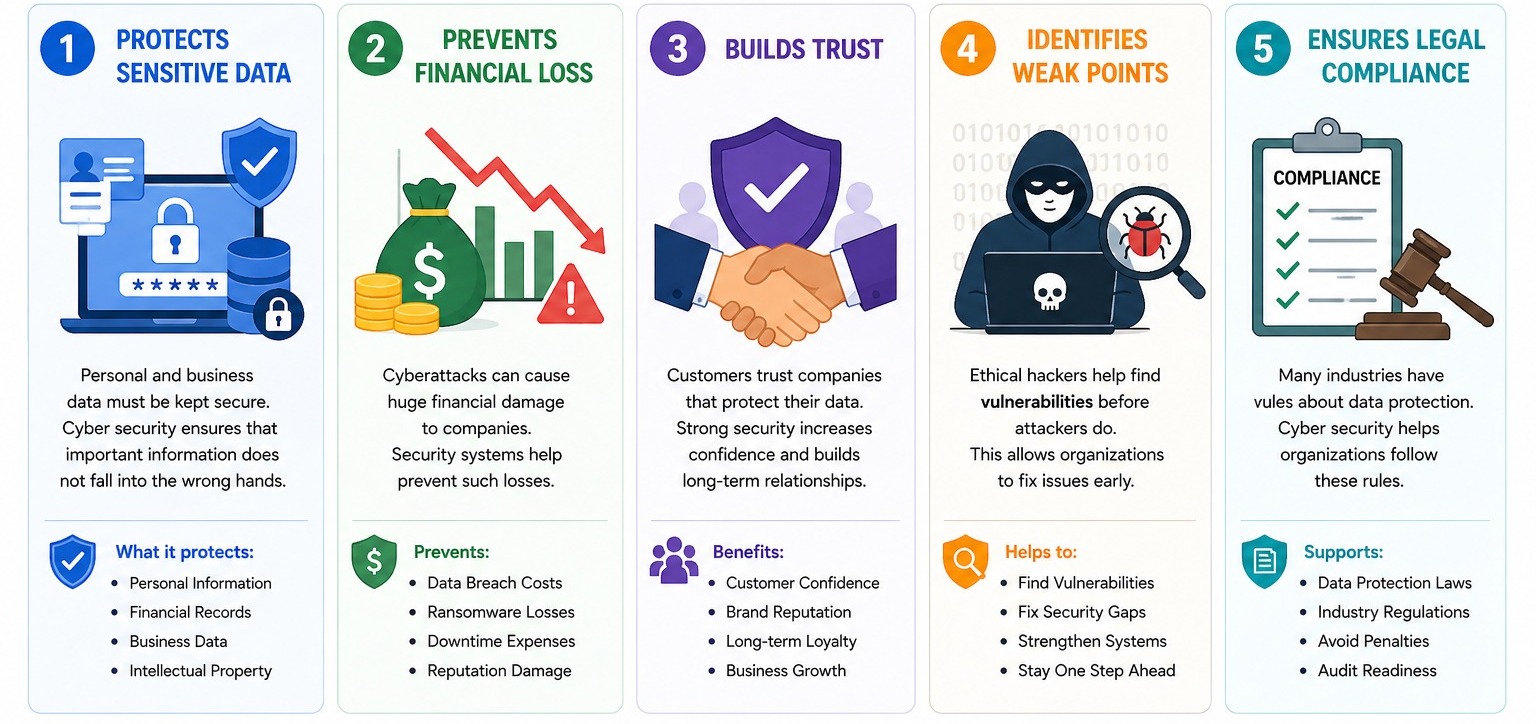
3. Why Cyber Security and Ethical Hacking are Important
4. Key Skills Required in Cyber Security and Ethical Hacking:
To build a career in this field, you need both technical knowledge and practical skills.
Basic Skills:
- Understanding of computer networks
- Knowledge of operating systems (Windows, Linux)
- Basic programming (Python, Java, etc.)
- Awareness of cyber threats
Technical Skills:
- Vulnerability scanning
- Penetration testing
- Network security
- Web application security
- Encryption and cryptography
Tools You Will Learn:
- Kali Linux
- Nmap
- Wireshark
- Metasploit
- Burp Suite
5. How Ethical Hackers Work
Ethical hackers follow a step-by-step process to test systems:
- Information Gathering – Collecting details about the target system
- Scanning – Finding open ports and vulnerabilities
- Gaining Access – Trying to enter the system
- Maintaining Access – Checking how long access can be kept
- Reporting – Sharing findings with the organization
6. Practical Learning and Industry Exposure
One of the most important parts of learning cyber security is practical experience. Just reading theory is not enough.
Good training programs provide:
- Live classes with experts
- Real-world projects
- Lab environments for practice
- Simulated cyberattacks
- Case studies
7. Career Opportunities in Cyber Security
Cyber security is one of the fastest-growing career fields in the world. There is a high demand for skilled professionals.
Some popular job roles include:
- Cyber Security Analyst
- Ethical Hacker
- Penetration Tester
- Security Engineer
- Network Security Specialist
- Security Consultant
8. Salary and Growth
Cyber security professionals are well-paid because of the high demand and specialized skills.
- Freshers can start with good salary packages
- Experienced professionals earn even higher salaries
- Opportunities are available both in India and abroad
9. Conclusion
Cyber security and ethical hacking are essential in today’s digital world. As cyber threats continue to grow, the need for skilled professionals is also increasing.
This field offers strong career opportunities, good salaries, and continuous learning. With the right training and practice, anyone can build a successful career in cyber security.
If you are interested in technology and want to protect systems from cyber threats, this is the right time to start your journey.




 Whatsapp us
 Call us
 Enquire Now