The world is getting more digital every day. We do banking and use UPI payments. We also use cloud computing and AI applications. We shop on e-commerce websites. Use government portals. Almost everything we do in our lives depends on technology.. With all this technology comes a big problem: cyber attacks.
Every day companies and governments and hospitals and startups and even individuals are getting attacked by hackers. We hear about ransomware and phishing attacks and data breaches all the time. This is a big threat.. It is also creating a lot of new job opportunities. One of the growing careers is Ethical Hacking and Cyber Security.
If you are a student or a fresh graduate or you want to switch careers or you are already working in Jaipur or Rajasthan or anywhere in India then cyber security is an option. You can get a salary and a stable job. You can also work with companies from around the world and even work from home.
This guide will tell you everything you need to know about building a career in Ethical Hacking and Cyber Security. It will explain what Ethical Hacking and Cyber Security is, about and how you can get started. Cyber Security is a career option and Ethical Hacking is a big part of it. With this guide you can learn more about Ethical Hacking and Cyber Security and how to make a career out of it.
1. What is Ethical Hacking?
Ethical hacking is when people check computer systems and networks to find out if they are safe. They do this to see if there are any weaknesses that bad people can use to get in.(Grras Solutions Pvt. Ltd.)
Ethical hackers are guys who are allowed to use hacking skills to make things more secure. They do this to help companies.
These good hackers work with companies to do a things. They:
- Detect vulnerabilities
- Prevent data breaches
- Secure networks
- Protect customer data
- Improve cyber defense systems
We also call these hackers other names. They are known as Ethical Hackers. We also call them White Hat Hackers or Security Analysts or Penetration Testers or Cyber Security Specialists.
2. What is Cyber Security?
Cyber security is a field that works to keep systems and networks safe from bad people who try to attack them. It also protects the cloud and the information we store there.(Grras Solutions Pvt. Ltd.)
Cyber security includes:
- Network security
- Cloud security
- Application security
- Information security
- Endpoint security
- Digital forensics
- Incident response
- Threat intelligence
Cyber security is very important and one of the parts of cyber security is something called ethical hacking. Ethical hacking is a part of cyber security because it helps us find out how to stop the bad people who try to attack our systems and networks. Cyber security and ethical hacking go hand, in hand to keep our security safe.
3.Why Cyber Security Matters More Than Ever
India is seeing growth in digital tech:
- Over 900 million people are using the internet
- Many Indians are adopting payments quickly
- Startups and software as a service (SaaS) companies are growing fast
- Cloud computing is expanding
- More people are using intelligence (AI) and Internet of Things (IoT) devices
But cyber crimes are also increasing fast.(Grras Solutions Pvt. Ltd.)
According to reports:
- Cyber attacks in India went up a lot after digital banking became popular
- Ransomware attacks happen to businesses every day
- Data breaches cost companies millions of rupees
- There is a shortage of cyber security jobs worldwide
This means there is a need for trained cyber security professionals, in India.(Grras Solutions Pvt. Ltd.)
4. Ethical Hacking vs Cyber Security
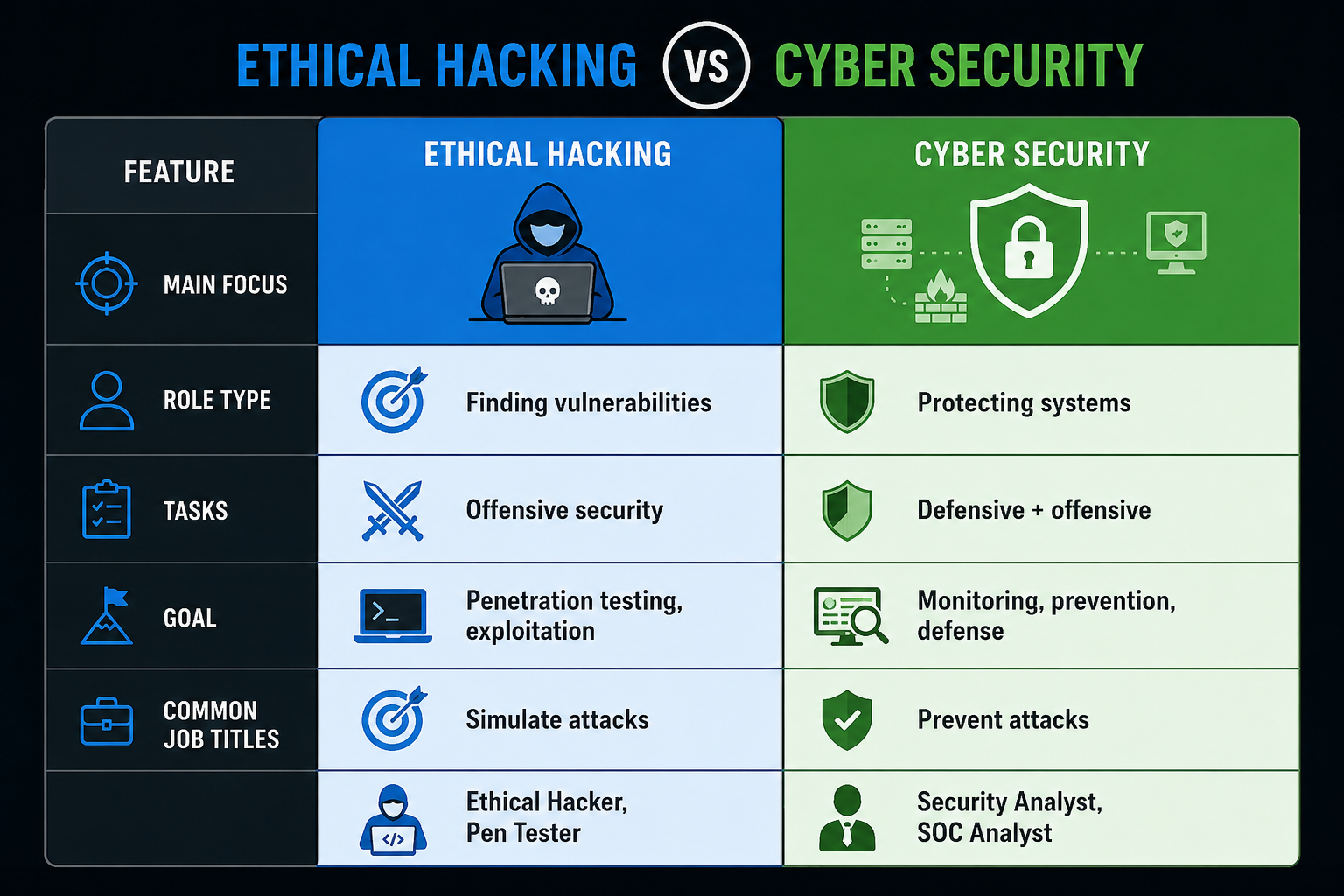
Types of Cyber Security Careers
1. Ethical Hacker / Penetration Tester
Tests systems for vulnerabilities using hacking techniques.
Responsibilities
- Conduct security testing
- Simulate attacks
- Generate vulnerability reports
- Recommend security improvements
Average Salary in India
₹4 LPA to ₹15 LPA+
2. SOC Analyst (Security Operations Center Analyst)
Monitors networks and detects threats in real time.
Responsibilities
- Monitor security alerts
- Investigate suspicious activities
- Respond to incidents
Average Salary
₹3.5 LPA to ₹10 LPA
3. Cyber Security Analyst
Protects systems from attacks and monitors organizational security.
Skills Needed
- SIEM tools
- Networking
- Incident response
- Risk assessment
4. Cloud Security Engineer
Secures AWS, Azure, and Google Cloud environments.
Cloud security is highly in demand in cities like Jaipur, Bengaluru, Pune, Hyderabad, and Gurugram.
Average Salary
₹8 LPA to ₹25 LPA
5. Digital Forensics Expert
Investigates cyber crimes and analyzes digital evidence.
Often works with:
- Law enforcement agencies
- Government departments
- Corporate security teams
6. Security Consultant
Advises organizations on improving cyber security infrastructure.
6. Skills Required for Ethical Hacking and Cyber Security
Technical Skills
Networking
Understanding:
- TCP/IP
- DNS
- HTTP/HTTPS
- VPN
- Firewalls
Operating Systems
- Linux
- Windows Server
Linux is especially important because many hacking tools run on Linux systems like Kali Linux.
Programming
Helpful languages include:
- Python
- Bash scripting
- JavaScript
- PowerShell
Web Security
Learn:
- SQL Injection
- XSS
- Authentication vulnerabilities
- OWASP Top 10
Cloud Security
Cloud platforms:
- AWS
- Microsoft Azure
- Google Cloud
Soft Skills Required
Cyber security professionals also need:
- Problem-solving ability
- Analytical thinking
- Communication skills
- Curiosity and continuous learning
- Attention to detail
Educational Qualifications
You do not necessarily need a computer science degree to enter cybersecurity.
Students from:
- BCA
- B.Tech
- B.Sc IT
- MCA
- Diploma backgrounds
- Non-technical fields
can transition into cybersecurity with proper training and practice.
Many successful ethical hackers are self-taught professionals.
Popular Cyber Security Certifications
Certifications help validate skills and improve job opportunities.
Beginner Certifications
- CompTIA Security+
- Certified Ethical Hacker (CEH)
- Google Cybersecurity Certificate
Intermediate Certifications
- eJPT
- PNPT
- CompTIA CySA+
Advanced Certifications
- CISSP
- OSCP
- CISM
7. Salary of Ethical Hackers in India
Cybersecurity offers excellent career growth.
Popular job roles include:
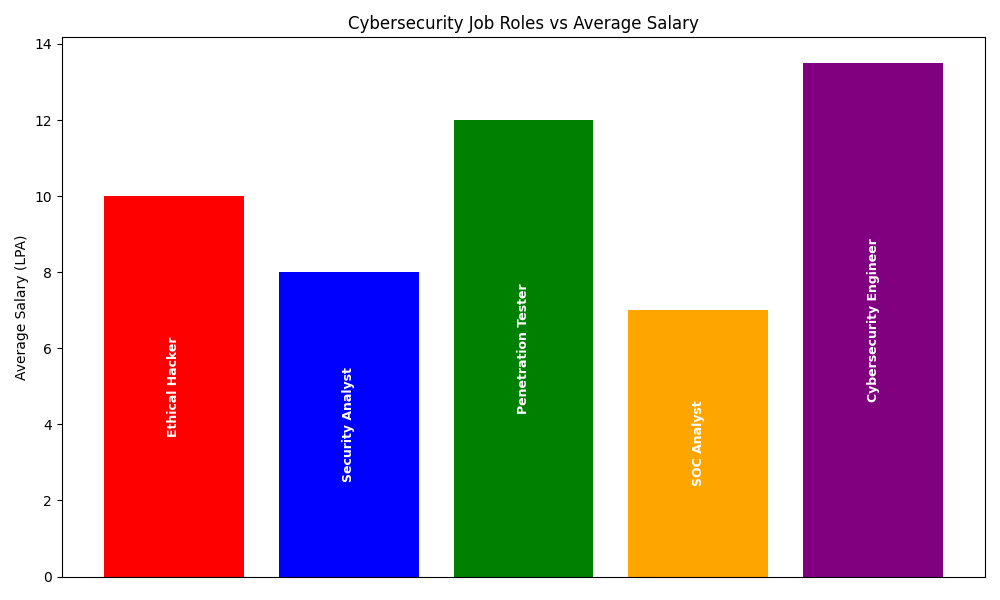
As companies invest more in digital security, demand for cybersecurity professionals continues to rise globally.
8. Cyber Security Demand in Jaipur, Rajasthan, and India
Jaipur is growing as an IT and startup hub with increasing demand for cyber security professionals.
Areas like:
- Malviya Nagar
- Vaishali Nagar
- Mansarovar
- Jagatpura
- Sitapura Industrial Area
have growing IT companies, startups, and training ecosystems.
Across Rajasthan and India, industries are investing heavily in cyber security because of:
- Digital transformation
- Cloud migration
- Compliance requirements
- Online business growth
Cities with high demand:
- Bengaluru
- Hyderabad
- Pune
- Gurugram
- Noida
- Jaipur
9. Industries Hiring Cyber Security Professionals
- Cyber security professionals are needed in almost every industry.
Top Hiring Sectors
- Banking and Finance
- Healthcare
- Government
- E-commerce
- IT Services
- SaaS Companies
- Telecom
- EdTech
- Manufacturing
Remote Work and Freelancing Opportunities
Professionals can work as:
- Bug bounty hunters
- Freelance penetration testers
- Security consultants
- Remote SOC analysts
Popular platforms:
- HackerOne
- Bugcrowd
- Upwork
10. Future of Ethical Hacking and Cyber Security
The future of cyber security looks extremely strong because:
- AI-powered attacks are increasing
- Cloud infrastructure is expanding
- IoT devices are growing
- Data privacy regulations are becoming stricter
Emerging areas include:
- AI Security
- Cloud Native Security
- DevSecOps
- Zero Trust Security
- Blockchain Security
Cyber security is expected to remain one of the most stable and future-proof careers globally.
11. Common Challenges in Cyber Security Careers
While cyber security offers excellent opportunities, students should know the challenges.
Continuous Learning
Technology changes rapidly.
Pressure During Security Incidents
Critical attacks may require urgent response.
FAQs About Ethical Hacking And Cyber Security
1. What is ethical hacking in security?
Ethical hacking in security is the process of finding security weaknesses in systems and networks and applications with the proper authorization. Ethical hackers in cyber security help organizations prevent cyber attacks by finding and fixing vulnerabilities before criminals can exploit them. This way ethical hacking in security helps organizations.
2. Is ethical hacking a career option in 2026?
Yes hacking and cyber security are good career options. Hacking and cyber security continue to be among the fastest growing technology careers. Companies need professionals to protect sensitive data and networks and digital infrastructure from cyber threats. Ethical hacking and cyber security are in demand.
3. What skills are required to become a cyber security professional?
To become a cyber security professional you need skills like networking and Linux basics and penetration testing and problem solving and programming knowledge and understanding of cyber threats. You also need experience with tools like Wireshark and Nmap and Kali Linux. These skills are important for security professionals.
4. Can beginners learn hacking without prior experience?
Yes beginners can learn hacking in cyber security without prior experience. Beginners can start learning hacking in cyber security with basic computer knowledge. Many training programs cover the fundamentals of hacking in cyber security step by step including networking and operating systems and security concepts. This helps beginners learn hacking in cyber security.
5. Which job roles are available after learning cyber security?
After learning cyber security you can apply for job roles like Ethical Hacker and Security Analyst and Penetration Tester and Network Security Engineer and Malware Analyst and Cyber Security Consultant. These are the job roles after learning cyber security.
6. Do cyber security courses include training?
Cyber security courses include hands on labs and real world simulations and vulnerability testing and security projects. This helps students gain experience and industry ready skills, in cyber security. So cyber security courses include training to help students learn cyber security.
How Students in Jaipur Can Learn Cyber Security
Students in Jaipur can start learning security by:
- Learning Linux and networking basics
- Practicing on hacking labs every day
- They can join cyber security communities to connect with experts
- Participating in Capture The Flag competitions is also a way to learn
- Building home labs helps to practice what they learn
- Working on world cyber security projects gives them hands-on experience
Many students in Jaipur and Rajasthan start preparing for a career in cyber security during their graduation studies. Students, in Jaipur want to learn cyber security to start their careers.(Grras Solutions Pvt. Ltd.)
How GRRAS Helps Students Build This Career
GRRAS gives students and professionals the chance to learn technical skills with training programs that are related to the industry.
For students who want to learn about Ethical Hacking and Cyber Security GRRAS has a way of learning that includes things like
- Networking fundamentals
- Linux administration
- hacking tools
- Cloud security basics
- Real-world projects
- Interview preparation
- Certification guidance
When it comes to cyber security doing things by hand and learning from mentors is very important because companies usually want people who can solve problems in a way. They do not just want people who know things in theory.
Students from places like Jaipur, Mansarovar, Malviya Nagar, Vaishali Nagar, Jagatpura and other areas, in Rajasthan often look for places where they can learn things and also get help with their career and work on projects. GRRAS helps students with this. GRRAS is what students need to build their career in Ethical Hacking and Cyber Security. GRRAS provides the training that students need.
12. Conclusion
Hacking and cyber security are very important in todays digital world.
Cyber attacks are increasing so companies need experts who can keep systems protect important data and deal with online threats.
If you are a student, a graduate, a working professional or someone looking to switch careers in Jaipur, Rajasthan or anywhere in India cyber security is a great option because it offers:
- High demand in the industry
- Good salary growth
- Opportunities to work globally
- Chance to work remotely
- Stable career for a time
This field is great for people who are curious, like to learn new things and enjoy hands-on work. You can become a hacker a SOC analyst, a cloud security engineer or a cyber security consultant. Now is a time to start learning about digital security.





 Whatsapp us
 Call us
 Enquire Now