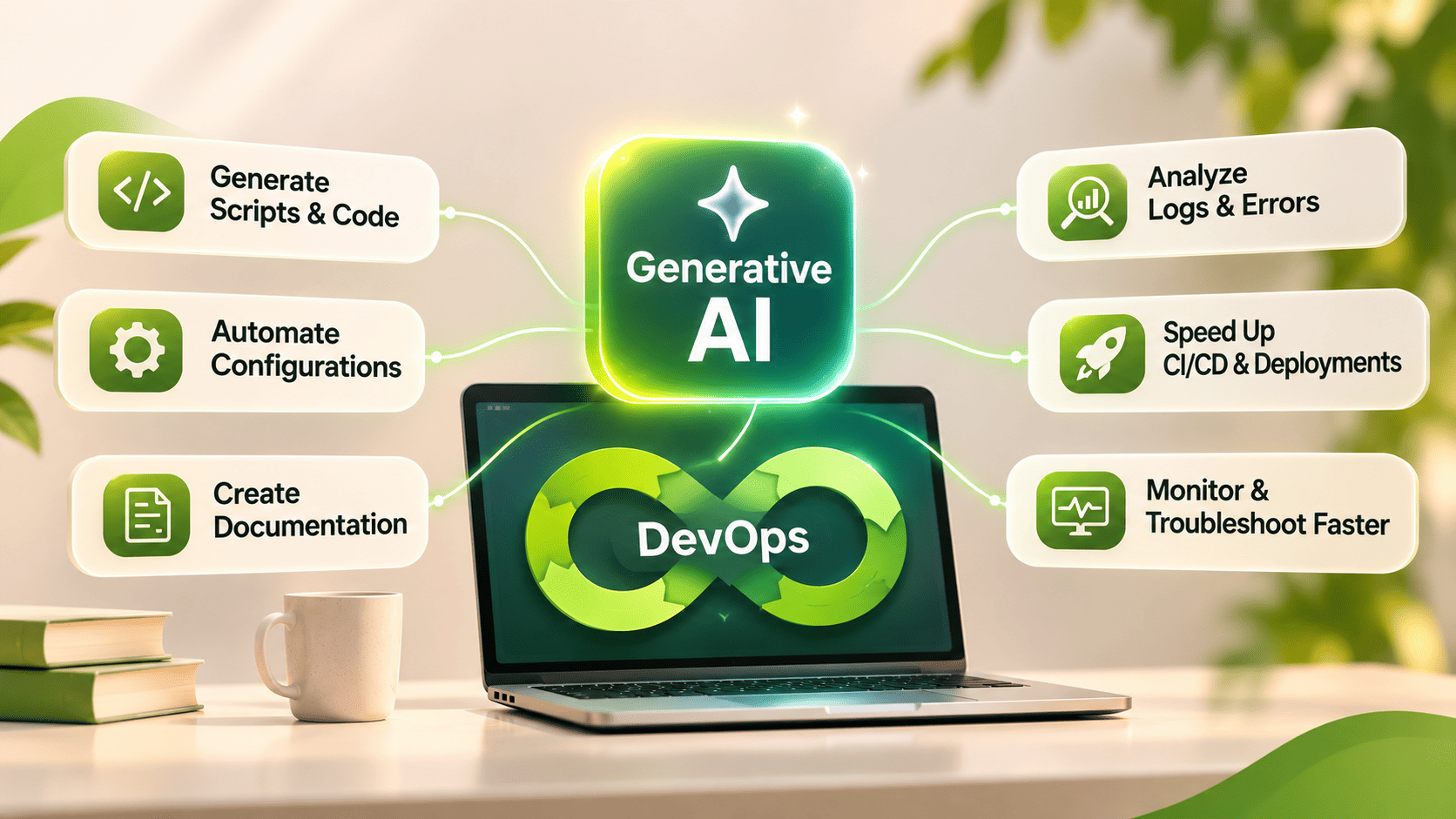
Think of all the time spent on script creation, fixing deployment issues, and analyzing application logs that could easily be done much quicker through AI. That is a daily problem faced by DevOps engineers. In the context of ever-growing cloud complexity consume time. It is hard for engineers to cope with both automation and monitoring, as well as troubleshoot and deploy the application. All of that has been successfully resolved by Generative Ai in DevOps. AI can assist engineers with coding and error understanding while streamlining their work process. However, how is this technology going to reduce the amount of manual work? What skills should you acquire in order to use AI in DevOps effectively?
Why Are DevOps Engineers Spending So Much Time on Manual Tasks?
The whole essence of the DevOps framework lies in increasing the speed of developing and deploying software. Nonetheless, engineers often find themselves engaged in repetitive tasks that occupy a significant portion of their day. Developing shell scripts and examining configuration files can be very time-consuming. The engineer has to keep an eye on how an application performs and examine any deployment failures. In case all of those activities are performed on a daily basis for each separate project, they may have a negative impact on development and decrease productivity. Engineers are forced to spend too much time addressing routine issues rather than system optimization or developing something innovative.
The contemporary IT environment has become much more complex due to the usage of various cloud platforms, containers, and additional tools for monitoring and automation processes. This process requires specific knowledge and constant attention. One wrong configuration setting can disrupt the process of deployment or application performance. Therefore, engineers have to examine logs and find out the actual reason for that issue. The combination of DevOps with AI can solve the problem and decrease the number of routine tasks that should be performed manually.
How Generative AI Makes Everyday DevOps Tasks Easier
One of the most important benefits of using AI in engineering is the ability of AI to accelerate the process of completion of certain repetitive tasks. So, creation of a script requires time, especially when the project implies automation of several different aspects. With the assistance of AI assistants, a script could be generated in response to a simple command, which would then be checked and modified by engineers in accordance with the project’s specifics. Thus, the application of AI DevOps is beneficial in scripting and configuration management. It may be helpful in explaining the meaning of unknown commands as well as giving recommendations regarding improving code.
Moreover, AI can facilitate the process of documentation and learning of technical instructions. Indeed, engineers have to work with various tools they have no previous experience in working with. Thus, comprehension of a new command and configuration format is a lengthy process. With the assistance of AI assistants, engineers could understand the meaning of new technical instructions and find out examples for these instructions depending on certain requirements. Also, AI assistants can be helpful in creating documentation for existing workflows. Yet, the output created with the help of AI has to be checked by engineers.
How AI Helps With Monitoring and Troubleshooting
Monitoring is the key function in any DevOps operation. It allows engineers to see how application performance and the state of infrastructure affect each other and detect any problems to fix them in time. If there is a problem, the engineer needs to find out what exactly causes it before it reaches users. Generally, troubleshooting is about looking through logs and analyzing data obtained from different tools. In case there is an issue on many services at the same time, it becomes hard to detect its true cause. It can take a lot of time, during which engineers cannot do anything else. AI-based monitoring tools can simplify this procedure for engineers who have to analyze huge quantities of technical information.
For instance, let us assume that some application gets slow because of the recent changes in its code. To troubleshoot it, the engineer will have to look through many logs and try to determine what exactly causes this problem – the configuration of the system or something else. The tool will be able to provide an engineer with summarized information and detect any abnormalities that could cause the problem. Then the engineer can check the findings and try to solve it. Therefore, AI for DevOps Training Course learning applications can help professionals see how intelligent monitoring and troubleshooting works.
Can Generative AI Improve CI/CD and Deployment Workflows?
In addition to CI/CD processes, pipelines may assist the development teams to improve the delivery of the applications. They automate the code integration and testing and deployment process. Nonetheless, setting up and maintaining CI/CD pipelines is time-consuming. Programmers are required to generate configuration files and analyze failed builds while dealing with various environments. The bigger a project is, the harder the little mistakes turn out to be. In this situation, the use of AI may help engineers to automate the generation of pipelines’ configurations and analyze failures during the development of software.
For instance, when deployment fails due to wrong configurations, an engineer may consult with AI and find solutions to the problem. AI will explain the meaning of the unknown commands and offer possible improvements of the scripts. It saves time for researching and solving common problems. It should be taken into account that all of the AI-generated configurations should be thoroughly tested prior to their implementation. Moreover, programmers should know how to use pipelines and what changes to make.
Why Should DevOps Engineers Learn AI and MLOps Skills?
While automating routine tasks in the household may not require much technology, businesses are employing machine learning models in their applications and operations. The creation and testing of such models is crucial before implementation. Moreover, models require monitoring in order to ensure that they perform effectively. All these tasks imply some additional responsibilities when compared to regular software deployment. That is why it is necessary to consider MLOps. With the help of an mlops engineer course, it will become easier for learners to learn about how machine learning models are created and managed using automated workflows. The course will also allow learners to grasp some aspects of deployment and monitoring of machine learning models.
When one understands the basics of infrastructure and automation, then MLOps becomes quite logical to learn. The technical expertise of a person may facilitate the understanding of the machine learning deployment workflows. Nevertheless, it is still important to comprehend how models are trained and evaluated. In order to gain this knowledge, one can enroll in a machine learning and ai course. The gained understanding will make it easier to understand the work of AI applications and how they should be managed in production.
What Skills Do You Need to Work With AI in DevOps?
There is no need to be an expert in artificial intelligence before using AI software in DevOps. Nevertheless, one has to have a solid technical background. One has to start with learning Linux and scripting since these skills help to comprehend the automation process. The next step is learning Python and obtaining some information about CI/CD pipeline and cloud platforms. Information related to Docker and Kubernetes can be also helpful as it helps to understand how applications are built and deployed. After mastering the basics, it is time to learn more about AI assistants and how they can assist in different engineering activities. This knowledge will also be helpful to detect incorrect recommendations that might be suggested by AI systems.
With experience, one needs to master the skills of deploying and monitoring of machine learning models. Model versioning and automated pipelines can serve as a way to connect one’s existing technical skills to MLOps. There are special mlops certification course that introduce these topics via classes and exercises. Besides that, one should learn how to review AI-generated code and detect possible problems. Some AI tools can offer incorrect recommendations or configurations. A good technical background will allow one to assess if the AI-generated code is applicable to the current project.
How to Start Your AI and MLOps Learning Journey With Grras Solutions
The abundance of technology and resources available for learning could confuse someone starting to do something. A structured way of learning is what should be adopted rather than getting entangled in all those learning resources. If one already works in DevOps they should start learning about the way AI-based software can enhance their operations. One should try scripting and debugging through the use of AI-based assistants. After understanding their application, one should shift their focus on learning the basics of machine learning and how MLOps helps people handle ML projects. A MLOps Certification Course Online that is flexible enough to cater to working professionals could be an effective choice in such a case.
Grras Solutions provides industry-specific IT training programs to its learners so that they could develop their technical skills. Those who are eager to learn about the field of AI-driven automation can take the mlops certification training courses which help understand the process of handling ML workflows. People who need practical experience and want to build their career can join mlops course with placement. The focus of the company is on practical learning and training of the learners to equip them with industry-relevant skills.
Conclusion
DevOps engineers are adapting to the changes brought about by generative AI through streamlining processes and facilitating troubleshooting. Tasks such as scripting and enhancing deployment processes are just some of the phases in software development that are supported by the use of AI. Nevertheless, there is the need for engineers to have a solid technical background and experience. Engineers who have both automation knowledge and expertise in the use of AI can equip themselves for the changing demands of the industry. In case you are thinking of joining this rapidly developing domain, it is important for you to start by equipping yourself with the technical background and begin exploring machine learning operations. Properly structured mlops certification training will enable you to learn about the future learning steps you should take.




 Whatsapp us
 Call us
 Enquire Now