Most people do not fail due to stopping to learn but rather due to the absence of an IT learning roadmap, which determines how and when to acquire certain skills. Three years spent in IT without an IT learning roadmap may result in a jumbled set of incomplete courses, various useless certifications, and dead-end career despite all efforts you obviously put in. However, three years with the appropriate roadmap, which begins with the appropriate foundation and continues with the necessary specializations and timely certifications, may turn you into a senior IT professional with those pay packages that most people even dream of. This blog provides a perfect roadmap
Why Most IT Learners Stay Stuck — And What a Roadmap Changes
Do you know that feeling when it’s hard to choose what technology to learn today because there are too many options? It starts with Cloud Computing, then comes DevOps, followed by Kubernetes or AI and so on. Soon, you find yourself with twenty open tabs in your browser, numerous entries in your YouTube history list and several unfinished online courses.
That is precisely what happens to many people who want to become an IT specialist but have no idea how to do it right. It is not a question of motivation or intelligence – people just need a proper IT career roadmap that will help them to concentrate on the right skills development. Without it, it is easy to learn unrelated technologies that will add nothing to your resume but confusion.
An IT career roadmap can completely change your experience. With the correct plan, you won’t have to achieve trends all the time. You will learn new skills logically building on the previous experience. Each course will prepare you for a subsequent certificate. And each certificate will prepare you for a new job position. This way, you won’t feel busy anymore you’ll start making progress. This is how successful IT specialists develop from newcomers to specialists and further to technical leaders.
Year 1 — Building the Foundation With Cloud and Linux Fundamentals
Every good engineer builds a solid foundation. It’s impossible to master advanced topics such as automation, container orchestration, or cloud native before having knowledge about how current IT infrastructure works. Think about building a house you will not put a roof without installing a foundation first. During your first year of work you will be learning Linux, cloud fundamentals, basic networking, virtualization, and systems administration. This is when an organized Cloud Computing Course will be one of the most valuable decisions you can make. You will learn how clouds work, how virtual machines are launched, how networking is used, and how businesses are managing their infrastructure.
Year 1 Roadmap
- Learn basics of Linux Operating System.
- Learn Networking, Storage, Virtualization.
- Enroll in a formal Cloud Computing course.
- Work on small projects with cloud infrastructure.
- Learn Git and version control systems.
- Learn basic security concepts.
- Develop troubleshooting and documentation skills.
One more great thing to do during your first year is to get RHCSA training. In spite of the current decline of the dominance of Red Hat in the market, Linux operating systems are actively used all around the world. There is an increasing need for professionals skilled in managing Linux systems. After 1 Year IT learning roadmap, your aim is not mastering all possible technologies your goal is just to be comfortable working in Linux and dealing with infrastructure problems.
Year 2 — Going Deep With DevOps, Kubernetes and Advanced Certifications
It is here that you will see your career take off. Having gained enough knowledge on Linux and cloud computing concepts, it is now your time to focus on automation, CI/CD, IaC and container orchestration. These are not just new terms in the field of Information Technology, but these are the actual means that organizations use to develop and deploy software applications. DevOps Courses help you gain a complete understanding about the CI/CD pipeline, automation/deployment tools, Infrastructure as Code, configuration management, monitoring and collaboration between dev and ops teams. Manual server management can finally be done away with.
Year 2 Learning Roadmap
- Gain experience in CI/CD pipelines.
- Learning about Infrastructure as Code.
- Understand Docker containers.
- Get Kubernetes Certification.
- Cluster deployment and management practice.
- Learn about monitoring and logging tools.
- Develop DevOps Projects for your portfolio.
One of the most important achievements in your second year will be Kubernetes Certification. Kubernetes is now considered as the standard technology for container orchestration and every company in any industry needs engineers for deployment and maintenance of Kubernetes clusters. Along with Kubernetes, OpenShift Training will help you get familiar with enterprise container platforms. After completing your second year of learning, you need to have a portfolio of your work which includes real-world cloud deployments, automated pipelines, and containerized apps.
Year 3 — Specializing, Leading and Becoming the Engineer Companies Fight Over
In your third year, you need to switch your focus from learning different tools to solving business problems using those tools. By now, no company wants to hire a person because of his knowledge of any specific tool. Rather, they want someone who understands why the tool works and how it solves some particular business problems. From this point onward, you have started your journey to be a senior engineer, a cloud architect, a DevOps leader, or a platform engineer.
This is the year when you can specialize on different domains. So, if you have an interest in cloud computing, go ahead and learn advanced concepts of cloud architecture and security. Similarly, if you feel good about automation, learn everything about DevOps and platform engineering. And if containerized systems attract you, keep working with Kubernetes and OpenShift Training. Instead of just earning random certificates, specialize yourself in one field.
There is one major distinction between a mediocre engineer and a well-paid engineer and that is their area of expertise. Mediocre engineers know more tools but do not excel in any specific tool, while highly-paid engineers know fewer tools, but are experts in their respective fields. Build up your practical experience, help in developing open-source tools, work on improving your documentation and communication skills.
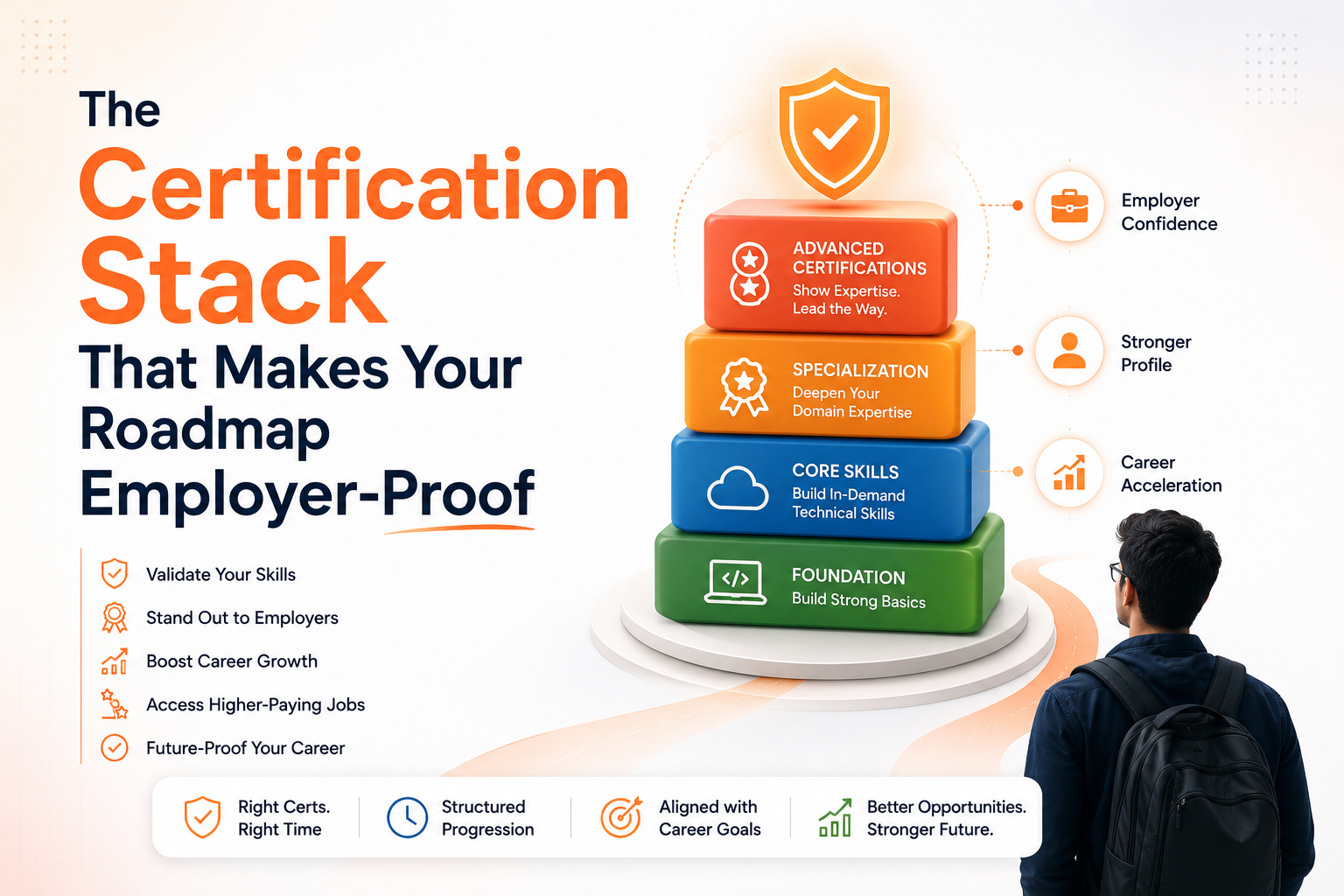
The Certification Stack That Makes Your Roadmap Employer-Proof
While technologies keep changing on a yearly basis, structured certification paths will show dedication, acquired knowledge, and expertise. Certifications are not to be collected just to have something on the CV. They need to be earned and they should be built up one after another during your career path.
A Good IT Certification Roadmap
- Take RHCSA Certification for learning how to manage Linux.
- Acquire basics of Cloud Computing by taking a Cloud Computing Course.
- Learn DevOps by following a structured DevOps Course.
- Get a recognized Kubernetes Certification.
- Take OpenShift Training in order to move to an enterprise-level.
- Develop your portfolio along with each new certification.
- Upgrade your skills according to the technology updates.
Such a structured IT certification roadmap will help recruiters understand your career path easily. You won’t look like a person who finished several unrelated courses, but someone who started with the basics of Linux and cloud computing before progressing to automation, Kubernetes, enterprise-level platforms, and infrastructure management.
Digital Marketing and Beyond — Adding Business Skills to a Technical Profile
The technical proficiency of engineers makes them believe that they will definitely advance in their careers. It might seem that way to some degree, but the truth of the matter is that most modern companies appreciate engineers who have an understanding of business objectives, customer psyche, and digital revolution.
That’s why it makes sense to develop complementary business skills, which will definitely help to improve your overall resume. Being able to understand such aspects as analytics, digital branding, digital communication, client acquisition, and business strategy will make it easier for technical professionals to convey information to clients, stakeholders, and leaders.
While a Digital Marketing Course with Internship may not be directly connected to cloud computing at first glance, it helps to develop an important set of business-related skills, including analytical skills and communication skills. Regardless of whether you will become a cloud consultant, a solutions architect, an entrepreneur or a technical leader, it will make you a much better professional to know how technologies help companies grow.
Why Grras Solutions Is Where Serious IT Professionals Start Their Roadmap
It gets even simpler when you get training from professionals with an understanding of the industry demands. The entire training strategy of Grras Solutions is built on one goal alone—to make learners employable, not merely certifiable. The entire program is tailored to meet hiring trends while giving the learners the necessary exposure to industry technologies.
Be it your IT career roadmap, advanced IT certification roadmap, or changing career tracks to cloud computing and DevOps, Grras Solutions offers learning paths that take away all the guesswork from the process. Rather than taking separate unconnected courses, the learner progresses through a well-designed program where each skill leads to another.
The benefits for the students are:
- Industry expert trainers.
- Hands-on labs.
- Real-world projects.
- Certification preparation.
- Placement support.
- Resume building and interview preparation.
- Professional career mentoring.
From Cloud Computing Course to DevOps Course, from RHCSA Training to Kubernetes Certification and OpenShift Training, Grras Solutions offers a learning ecosystem with a career growth focus rather than certification focus.
Ready to Build Your IT Career the Right Way?
What you really don’t require is one more tutorial, half done courses and certifications which are just aimless. What you need is a structured career roadmap which would enable you to translate each and every hour spent into tangible career success. At Grras Solutions, we help aspirants chart their way out using the structured IT career roadmap consisting of expert training, hands-on projects, internationally recognized certifications and placement assistance.
Starting from the Cloud Computing Course, DevOps Course, RHCSA Training, Kubernetes Certification and ending with the Digital Marketing Course with Internship, all our course offerings will equip you to be industry ready, rather than only exam-ready. Chart your IT career roadmap today with Grras Solutions and develop yourself with the skills, confidence and certifications that top employers are actively hiring for in 2026.




 Whatsapp us
 Call us
 Enquire Now