The DevOps community has changed the process of software creation by combining the efforts of development and operations teams in building, testing, deploying and supporting applications. Nowadays, automation, cloud, containerization, CI/CD – all these trends help organizations save time on deployment, increase software quality and release new products faster. As companies proceed with implementation of cloud-native technologies, people who are able to automate routine processes and support IT infrastructure are now in demand.
As far as beginner DevOps practitioners are concerned, a question which often arises is whether to learn Shell Scripting or Python for DevOps. These are both important technologies utilized by DevOps engineers, however, they solve different issues and complement each other in practice. Knowing about the scope of application of each of the technologies will help to lay down solid grounds and move forward to cloud automation, IaC and enterprise deployments.
Why Shell Scripting Should Be Your Starting Point
Every DevOps practitioner dedicates much time on Linux operating systems as most production servers and applications are deployed on Linux. Regardless of the process whether it is installing the application, setting up the server, controlling the services, or debugging the application, Linux command line becomes an essential skill. Shell scripting gives the opportunity to the beginners to automatize all those tasks that are done in their everyday routine while gaining deep knowledge of the inner mechanisms of operating systems.
Instead of executing commands every day manually, shell scripts unite several commands in order to create automation scripts and thus save time and minimize mistakes. The beginners learn how to automate backup procedures, control the services and applications, manage files, and so on.
Why Python Has Become the Preferred Automation Language
Whereas infrastructure management used to be done at the OS level only, now the field has expanded because of the development of cloud computing and automation. Contemporary DevOps programmers have to deal with cloud computing, RESTful API services, monitoring tools, databases, containerization platforms, and many other software products, which all belong to the Infrastructure as Code category. In order to manage those products effectively, there is a need for an adequate programming language that will facilitate complex actions.
The selected language for automation of the infrastructure is Python. This is a highly flexible language with very easy syntax, huge library, and excellent cross-platform opportunities. Using this language, developers are able to automate cloud resources, manage infrastructure data, interact with APIs, create reports, develop automation framework systems, and many other operations. Unlike scripting languages, Python provides for modularity of code.
Shell Scripting vs Python: Understanding the Key Differences
In terms of the mentioned above, both methods help in automating routine activities. However, the purposes of these technologies are different in terms of DevOps process. First of all, Shell Scripting technology is used for conducting operations system actions, executing Linux commands, managing files, and handling services and operating systems.
The second reason why Shell Scripting can be considered a useful technology is its light weight. This characteristic helps in fast processes, low power consumption, and interaction with the operating system. Secondly, thanks to the Python programming language, it is possible to create more complex solutions due to interacting with cloud platforms, large amounts of data, database operations, APIs usage, and automation solutions development.
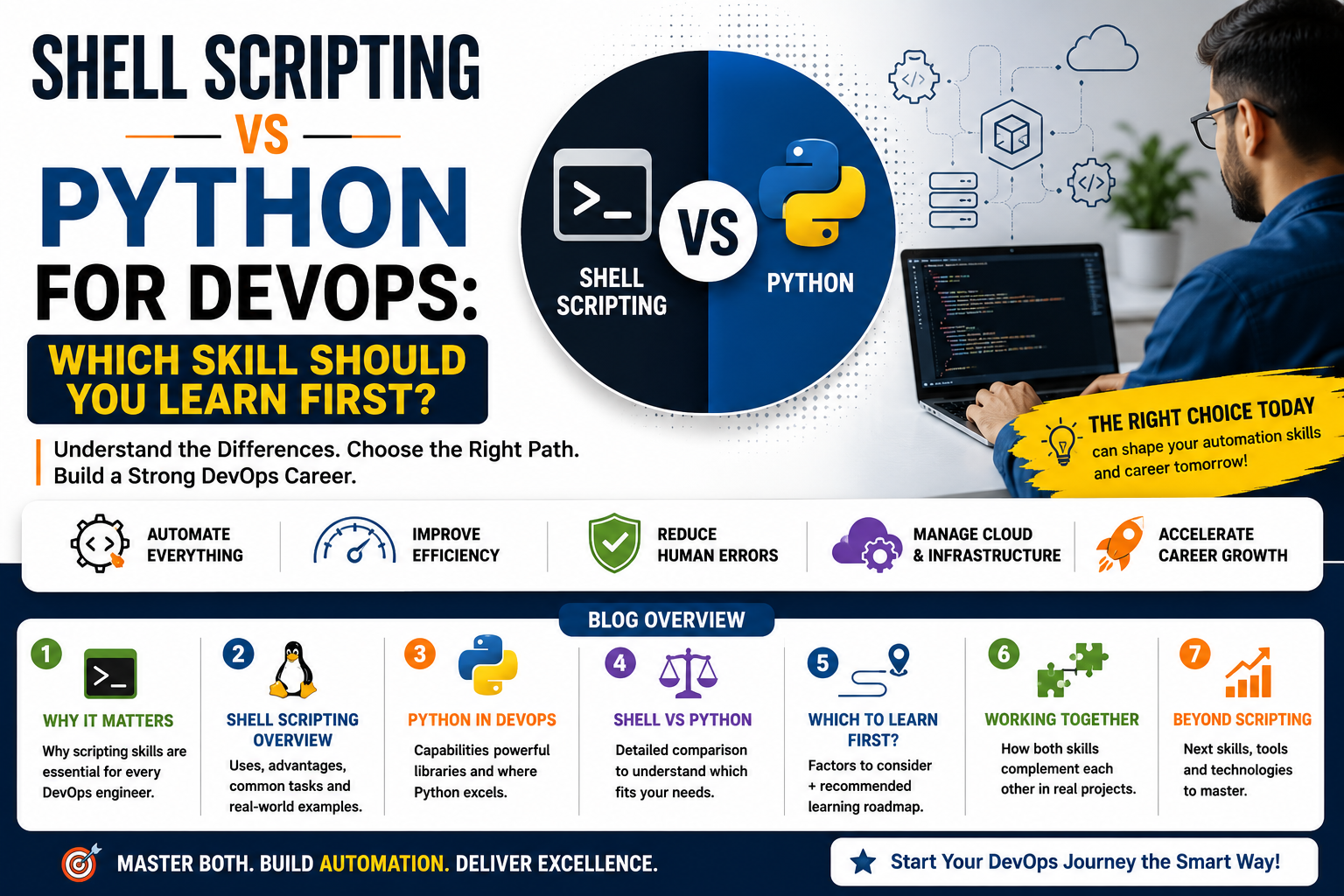
Which Skill Should You Learn First?
Shell Scripting should be taken as an initial part of education, followed by Python. The knowledge of basic Linux concepts is needed to understand how servers operate, how applications are launched, how OS handles files, users, permissions, networking, and processes. It is required to know such things prior to automating anything through programming.
The vast majority of the programs that are designed and implemented within a DevOps certification course follow this pattern since it is done by the industry. One gets used to working with Linux OS and its command line interface before moving onto such topics as Python scripting, cloud automation, CI/CD, IaC, and container orchestration.
How Shell Scripting and Python Work Together in DevOps
Professional DevOps engineers never rely on one kind of automation software since any current infrastructure requires a number of automation tools to work simultaneously. Shell Scripts can successfully perform all the required tasks related to OS like the installation of packages, creation of directories, permissions handling, configuring services, and preparing servers for deployment.
When the infrastructure is set up, Python starts to perform those tasks which include the interaction with cloud services, API, monitoring platforms, configuration management, and reporting of the infrastructure. Many companies also Learn Azure DevOps to develop CI/CD automation pipelines in which Shell scripts and Python scripts perform the tasks in a single pipeline.
Career Advantages of Learning Both Skills
The fast-paced development in areas like cloud computing, automation, and applications in containers has led to the growing demand for DevOps experts in almost all industrial sectors. The organizations are looking for such people who will be able to take care of Linux systems, perform infrastructure automation, work on deployment process optimization, and minimize manual efforts through scripts and programming. The learning of Shell Scripting and Python gives the professionals a good balance in terms of skill sets to deal with the system as well as automation-related tasks.
Most of the aspirants prefer taking a DevOps course with placement as it gives them the opportunity to learn in a systematic manner as well as do some practical project work, prepare for interviews, and secure job. Rather than just understanding the theoretical aspects, the students learn practically through deploying their knowledge in different situations.
Expanding Your DevOps Skill Set Beyond Scripting
While shell scripting and Python are the building blocks of DevOps automation, an engineer in a contemporary environment needs to learn about far more advanced technologies. Cloud technologies, Kubernetes, Docker, Infrastructure as code, and CI/CD pipelines are now crucial elements in the development process. The knowledge of all these technologies enables specialists to automate entire lifecycles of applications and not just script individual activities.
One of the useful steps that you can take to enhance your technical portfolio would be getting the Red Hat OpenShift certification that shows that you can operate in enterprise-grade Kubernetes environment and run containerized applications. Since more and more companies switch to the cloud-native approach, people who know OpenShift have great value as specialists in creating scalable, reliable, and highly-available application platforms.
A Practical Learning Roadmap for Beginners
Having an organized roadmap at the start of the DevOps learning process will make it easy and manageable. Rather than attempting to gain proficiency in all technologies at once, one needs to develop basic knowledge first and then move towards advanced automation tools and cloud-based platforms. In doing so, one will be able to know how each technology contributes to the entire DevOps life cycle. Also, the process of continuous practice will help build confidence.
One such learning road map could be:
- Linux fundamentals and command-line basics.
- Practice shell scripting for system administration.
- Infrastructure automation using Python.
- Git and version control.
- Docker and containers.
- Kubernetes for orchestration.
- CI/CD pipelines in Jenkins/GitHub Actions.
- Infrastructure as Code in Terraform/Ansible.
- Deployment in AWS/Azure/Google Cloud.
- DevOps projects.
Many people choose to speed up their learning process by joining some of the reliable DevOps training institute where professional trainers guide them through the labs and live projects based on the latest industry standards. In case if one wants to specialize in enterprise Kubernetes platforms, one can take up the do280 course that deals with deploying, administering, and troubleshooting of applications in Red Hat OpenShift.
Conclusion
The selection of shell scripting or Python should never be made by considering that the user has to select one of these options over the other since the significance of both the technologies is same in the DevOps world. While Shell Scripting is responsible for imparting the requisite knowledge of Linux administration and operating system management along with command-line automation, Python helps in building scalable solutions that can help in interacting with Cloud Platforms, APIs, Monitoring Systems, and Enterprise Applications.
Shell Scripting and gradually proceeding towards Python is the best way forward for newbies. It allows you to gain insight into the working of systems before going ahead with automation using advanced programming concepts. As you move on and learn cloud computing, Containers, Kubernetes, CI/CD pipelines, Infrastructure as Code and many other interesting things, your knowledge base will keep expanding. Are you ready to embark upon the journey of DevOps training? Join the DevOps training program offered at Grras Solutions and learn all the concepts of DevOps from scratch. At Grras Solutions, you will get experienced instructors, live labs and also assistance in securing placements.




 Whatsapp us
 Call us
 Enquire Now