The evolution of the infrastructure inside the modern companies occurs very fast. Nowadays, corporations make use of many tools, such as cloud-native software, Kubernetes, microservices, hybrid clouds, and continuous delivery pipelines to stay competitive. Despite being quite beneficial and effective, they present serious challenges with regard to their monitoring and troubleshooting.
Here is when open-source AIOps and Grras Solutions prove to be very helpful. Artificial Intelligence for IT Operations (AIOps) is defined as a strategy of managing and controlling operations using machine learning, analysis of huge amounts of data, and automation tools. Using AIOps methodologies and Grras Solutions, any corporation can significantly facilitate its operations and increase the speed of its activity. AIOps is currently vital for modern DevOps specialists because most companies nowadays use artificial intelligence tools in managing infrastructure.
Everything related to the AIOps is discussed in this guide. Here you will find out what AIOps is and how it works, learn about different examples of its applications and trends in the area, and get to know about numerous career opportunities and automation possibilities.
What Is AIOps?
AIOps is the abbreviation of Artificial Intelligence Operations. This technology is leveraged in order to leverage the powers of AI, machine learning, analytics, and automation for the better management of the IT operations. The need for manual scanning of alerts and logs is eliminated by an AIOps solution as it automatically analyses and identifies those insights and anomalies and takes action accordingly.
To be more precise, AIOps can be considered as intelligent monitoring for the DevOps community. With the help of this strategy, companies can minimize operational noise and quicken the response time.
The operational data generated by the modern-day organizations come from:
• Application logs
• Cloud Infrastructure
• Kubernetes Clusters
• Network Devices
• Monitoring tools
• Security tools
• CI/CD Pipeline
Why AIOps Is Important in Modern DevOps ?
The conventional approach to IT operations relies greatly on manual monitoring and remediation. Within larger setups, for example, operators can get up to thousands of alarms each day, thus failing to determine what the root cause of the problem is. Such approaches suffer from alert fatigue and lead to extended downtime and slower responses.
The use of AI in DevOps has been instrumental in addressing such problems, adding automation and intelligence to operations.
Key ways in which AIOps helps DevOps include:
• Detection of anomalies before outages occur
• Correlation of multiple alarms into an incident
• Root cause analysis automation
• Lowering MTTR
• Application reliability improvement
• Enhanced operational visibility
Such benefits have direct consequences on the bottom line of organizations operating critical business applications.
How AIOps Works?
AIOps platforms work in various intelligent layers, which convert unstructured operational data into insightful knowledge.
- Data Collection
Step one is data collection from various systems and applications. This will entail collecting logs, metrics, performance metrics, traffic, and security data.
Some data sources might be:
• Amazon Web Services CloudWatch
• Kubernetes logs
• Application performance monitoring (APM)
• CI/CD pipelines
• Server metrics
• Database performance metrics
The platform aggregates all this information into an operation data layer.
- Data Correlation
With the information obtained, machine learning algorithms can establish connections between different events. It is not the case that every incident gets considered individually, but the artificial intelligence engine recognizes those that are interconnected.
Let us suppose that the CPU utilization has increased, application latency is higher, and there has been a database connection failure; then, it can recognize that these three are interconnected.
- Anomaly Detection
The platform uses machine learning techniques to detect patterns of normal system behavior and automatically detects any anomaly in the system without following any predetermined threshold rules. This helps DevOps teams be more efficient in identifying anomalies that could potentially affect application performance and take necessary action well in advance, which wouldn’t be possible using static thresholds-based solutions.
Some of the examples of anomalies that can be detected include:
• Sudden increase in traffic
• Unintended memory leak
• Increase in API latency
• Failure in deployment process
• Network congestion
• Downtime
- Root Cause Analysis
Another remarkable feature of AIOps is the automatic root cause analysis. In the IT world, one malfunctioning component might result in hundreds of alerts in all kinds of applications, servers, databases, and clouds. Finding out the exact reason behind it may take much time and result in even bigger downtime.
In contrast, AIOps tools can correlate data in order to determine the reason for the problem faster and easier than ever before. The user does not need to look through the log files of several different systems, but rather the machine will find out the problem.
Advantages:
• Quicker diagnosis
• Less downtime
• Better incident management
• Operational load reduction
Thus, DevOps engineers will be able to concentrate on developing innovations instead of performing mundane assignment.
- Automated Remediation
Automated actions can be executed by the system in the event of an incident. As opposed to having engineers manually deal with operational disruptions, AIOps platforms can automatically run certain workflows that have been predetermined in relation to actual circumstances.
This allows the organization to increase efficiency, ensure service continuity, and prevent downtime even in case of a production incident. These actions are done through automation.
Examples include:
• Restarting downed services
• Automated scaling of cloud infrastructure
• Rollback of failing software deployments
• Creating ticket incidents
• Smart alerts
• Automated remediation scripts
This leads to the formation of a self-healing infrastructure environment.
Real-World Use Cases of AIOps
AIOps is currently being leveraged by various companies across sectors to boost their operational efficiency. Whether it is a startup that operates using a cloud-native architecture or an enterprise organization, the company is leveraging AIOps solutions to streamline the operations of its IT environment. The banking industry, health care industry, eCommerce sector, telecom sector, and manufacturing industry utilize AIOps for various purposes.
Intelligent Incident Management
The larger companies have many operational alerts on a daily basis. However, the AIOps solutions help minimize the noise in the system by clustering similar alerts together and giving priority to only critical alerts.
Advantages of using AIOps systems are:
• Rapid detection of problems
• Less alert fatigue
• Productivity improvement
• Increased visibility
An online shopping organization can use AIOps technology for identifying checkout performance problems in advance.
Predictive Infrastructure Monitoring
Classic monitoring tools respond to issues only when they arise. Predictive monitoring using AIOps can detect early warnings for issues before they happen.
Some examples are:
• Early prediction of server crashes
• Alerting on abnormal memory usage
• Lessening the effects of traffic surges
• Safeguarding against insufficient storage space
Cloud Cost Optimization
Cloud infrastructure tends to be expensive when not optimized correctly. AIOps software analyzes cloud consumption trends and makes recommendations for cost reduction.
Features include:
• Discovery of idle resources
• Detection of over-provisioned servers
• Optimization of scaling strategies
• Prediction of resource requirements
Efficiency increases while costs decrease.
Security Threat Detection
Operations that involve AI technologies are being increasingly combined with cybersecurity measures. With the rising level of complexity and frequency of cyber attacks, companies require security monitoring systems based on artificial intelligence to detect threats.
It is very difficult for traditional security solutions to process large amounts of information in the form of logs, network activities, and user actions. Thanks to AI technology, AIOps platforms can quickly discover abnormal behavior and decrease the response time to security threats.
Some examples of suspicious behavior include:
• Trying to log in using unauthorized credentials
• User actions that deviate from previous activities
• The unusual use of network services
• Insider threats
CI/CD Pipeline Optimization
DevOps processes today produce enormous volumes of deployment data from CI/CD pipelines, test systems, infrastructure monitoring tools, and application performance systems. Manual management of this data quickly becomes extremely hard, particularly in large cloud-native deployments where deployments occur several times daily.
The use of AI-driven analytics allows organizations to optimize their release strategies, detect potentially risky patterns in their deployments, make accurate failure predictions before they affect production, and boost the performance of their software deliveries. This is probably the fastest-developing application of DevOps with AI in corporate settings today since it allows for much faster and safer software deliveries.
It offers numerous advantages, including:
• Quick deployments
• Less failed deployments
• Efficient testing
• Reliable releas
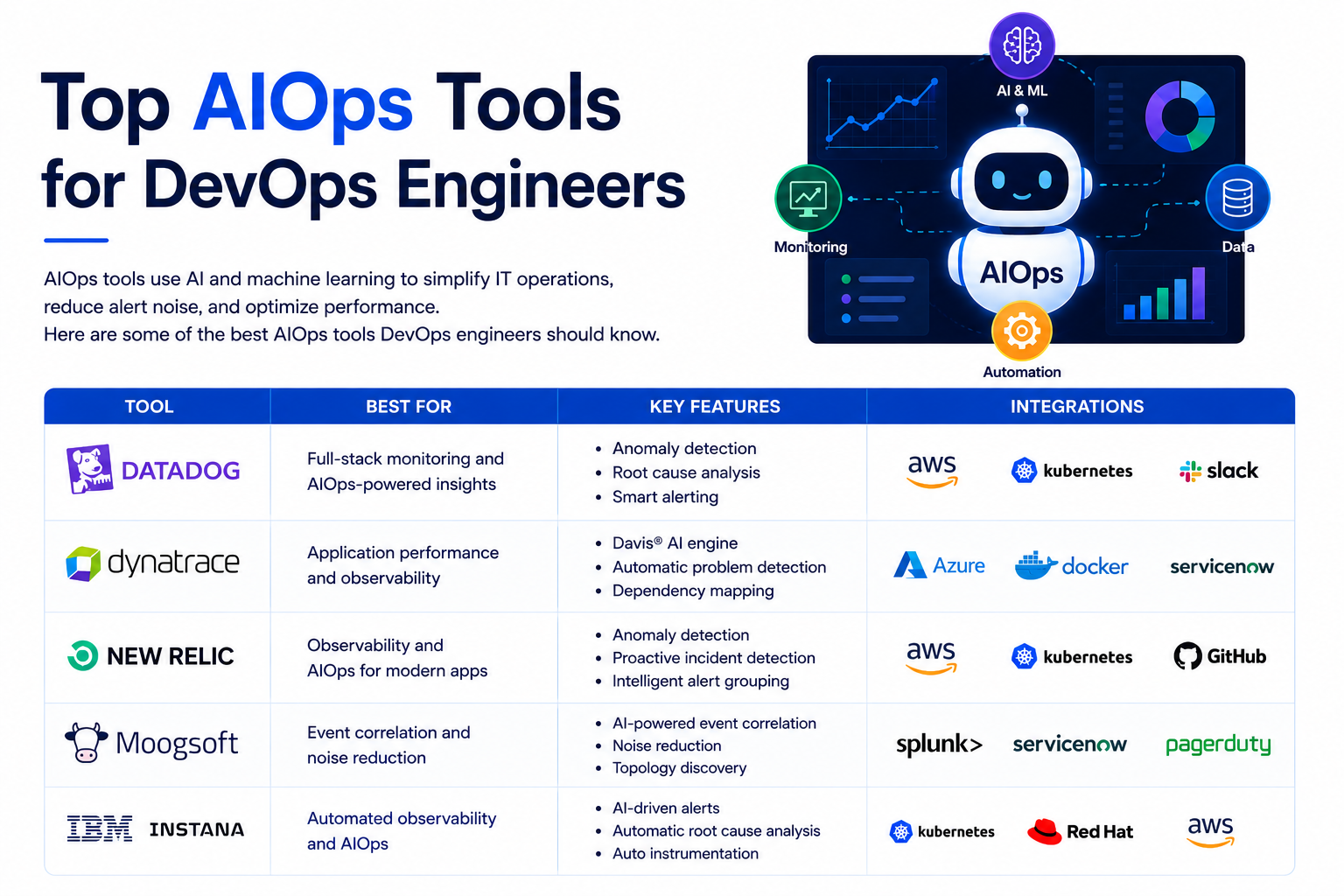
Top AIOps Tools for DevOps Engineers
There are several major AIOps solutions currently available on the market that offer intelligent observability, machine learning, and automation features. They are used to simplify IT environment management by incorporating observability, machine learning, predictive analytics, and automation into a cohesive operational framework. Contemporary enterprises leverage these AIOps platforms for infrastructure observability, anomaly detection, automated incident response, and performance optimization.
Dynatrace
The product provides the complete observability solution with AI-driven monitoring and automated root cause analysis. The use of AI engines enables efficient analyzing of infrastructure, applications, containers, and end-users’ experience.
This product can be helpful in providing insight into complicated cloud-native environments by allowing DevOps to find performance problems, dependencies, etc., faster.
The following are the key features of this product:
• Distributed tracing
• Kubernetes monitoring
• Anomaly detection with AI
Splunk ITSI
The Splunk IT Service Intelligence employs machine learning in its effort to optimize operational intelligence. This allows organizations to gather, analyze, and visualize high amounts of data produced by machines through applications, servers, cloud services, and network infrastructure. With the help of AI analytics, DevOps professionals can spot anomalies and manage their operations.
Some common features include:
Log Analytics
• Predictive Monitoring
• Event Correlation
• Incident Management
Datadog
Datadog happens to be among the most commonly used services that offer monitoring and observability features in the cloud-native space. One can get real-time visibility into applications, servers, containers, databases, and the cloud infrastructure itself through an integrated solution offered by Datadog.
Engineers who work using DevOps use Datadog in order to have visibility into their applications, as well as track various metrics and anomalies.
Datadog has gained popularity among companies that use microservices architecture and Kubernetes due to high integration possibilities, and also because they offer intelligent insights thanks to artificial intelligence.
Best suited for:
• Microservices
• Containers
• Hybrid cloud spaces
• Kubernetes environments
New Relic
New Relic offers intelligent application performance monitoring and infrastructure observability. It allow businesses to obtain profound insights into application performance, cloud infrastructure, user experience, and system health via real-time monitoring and analysis using AI technology.
For DevOps professionals, it offers capabilities to spot bottlenecks and troubleshoot problems faster for increase application reliability.
The tool is known to enable full-stack observability by giving the ability to monitor application performance, logs, traces, and infrastructure from a single console.
Key capabilities of the New Relic tool include:
- AI insights
- Performance monitoring
- Infrastructure observability
- Full-stack monitorin
Moogsoft
Moogsoft is an AIOps solution whose main goal is the reduction of noise from alerts and efficient handling of incidents in complex IT infrastructures. Using machine learning and event correlation technologies, Moogsoft finds similar alerts, eliminates duplicate alerts, and prioritizes important incidents automatically. Thus, DevOps and IT operators will be able to handle incidents quickly and avoid the weariness of numerous alerts.
Companies may apply it to:
Event correlation
• Operational intelligence
• Workflows automation
• Incident resolution
Generative AI and DevOps Transformation
AI language models and AI assistants will give rise to the next era of innovation in DevOps. The current generation of AI is able to understand natural language, generate code, perform analysis, and help developers collaborate on infrastructure management processes in real time. All of these capabilities make it possible to expect a new era of DevOps operations.
Some of the current applications of Generative AI in DevOps are:
- Code Generation in Infrastructure as Code
- Automated Documentation
- Troubleshooting through AI
- Script Generation
- CI/CD Optimization
- ChatOps Assistants
Using AI co-pilots makes it possible to generate Kubernetes manifests, Terraform scripts, and monitoring queries within seconds.
However, human participation remains critical in this case because of the necessity to validate AI-generated outputs.
AI in Industrial Automation
The use of AIOps methodologies has been revolutionizing manufacturing and industrial processes. Contemporary factories produce huge amounts of telemetry data through Internet of Things (IoT) devices, robotics, and industrial sensors.
Manual analysis of such data is difficult, particularly in larger industrial settings that prioritize efficiency and uptime.
Using AI in industrial automation enables organizations to:
• Predict breakdowns in machinery
• Lower maintenance costs
• Enhance productivity levels
• Optimize manufacturing processes
• Avoid downtime
The integration of operational technology and IT operations is promoting Industry 4.0 adoption worldwide.
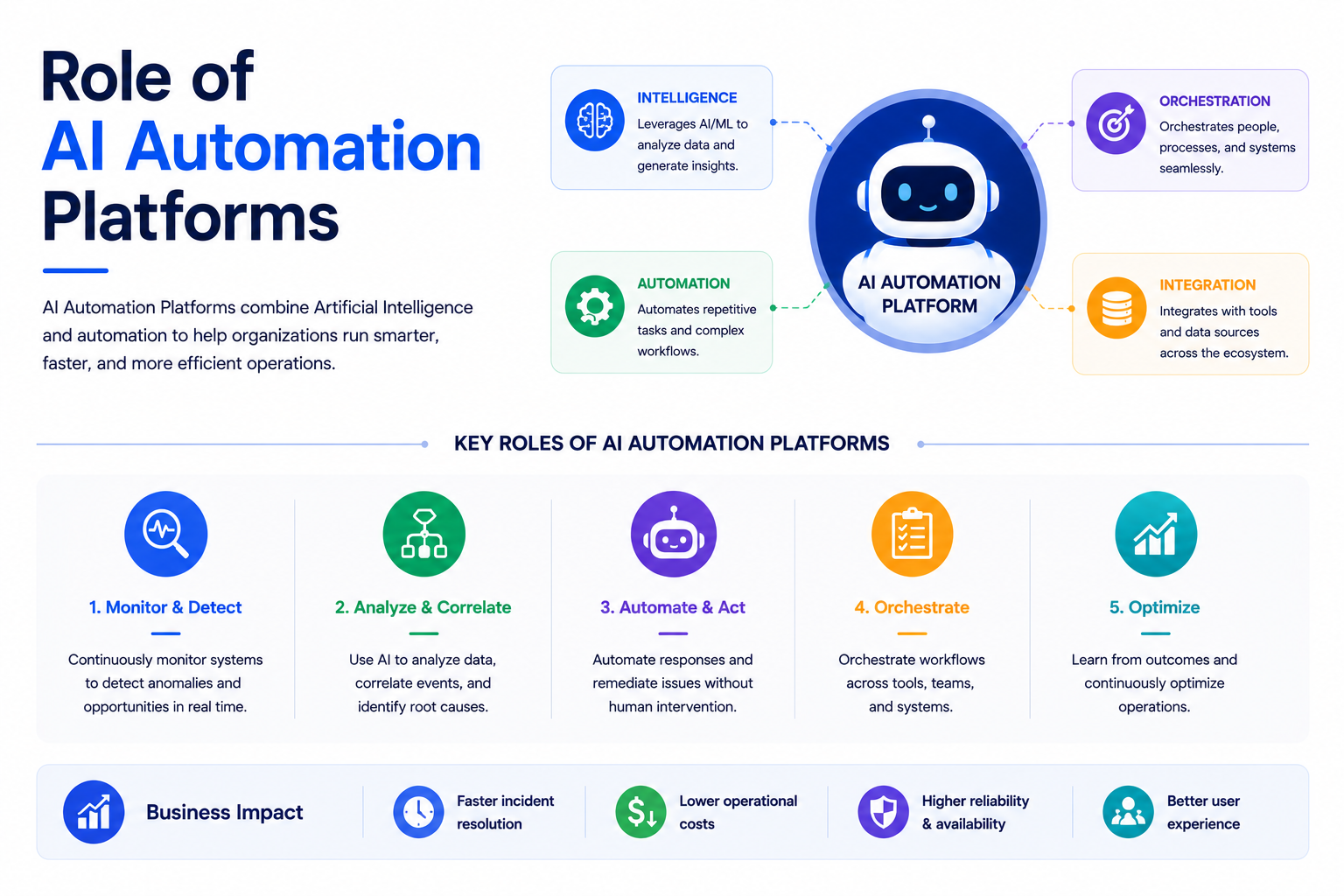
Role of AI Automation Platforms
The modern business is dependent on intelligent automation for infrastructure and process management. In today’s environment, which consists of a complex IT ecosystem of cloud-native applications, hybrid infrastructures, and deployment pipelines, the old-school ways of handling infrastructure and processes manually have been rendered obsolete.
Some of the features of an advanced AI automation platform are as follows:
• Workflow automation
• Infrastructure orchestration
• Infrastructure monitoring intelligence
• Incident management
• Recommendations based on artificial intelligence
Advanced automation platforms can help create highly scalable and self-healing operation environments.
AIOps on AWS and Cloud Platforms
The cloud vendors are aggressively deploying AI solutions in their operational intelligence suites. With more workloads being shifted to the cloud, the need to manage the performance, security, scalability, and reliability of the underlying infrastructure has become more complicated than ever before.
In response, some cloud players have introduced AI and machine learning solutions that are incorporated into their monitoring and management offerings.
Some examples of AIOps AWS include:
- Amazon DevOps Guru
- AWS CloudWatch Anomaly Detection
- AWS Systems Manager
- Amazon Lookout for Metrics
Other providers such as Microsoft Azure and Google Cloud offer similar solutions.
Career Impact of AIOps for DevOps Engineers
Among the top concerns that most IT specialists have is the possibility of AI replacing DevOps engineers. In truth, AI is changing jobs and not doing away with them.
Whereas AI technology is able to automate monotonous operational processes like monitoring, alerts, and basic troubleshooting, the presence of talented engineers is essential in designing infrastructure, cloud environments, enforcing security policies, and automating operations.
These are some of the areas where engineers are still needed:
• Cloud Architecture Design
• Infrastructure Automation
• Security Implementation
• Governance and Compliance
• System Reliability Engineering
• Validation of AI workflows
But DevOps practitioners who know how to use AI operations stand out.
Future Trends in AIOps
The future of AIOps is evolving quickly as organizations adopt more intelligent systems. As cloud-native technologies, automation, and AI capabilities continue to advance, businesses are increasingly investing in smarter operational platforms that can improve efficiency, scalability, and system reliability.
Autonomous Operations
The self-healing systems will be able to solve problems that occur in their operations with little human assistance. Self-healing systems are expected to predict problems using advanced analytics and automate the process of problem-solving.
This will assist organizations to reduce downtimes, maintain system reliability, and reduce operational efforts.
AI-Driven DevSecOps
The use of security intelligence will be fully embedded within DevOps practices. Artificial intelligence-driven solutions will monitor the infrastructure, apps, and deployment process continuously for potential vulnerabilities and malicious activities.
Such an approach would enhance security procedures but also streamline software development and delivery.
Conversational AI for Operations
The role played by artificial intelligence assistants in engineering will be in troubleshooting systems using conversational queries.
Rather than going through logs and dashboards to gather information manually, engineers will engage intelligent machines to get their insights instantly. This will make the job easier for the DevOps and IT operations teams.
Unified Observability Platforms
The process of monitoring, logging, tracing, and AI analysis will be consolidated within a single system. There will be an ability to have one dashboard where organizations will be able to view all details related to their infrastructure, applications, and other operations.
Hyperautomation
The integration of robotic process automation, orchestration, and artificial intelligence will fuel corporate-wide automation efforts. Companies will be more inclined toward automating repetitive processes within IT, security, and infrastructure operations.
The rising popularity of DevOps AIOps may change the face of IT operations in the coming years.
Best Practices for Implementing AIOps
There are several key steps that organizations should take when implementing AI in Ops solutions. This approach will help companies achieve maximum efficiency in their operations while minimizing potential negative effects that come with automation.
Start With a Narrow Case Study
Begin with a narrow use case that can be related to anomaly detection or incident management. By starting small, organizations will be able to experiment with different approaches, analyze their outcomes, and fine-tune the process.
Clean Up Your Data
AI relies on operational data. Incorrect, poor quality, or incomplete data can lead to incorrect conclusions, unnecessary alarms, and inefficient operation of automated procedures.
Businesses need to focus on data normalization and increase visibility across systems by creating better logging practices.
Choose Complementary Platforms
Find a solution that integrates with your existing ecosystem. Integration with cloud technologies, CI/CD tools, automation platforms, and monitoring systems increases productivity.
Retain Oversight Over Operations
AI is there to support engineers rather than substitute operational decisions. Some human input and oversight are essential in situations when important decisions have to be made, including security management.
Measure Operational Outcomes
Key indicators may include:
- MTTR reduction
- Downtime improvement
- Alert reduction
- Deployment success rates
- Cloud cost optimization
Many companies are now experimenting with advanced AI DevOps tools for enhanced observability and automation.
Final Thoughts
AIOps will soon become one of the most vital innovations within modern IT operations as complexity levels increase for many organizations. With the need for an intelligent system that can analyze operational information, predict potential issues, and automate fixes in order to ensure reliability increasing, organizations should look to adopt AIOps.
In order to stay competitive and relevant within DevOps, the learning of AIOps should soon become a necessity. This technology is essential for the management of cloud-native, distributed and enterprise applications within the IT industry.
The future is automation, and the adoption of intelligent technologies is a must for any DevOps engineer. Learning and integrating AIOps will lead to increased career prospects and financial gain for individuals.





 Whatsapp us
 Call us
 Enquire Now