The emergence of cloud-native apps has made changes in the approach of businesses to creating, deploying and managing applications. Today, they require faster deployment, increased scalability, secure app delivery and no increase in operational complexity. This can be achieved only thanks to container technologies and automation. Hence, there is a great demand for the personnel with advanced knowledge about Kubernetes and OpenShift in the IT market. For newbies who want to become DevOps engineers, getting OpenShift training will be a great way to get acquainted with the enterprise container platform and prepare for future work in the clouds.
Although Kubernetes and OpenShift should be regarded separately, their combination allows professionals to have a broader set of knowledge about enterprise-level container platforms as Kubernetes is the base technology while OpenShift adds security, CI/CD capabilities, monitoring and other tools to it.
By choosing the path of studying Kubernetes and OpenShift for DevOps engineers, one will be able to acquire an advantageous knowledge of technologies that help in building, delivering and managing cloud-native applications.
Understanding Kubernetes and OpenShift
Prior to conducting analysis on the benefits of the platforms for the career, it is important to clarify how they interconnect. The Kubernetes is an application which automates deployment, scaling and management of containerized applications, thus ensuring efficient operations of such applications without any manual intervention.
Red Hat OpenShift is a ready for production platform which makes use of Kubernetes technology. Along with the basic functions of Kubernetes, the Red Hat OpenShift incorporates some other useful features like security policies, image registry, monitoring and logging, and better cluster management. All these features make the Red Hat OpenShift a valuable tool in enterprises as it ensures standardization and safety of the applications’ deployment.
In practice, when people learn Red Hat OpenShift, they will find out that they cannot forget about Kubernetes and will have to apply their knowledge for improving the process of work. Such concepts as Pods, Services, Deployments, ConfigMaps, Namespaces will stay the same. The only addition that Red Hat OpenShift provides engineers with is an opportunity to manage these things in a more convenient way. Knowledge of both platforms will allow an individual to succeed in any professional field. Some companies may choose to use only upstream Kubernetes, while others – only OpenShift.
Why Learning Both Technologies Is a Smarter Choice
The question comes up regarding the necessity of learning Kubernetes prior to OpenShift or the other way around. The answer is Kubernetes is the correct starting point to learn from; however, learning only one platform can hinder your career opportunities. As OpenShift is an advanced form of Kubernetes, it is rational to learn both of them simultaneously.
Starting with Kubernetes course will help you to gain some experience in basics of container orchestration such as cluster management, networking, volumes management, deployment, scaling, and workload scheduling. As soon as you get to know everything about these processes, learning OpenShift will become absolutely easy for you.
Moreover, studying both Kubernetes and OpenShift will let you overcome the theoretical stage and gain practical skills in how enterprises deploy applications, ensure their security, automate their deployment, control access of users to applications, and monitor workloads.
Main advantages of this tandem are the following:
- Increase cloud-native knowledge.
• Understanding of enterprise application platforms.
• Advanced troubleshooting skills.
• Knowledge of working with production environments.
• Ability to operate in multiple cloud infrastructures.
Surely, all these skills will increase your proficiency as a DevOps engineer.
How Kubernetes and OpenShift Fit Into the Modern DevOps Roadmap
First of all, in order to become a DevOps engineer professionally, one needs to understand how different tools interact but not specialize in only one tool. Most of the people start from learning such technologies as Linux, networking, scripting, Git, and Docker before starting with container orchestration. At this point of having enough skills, such technologies as Kubernetes and OpenShift will be important due to the bridging gap between the development and infrastructure. DevOps roadmaps usually contain the mentioned technologies as a core of cloud-native technologies learning.
The main DevOps pipeline includes packaging the code, which has been developed by developers, and deploying this code into containers via Kubernetes. This technology enables automating the deployment, scaling, and management of applications on multiple servers. On the other hand, OpenShift provides all of this plus some enterprise features such as CI/CD pipeline integration, role-based access control, monitoring, logging, and security.
Moreover, learning Kubernetes and OpenShift makes it easier to understand how more complex DevOps technologies work such as Infrastructure as Code (IaC), GitOps, Kubernetes Operators, hybrid clouds, etc. Instead of learning these things separately, it is possible to understand how they interact together in the same ecosystem. Hence, it will be easier to build the DevOps deployment pipeline, to automate repetitive operations, and to cooperate with developers and operation engineers.
For the DevOps engineers who want to work for a long period of time, these technologies cannot be additional because they form the basis of many platforms and practices.
Why Enterprises Are Investing in Kubernetes and OpenShift
Today, organizations face constant challenges of building applications rapidly but maintaining the high level of security, reliability, and performance at the same time. The traditional approach to deployment may be considered as inefficient and manual in nature, resulting in possible development delays and errors. The use of Kubernetes and OpenShift provides organizations with a solution of their problems and helps build up a scalable, efficient and consistent way of application management.
Thanks to Kubernetes, an organization gains an ability to easily deploy and manage a large number of containers due to the features of automatic scaling, self-healing, load balancing and optimization of resources. By offering its customers such benefits as security, centralization of management, development tools and easy cluster administration, OpenShift turns Kubernetes even more effective and valuable. This way, companies do not have to spend their time on the management of their infrastructure and can focus on innovations.
Kubernetes and OpenShift become especially vital for those organizations that chose a microservices architecture and hybrid clouds. Whether applications are deployed on public cloud service providers, private data centers or their combination, Kubernetes and OpenShift provide organizations with an equal operational environment. It helps businesses to reduce expenses and to increase the velocity of deployment as well as availability of their solutions.
Industries such as banking, healthcare, retail, manufacturing and telecommunications are increasingly making investments in Kubernetes and OpenShift since it helps to grow a business and transform digitally. As far as adoption among enterprises increases, specialists with Kubernetes and OpenShift experience become very valuable employees of DevOps and cloud engineering teams.
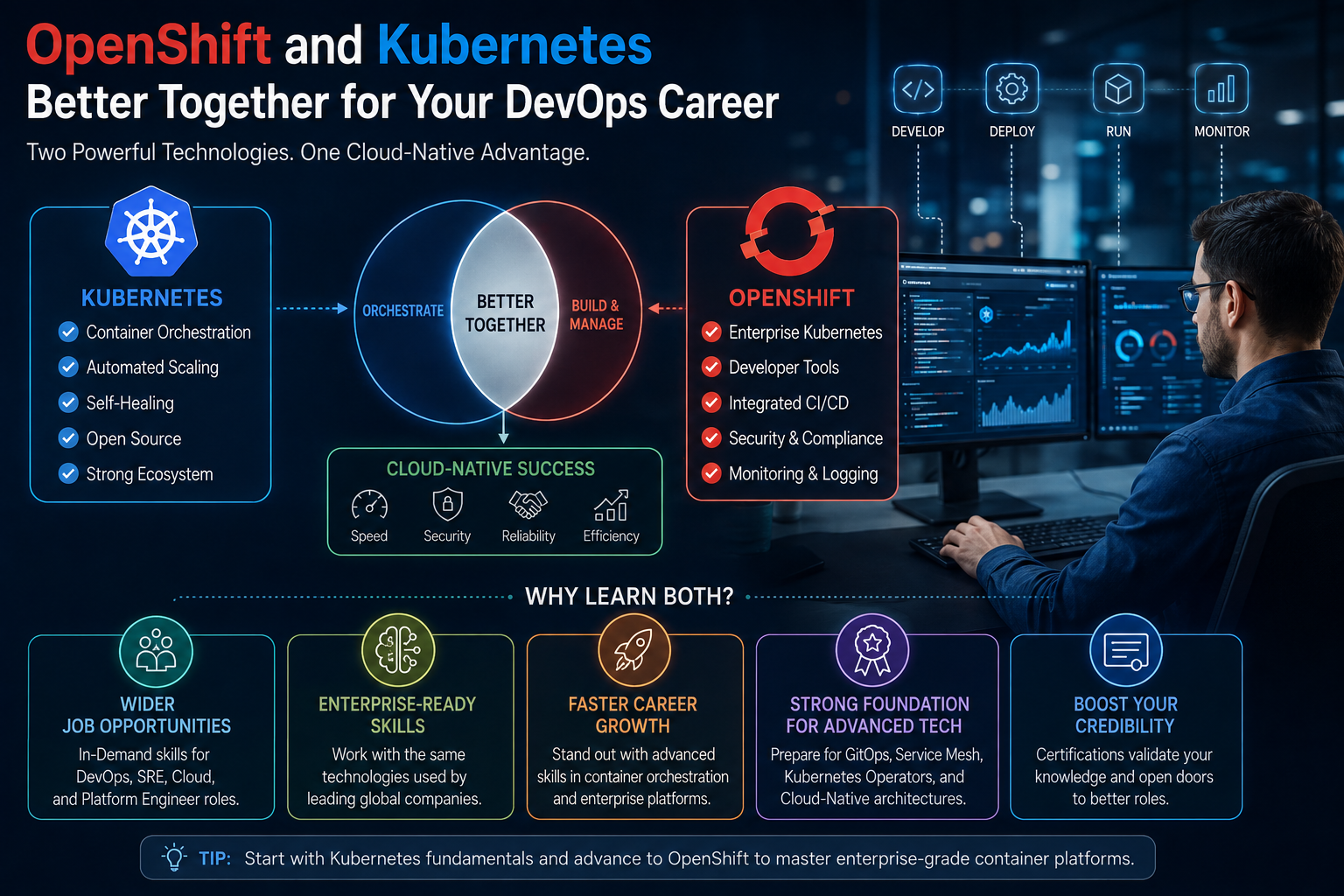
How Learning Both Technologies Accelerates Your Career
Nowadays, the requirements of most employers do not stop on the ability to manage infrastructures only. It is essential to understand how to deploy applications, apply automation, monitor processes, guarantee security, and implement cloud-native architecture. The studying of Kubernetes and OpenShift allows approaching the problem from another perspective and being prepared to work in enterprises.
Furthermore, almost all enterprises suggest getting some kind of certification in order to confirm the professional abilities of their employees. Getting Red Hat OpenShift Certification will confirm your competence in enterprise container platforms and in working with them in the right way. Even though certification cannot replace practice, it allows presenting yourself from the best side and showing the desire of continuous self-development.
Apart from getting any kind of certification, the studying of Kubernetes and OpenShift allows acquiring practical skills. You will be able to deploy applications, apply the automation, solve production problems, and work well with departments of development, operations, and security.
Since most enterprises develop their infrastructure nowadays, engineers familiar with these two platforms will have more opportunities and career perspectives.
Career Opportunities After Learning Kubernetes and OpenShift
As a result of the continued utilization of cloud-native technology by the companies, the demand for experts with skills in Kubernetes and OpenShift is growing within many industries. Today, the companies do not require DevOps engineers due to the skills in automation but need an individual who is going to deploy the containerized application and optimize the cloud in order to support continuous software delivery. It is an excellent career choice for experts with skills in both technologies.
One may take different job roles including DevOps Engineer, Cloud Engineer, Platform Engineer, Site Reliability Engineer (SRE), Kubernetes Administrator, Cloud Consultant, Infrastructure Automation Engineer, among many other positions. The reason is that Kubernetes and OpenShift are popular technologies in many organizations, which leads to the existence of such vacancies in different industries like banking, healthcare, ecommerce, manufacturing, telecoms, IT services, among many others.
Many experts who intend to get employed after finishing the DevOps course with placement find that the course is the best way due to the availability of technical training, project development, interview preparation, resume writing, and career planning. The reason is that working on practical projects during training prepares them for production and thus facilitates technical interviews. Besides, the employers usually prefer those experts who have GitHub projects rather than theoretical knowledge.
Learning Kubernetes and OpenShift simultaneously helps the experts to become future managers in the organizations due to the gained experience. As a result of the gained experience, an expert may move on to such positions as Cloud Architect, DevOps Lead, and Platform Engineering Manager.
Certifications That Strengthen Your Professional Profile
Nevertheless, besides practical skills, DevOps engineers may take some certificates that will add value to their portfolio and will make them more professional. Certificates are the signs of one’s proficiency, which means that this person has necessary knowledge and is aware of best practices in this area. So, the combination of practical experience and certificates can bring great success in searching for a job.
One of the most popular certificates for cloud native engineers is the Certified Kubernetes Administrator (CKA). The CKA certificate is about your ability to work with Kubernetes clusters, configure and troubleshoot them. Thus, it is performance-based, which means that you will be checked for your ability to solve problems rather than for theoretical knowledge.
It is the best way to prepare for the exam – to practice in real-life projects. You need to get some experience in deploying multi-container applications, cluster resource management, network configuration, setting up security policies, and monitoring workload. And this way, you will be able to pass the exam and become a certified kubernetes administrator.
Though, those people who want to build successful careers in DevOps should treat certificates as milestones of their careers and not as the end point.
Choosing the Right Learning Path
The way in which you learn is an important factor in your success. Free resources and documentation are helpful in grasping the concepts but structured learning can help you develop skills in a proper order. A good DevOps course online will guide you through proper learning through practical labs, mentoring, industry-relevant projects and more, making the technologies easy to comprehend.
For an effective learning process:
- Work on small Kubernetes and OpenShift projects frequently.
• Gain knowledge of Linux, networking and Docker basics.
• Study CI/CD tools along with container orchestration.
• Refer to the latest documentation and news.
• Maintain a portfolio of your practical skills.
Consistency is better than speed. Spending some time every week working on practical labs and deployment issues will give you confidence to handle real production systems.
Conclusion
The above approaches have shown themselves to be important components in solving issues in the current DevOps environment. While Kubernetes works as the foundation for container orchestration, OpenShift is the platform designed to provide application deployment and other features making sure they are secured and manageable. Comparing both tools will allow you to acquire more cloud-native knowledge and be prepared for the issues you will face working in the current environment.
Choosing the right place to receive the necessary knowledge, you should pay attention to such aspects as Kubernetes certification cost and training quality. Learn Kubernetes and OpenShift at Grras Solutions.
Having the right knowledge and experience, one will easily create his/her career in DevOps. With the growing popularity of cloud-native solutions, Kubernetes and OpenShift will provide only promising prospects for you.





 Whatsapp us
 Call us
 Enquire Now