Cloud computing has become one of the most important technologies in today’s digital world. Businesses are moving from traditional systems to cloud platforms because they are faster, more flexible, and cost-effective. Among all cloud providers, Amazon Web Services (AWS) is the most popular and widely used platform.
This blog will help you understand AWS cloud computing in simple words, including its features, services, benefits, career opportunities, and future scope.
1. Introduction to Cloud Computing
Before learning AWS, it is important to understand cloud computing.
Cloud computing means storing data and running applications on the internet instead of using local computers or physical servers. Earlier, companies had to buy expensive hardware and maintain it. Now, they can use cloud services and pay only for what they use.
Cloud computing provides:
- Storage for data
- Computing power
- Networking services
- Software tools
Everything is available online, which makes it easy to access from anywhere.
2. What is AWS?
Amazon Web Services (AWS) is a cloud computing platform developed by Amazon. It provides a wide range of services like computing, storage, databases, networking, analytics, and more.
AWS started in 2006 and quickly became the market leader in cloud computing. Today, it is used by companies like Netflix, Amazon, Airbnb, and many startups.
With AWS, users can:
- Launch virtual servers
- Store data securely
- Build and deploy applications
- Scale systems based on demand
3. Why AWS is Popular
AWS is the most widely used cloud platform for many reasons.
- 1. Global Infrastructure: AWS has data centers around the world. This helps in fast performance and low latency.
- 2. Large Number of Services: AWS offers more than 200 services, covering almost every IT need.
- 3. Scalability: Users can increase or decrease resources anytime based on demand.
- 4. Cost-Effective: AWS follows a pay-as-you-go model. You only pay for what you use.
- 5. Security: AWS provides strong security features like encryption, firewalls, and identity management.
- 6. Reliability: AWS ensures high availability and backup systems to avoid data loss.
4.Key AWS Services Explained
AWS has many services, but beginners should focus on the core ones.
- 1. EC2 (Elastic Compute Cloud): EC2 provides virtual servers in the cloud. You can use it to run applications just like a physical computer.
- 2. S3 (Simple Storage Service): S3 is used to store files, images, videos, and backups. It is highly secure and scalable.
- 3.RDS (Relational Database Service): RDS allows you to use databases like MySQL, PostgreSQL, and Oracle without managing them manually.
- 4.Lambda: Lambda is a serverless service. It allows you to run code without managing servers. You only pay when your code runs.
- 5.VPC (Virtual Private Cloud): VPC helps you create a private network inside AWS. It improves security and control.
- 6.IAM (Identity and Access Management): IAM is used to control who can access AWS resources. It helps manage users, roles, and permissions.
5. Types of Cloud Computing Models
AWS supports different types of cloud service models.
- 1.Infrastructure as a Service (IaaS): Provides basic infrastructure like servers and storage.
Example: EC2 - 2.Platform as a Service (PaaS): Provides a platform to develop and deploy applications.
Example: Elastic Beanstalk - 3. Software as a Service (SaaS): Provides software applications over the internet.
Example: Web-based email or CRM tools
6. Deployment Models in Cloud
There are different ways to use cloud services.
- Public Cloud: Services are provided over the internet and shared among users.
- Private Cloud: Cloud infrastructure is used by a single organization.
- Hybrid Cloud: Combination of public and private cloud.
7. Advantages of AWS Cloud Computing
Learning and using AWS has many benefits.
- Cost Savings: No need to invest in hardware. Pay only for usage.
- Flexibility: Easily scale resources up or down.
- Accessibility: Access data and applications from anywhere.
- Security: Advanced tools for data protection.
- Backup and Recovery: Automatic backup options reduce risk of data loss.
- Fast Deployment: Applications can be launched quickly.
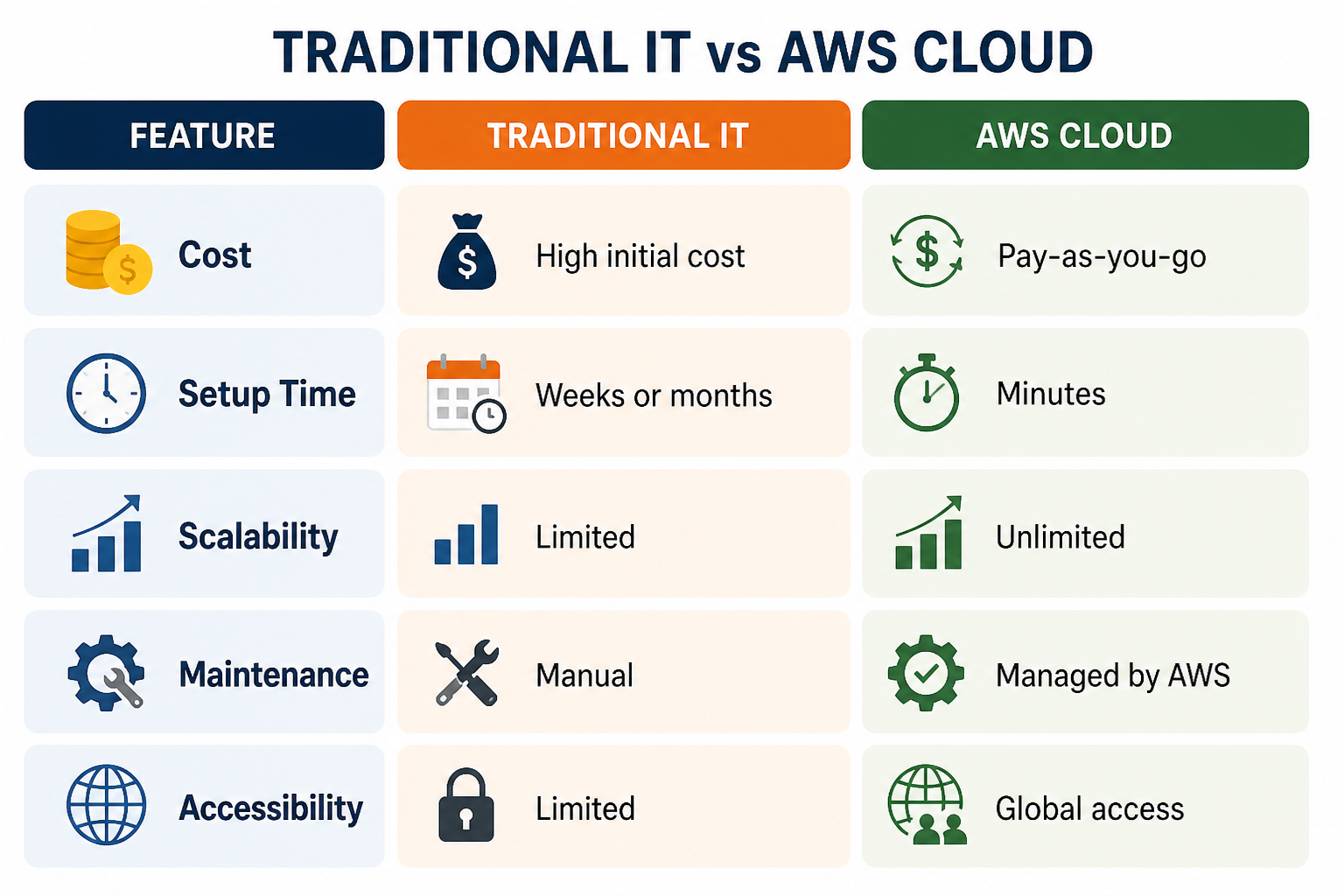
8. AWS vs Traditional IT Infrastructure
9. AWS vs Azure:
AWS and Microsoft Azure are the two biggest cloud providers.
AWS
- More services
- Better for startups and developers
- Larger market share
Azure
- Strong integration with Microsoft tools
- Preferred by enterprises
10.Career Opportunities in AWS
AWS skills are in high demand. Many companies are hiring cloud professionals.
Popular Job Roles:
- Cloud Engineer: Manages cloud infrastructure.
- AWS Solutions Architect: Designs cloud systems and solutions.
- DevOps Engineer: Automates development and deployment processes.
- System Administrator: Maintains servers and systems.
- Cloud Consultant: Helps businesses adopt cloud solutions.
11. Salary and Job Demand
AWS professionals earn good salaries compared to other IT roles.
- Entry-level: Good starting salary
- Mid-level: Strong growth opportunities
- Experienced: High-paying roles
12. AWS Certification Path
Certifications help validate your skills.
- Beginner Level: AWS Cloud Practitioner
- Basic understanding of AWS
- Intermediate Level: AWS Solutions Architect Associate
- Design and deploy applications
- Advanced Level
- AWS DevOps Engineer
- AWS Solutions Architect Professional
13. Skills Required to Learn AWS
To learn AWS effectively, you should have basic knowledge of:
- Computer networking
- Operating systems (Linux preferred)
- Basic programming (optional but helpful)
- Understanding of databases
14.How to Start Learning AWS
Follow these steps to begin your AWS journey:
Step 1: Learn Basics
- Understand cloud computing concepts.
Step 2: Create AWS Account
- Use AWS Free Tier to practice.
Step 3: Learn Core Services
- Focus on EC2, S3, RDS, IAM.
Step 4: Practice Hands-on
- Create projects and deploy applications.
Step 5: Prepare for Certification
- Take practice tests and training courses.
15. Real-World Use Cases of AWS
AWS is used in many industries.
- Web Hosting: Hosting websites and applications.
- Data Storage: Storing large amounts of data securely.
- Machine Learning: Building AI-based applications.
- Backup Solutions: Data recovery and disaster management.
- Streaming Services: Platforms like Netflix use AWS.
16. Common Challenges in AWS
While AWS is powerful, beginners may face some challenges.
- Understanding pricing structure
- Learning many services
- Managing security settings
With practice and training, these challenges can be overcome.
17. Future Scope of AWS
Cloud computing is growing rapidly. AWS continues to lead the market.
Future trends include:
- Artificial Intelligence
- Machine Learning
- Internet of Things (IoT)
- Big Data Analytics
AWS plays a major role in all these technologies.
18. Why Students Should Learn AWS
AWS is a great choice for students and freshers.
- Easy to start
- High demand skill
- Good career growth
- Opportunities in India and abroad
Learning AWS early can give a strong advantage in the IT industry.
19. Why Businesses Use AWS
Businesses prefer AWS because:
- Reduces infrastructure cost
- Improves performance
- Ensures data security
- Supports global operations
It helps companies grow faster without heavy investment.
FAQs About AWS cloud computing
1. What is AWS cloud computing in simple words?
AWS cloud computing is a platform by Amazon that provides online services like servers, storage, databases, networking, and security over the internet. Businesses use AWS to run applications without managing physical hardware.
2. Why should beginners learn AWS in 2026?
AWS is one of the most widely used cloud platforms worldwide and offers strong career opportunities in cloud engineering, DevOps, and cloud security. Beginners prefer AWS because of its easy learning resources, free tier access, and high industry demand.
3. Which AWS services are most important for beginners?
Some essential AWS services for beginners include Amazon EC2, Amazon S3, AWS Lambda, IAM, and VPC. These services help learners understand cloud servers, storage, security, and networking concepts.
4. What skills are required to start a career in AWS cloud computing?
To begin a career in AWS cloud computing, learners should understand Linux basics, networking concepts, cloud fundamentals, scripting languages like Python or Bash, and basic DevOps tools. Hands-on projects and certifications also help improve job opportunities.
5. Is AWS cloud computing a good career option in India?
Yes, AWS cloud computing is considered a strong career option because companies across IT, healthcare, finance, startups, and enterprises are moving to cloud infrastructure. Cloud professionals are in high demand and often receive competitive salary packages.
6. Which AWS certification is best for beginners?
The AWS Certified Cloud Practitioner certification is the best starting point for beginners. After gaining basic knowledge, learners can move to advanced certifications like AWS Solutions Architect Associate or AWS DevOps Engineer.
Conclusion
AWS cloud computing is one of the most important skills in today’s technology world. It provides powerful tools to build, manage, and scale applications easily.
Whether you are a student, IT professional, or business owner, learning AWS can open many opportunities. With high demand, good salaries, and strong future growth, AWS is a smart career choice.





 Whatsapp us
 Call us
 Enquire Now