The need for DevOps specialists keeps growing because of the increasing demand for automation, cloud technology and other innovations related to DevOps. One of the most highly-demanded competencies among the specialists who develop DevOps is the expertise in Continuous Integration and Continuous Delivery (CI/CD). Whether you are a beginner DevOps specialist preparing yourself for your first interview or an experienced developer who wants to occupy a more challenging post, knowing the basics of CI/CD should become a necessity in 2026.
It all usually begins with obtaining the DevOps engineer certification, which gives you an opportunity to dive into such issues as automation, deployment, managing the infrastructure and cloud computing in general. This guide includes 50 frequently asked CI/CD questions and answers on DevOps interviews.
Understanding CI/CD Fundamentals
However, before tackling the questions, there should be an explanation on the importance of the use of CI/CD in software engineering.
Continuous Integration is a technique of merging changes in the codebase in the same source code repository in continuous intervals as well as the automated testing validates all integrations. CD is a method that keeps software deployment-ready all the time, whereas Continuous Deployment automates this process of software release into production after validating changes.
Those who have registered for courses at a respectable DevOps training institution know very well how much time goes into creating CI/CD pipelines.
Basic CI/CD Interview Questions
- Describe Continuous Integration.
Answer: Continuous integration is where code modifications happen in the repository very often to initiate building and testing procedures. - Explain Continuous Delivery.
Answer: Continuous delivery is a procedure that makes sure that your changes are deployed effortlessly through automatic testing on your changes in your code. - Explain Continuous Deployment.
Answer: Continuous deployment refers to the process involved in the release of validated changes through CI/CD. - Explain the Importance of CI/CD.
Answer: The importance of CI/CD lies in the fact that one is able to benefit from frequent releases, high-quality software as well as quick feedback. - Name Some CI/CD Tools.
Answer: There are a number of CI/CD tools including Jenkins, GitLab CI/CD, GitHub Actions, CircleCI, Azure DevOps, Bamboo, and TeamCity. Professionals looking to gain hands-on experience with these tools can explore training and certification programs offered by the Linux foundation. - What is CI/CD Pipeline?
A series of processes such as building, testing and deployment. - Explain Source Control.
Answer: Source control refers to change management of your code and cooperation with other developers. - Why is Git Important in CI/CD?
Answer: Git is important in CI/CD as it offers features such as versioning and automation of the process. - Explain Build Automation.
Answer: Build automation refers to the process of transforming your source code into an executable format and generating packages. - Explain Build Artifact.
Answer: It is the output after transforming your source code into an executable format.
Intermediate CI/CD Interview Questions
- Define Deployment Pipeline
Answer: The process of automation of moving software across different stages including development, testing, staging, and production environment. - Describe deployment environments.
Answer: Isolated environment used for application validation prior to releasing to the production environment. - Explain rollback strategy.
Answer: Rollback strategy refers to reverting back to a stable previous version if deployment problems arise. - Describe Blue-Green Deployment.
Answer: Involves the use of two similar environments enabling easy switching of traffic to previous or new versions. - Describe Canary Deployment.
Answer: Releases updates to a small portion of users before deploying updates to all users. - What is Infrastructure as code (IaC)
Answer: It refers to the management of infrastructure using configuration files. - What is Docker?
Answer: This refers to a containerization technology used for packaging and distributing applications and dependencies inside containers. - Define Docker Image.
Answer: An image template used in creating docker containers. - Define Docker Containers.
Answer: Refers to a docker container which is a runtime of a docker image. - How does containerization improve continuous integration/continuous delivery.
Answer: By maintaining consistency throughout the development, testing, and production environment.
Nowadays, many people like to take a DevOps course online as it offers practical experience with Git, Docker, Kubernetes, and CI/CD from anywhere around the world.
Jenkins and Automation Interview Questions
- What is Jenkins?
Answer: Jenkins is an automation framework for building, testing, and deploying software applications. - What is Jenkins Pipeline?
Answer: The pipeline is an automation pipeline defined using codes. - What is Jenkinsfile?
Answer: Jenkinsfile is the code script used to define the pipeline. - What is Jenkins Agent?
Answer: It is an agent that helps perform the task. - What is Pipeline as Code?
Answer: It refers to defining the pipeline using code. - How can you secure Jenkins?
Answer: Through the processes of authentication, encryption, credentials, and authorization. - What are Jenkins plugins?
Answer: Plugins refer to additional modules installed in Jenkins to increase its capabilities. - How can you integrate Jenkins with Git?
Answer: Whenever a change occurs in git, it triggers the process of building software applications. - What is CI trigger?
Answer: CI trigger initiates the start of the pipeline after meeting particular conditions. - How can one troubleshoot a pipeline?
Answer: Through logging, configuration checking, test result review, and infrastructure review.
Companies that seek to bring their processes up to speed by using cloud-native technologies will push their employees to learn Azure DevOps, which provides a comprehensive set of tools for code management and deployment.
Advanced CI/CD Interview Questions
- What is DevSecOps?
Answer: DevSecOps stands for utilizing security within all phases of CI/CD. - What is Shift-Left Testing?
Answer: This is the strategy of testing early during the development phase. - What are Quality Gates?
Answer: These are one of the requirements in code. - What is Artifact Management?
Answer: This is the management of code artifacts that need to be created. - What is GitOps?
Answer: This strategy implies using the Git repository as the deployment ground. - What is Kubernetes?
Answer: This is the method that is used for deploying containers and scaling apps based on them. - What are Ephemeral Environments?
Answer: These are environments created for testing. - What metrics could be used in CI/CD?
Answer: Deployment frequency, lead time, failure rate, change recovery. - What is Infrastructure Drift?
Answer: This term relates to infrastructure discrepancies. - How could AI be used in CI/CD?
Answer: AI could be useful for automation, prediction, and monitoring.
These kind of advanced subjects are usually taught in the curriculum of a DevOps Master Degree course that targets people who manage enterprise-level infrastructures.
Scenario-Based CI/CD Interview Questions
- What can be done to decrease build times?
Answer: Caching, parallel builds, and good tests. - How do you address the problem of failed deployment?
Answer: Analyze the logs, understand the reasons for failure, and rollback if required. - How do you secure sensitive information in CI/CD?
Answer: With vaults from different vendors, for instance, Microsoft, HashiCorp, AWS. - How do you ensure availability in CI/CD?
Answer: Infrastructure redundancy, disaster recovery plans. - How do you ensure that your solution is compliant in CI/CD?
Answer: Automatically performing compliance tests, adhering to security policies. - How do you deploy microservices?
Answer: Every microservice has its own unique deployment pipeline. - How do you monitor applications after deploying them?
Answer: Using monitoring and observability solutions like Prometheus, Grafana. - Why are tests flaky?
Answer: Due to incorrect timing, unstable environment, dependencies on other elements. - How do you make your automated tests more efficient?
Answer: Select the right set of test cases, run them in parallel. - What will be the future of CI/CD?
Answer: Increased automation, artificial intelligence operations, platform engineering, security improvements.
Such kinds of questions are usually used by DevOps Foundation Classes participants to improve their troubleshooting skills.
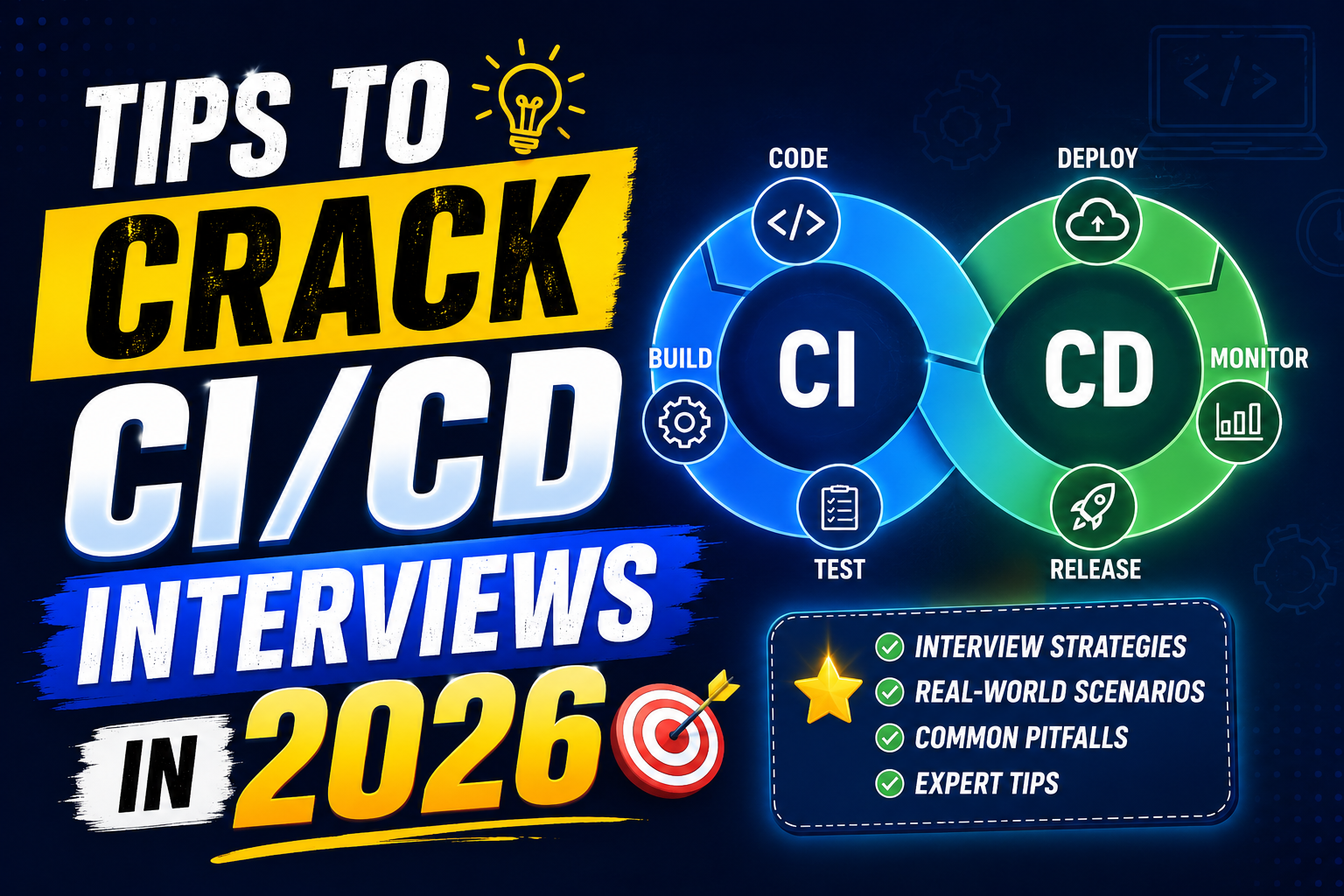
Tips to Crack CI/CD Interviews in 2026
It is necessary to have more than technical knowledge in order to ace DevOps interview questions. The firms today look for candidates who not only have experience but also possess effective teamwork skills, along with automation skills.
Here are some extremely productive tips that can help in preparation:
• Conduct full-fledged projects of implementing the CI/CD pipeline.
• Gain experience in working with Kubernetes.
• Get fluent in Infrastructure as Code using Terraform.
• Know about different methods of deployment.
• Conduct practice with Jenkins and GitHub Actions.
Attending The best DevOps training institute will ensure that you learn much faster with practical projects and mentoring sessions on real cases.
Also, taking a look at the best website to learn DevOps can prove beneficial for gaining information on new technologies.
The DevOps Coaching online services will be especially useful for gaining experience while fulfilling job responsibilities.
Conclusion
The practice of CI/CD has transformed from being a development good practice to being an absolute requirement for businesses to succeed. All organizations, regardless of industry, depend on their automated pipelines to develop applications quickly, reliably, and effectively. As a consequence, CI/CD engineers are some of the hottest commodities in the job market as of the year 2026.
Answering these 50 CI/CD interview questions effectively will not only allow you to showcase your technical skills but will also give you a chance to prove your problem-solving abilities and experience at the same time. Whether it is your first DevOps job application or an attempt at a leadership position, the best DevOps learning platform can help you get ahead.




 Whatsapp us
 Call us
 Enquire Now