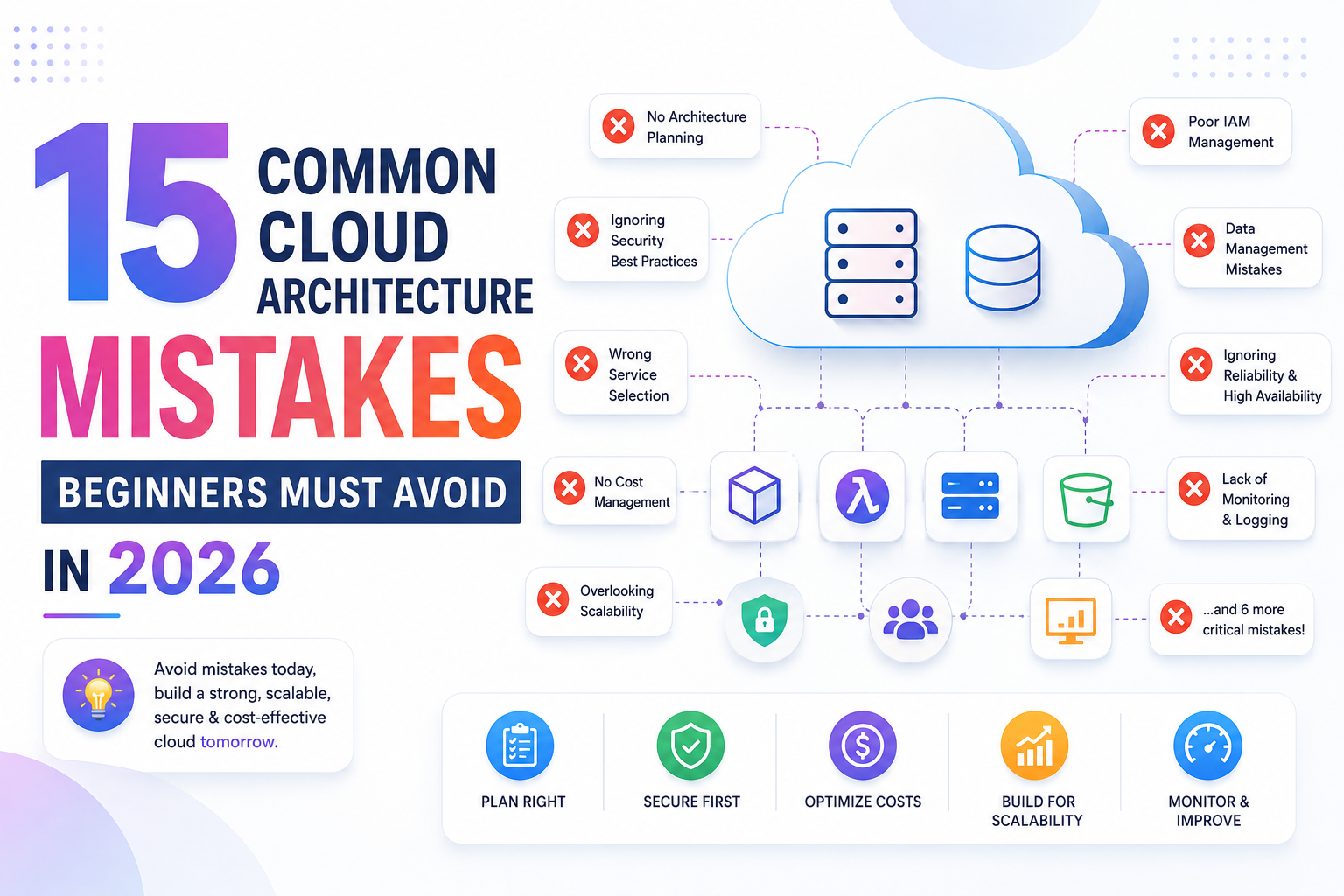
Here is a statistic that should get your attention: 94% of cloud computing architecture failure projects are not related to poor choice of technologies. These problems are related to completely preventable mistakes that any engineer can see and fix within five minutes. Novices don’t make these mistakes due to their inability to do so; rather, they fail because nobody ever told them what those mistakes were until they had created a system which failed at a very inopportune time. Any Cloud Computing Architecture you know has horror stories regarding crashing systems, ballooning invoices, and cybersecurity issues that could easily be avoided through one design decision. Fortunately for all of us, every single item on the list of common mistakes can be learned before you pay the price for doing it wrong.
Mistake #1–3 — The Foundation Errors That Make Every Other Problem Worse
Mistake #1: Developing the Cloud Environment Without Defining Requirements First
It is quite common for people who have just started learning cloud computing architecture certification to skip right to deployment without having clear insights on the business requirements, users’ needs, security considerations, etc. They tend to go right ahead and develop cloud environment because deployment in the cloud platform is fairly straightforward; however, architecture comes first, before deployment takes place. Lack of clear requirements inevitably leads to redevelopment of the environment.
Mistake #2: Thinking That the Cloud Is Like Old Infrastructure
The second common mistake beginners make involves setting up their infrastructure the same way as before but only in the cloud. The fact that automation, elastic capabilities, and managed services have made the cloud so popular seems to be overlooked. Instead of adapting existing infrastructure for the cloud, the result is simply the relocation of existing infrastructure into cloud resources. This makes managing operations difficult and means that the full potential of cloud technology is not being leveraged.
Mistake #3: Studying the Service Offering But Not the Architecture
Learners are able to implement service offerings, but lack the ability to understand how the different resource services interrelate within a larger context. Learners will be capable of creating virtual machines, storage accounts, and databases; however, they may fail to comprehend the relationship that exists between all the different resource services and the business needs. Hence, many contemporary Cloud Computing Courses for Beginners have shifted focus toward understanding cloud computing architecture rather than cloud service offerings.
Mistake #4–6 — Security Shortcuts That Look Fine Until the Day They Absolutely Aren’t
Mistake #4: Assigning Everybody Administrator Privileges
One way to quickly put yourself at risk is by allowing too many permissions. It’s common for newcomers to assign administrator privileges since it seems easier when deploying and testing out software. The more permissions you allow, the higher your chances of something going wrong accidentally. In the production environment, least privilege rules apply – everyone should have access only if it’s absolutely necessary.
Mistake #5: Disregarding Multi-Factor Authentication
Security can require significant financial investment in terms of security software, yet sometimes, simpler solutions tend to be neglected. Multi-Factor Authentication continues to be one of the best ways to decrease risks of account hacking. However, it is delayed by many novice IT professionals, assuming that it requires considerable effort. In truth, setting up an MFA protocol is relatively easy, while fixing hacked accounts may take days or even weeks of work.
Mistake #6: Insecure Storage of Passwords
Password, API key, and connection string values must not be stored in the application code and files at any cost. However, due to the fact that beginners find storing such values easier, they continue following this pattern even though this method is highly insecure. The topic of password management is typically covered when taking a cloud engineer online course. It includes using secret vaults, managing identities, and controlling access. All cloud engineers and cloud computing architecture are responsible for securing sensitive data.
Mistake #7–9 — Networking Mistakes That Bring Down Entire Systems at the Worst Possible Time
Mistake #7: Creating Flat Network Environments without Segmenting
Many beginners use a flat network design, placing all of their workloads within one network environment since this approach appears easier at first. Unfortunately, a flat design does not allow for proper securing and scaling when the applications start growing. Segmentation allows us to have better security and troubleshooting while decreasing the effect of potential failure or breaches. Good network architecture implies proper isolation of all resources and services.
Mistake #8: Failing to Design Traffic Routing
Networks are about connections, but they are also about traffic. Improper routing can cause important performance problems for the network, such as extra latency, inability to communicate in certain applications, and unexpected outages. Most engineers do not forming an opinion traffic routing until the problem emerges in production and try to fix it. A skilled architect considers routing from the very beginning when designing a new network environment.
Mistake #9: Failing to Think about Load Balancing and Connectivity
Good performance in test environment is great, but once applications go live, they face the challenge of real production traffic, which may expose some shortcomings in terms of connectivity design. Aspiring azure developer associate course who prepare for an associate certification course soon realize that load balancing and connectivity planning are crucial elements of network environments.
Mistake #10–12 — Scalability Assumptions That Work Fine in Testing and Collapse in Production
Mistake #10: Designing Systems for Today’s Traffic Only
There are plenty of cloud systems created around current workloads, while the architects forget about the future demands. Everything works fine in tests; however, the actual usage will be different. The increase in traffic might overwhelm the available computing resources, thus, causing performance issues. Cloud computing architecture need to think about future requirements when building new systems.
Mistake #11: Making a System Vulnerable
A single point of failure such as a specific server, database, or service dependency will destroy your entire system. Most people ignore the concept of high availability and redundancy since everything seems alright during the process of developing the product. There should always be a failover system in place.
Mistake #12: Not Preparing for Potential Disasters
The most common mistake that developers, especially when earning an aws cloud developer certification, make is not creating an action plan in case of unexpected problems or disasters. This is one of those situations where prevention is better than cure. You should create an emergency plan and test it before anything happens.
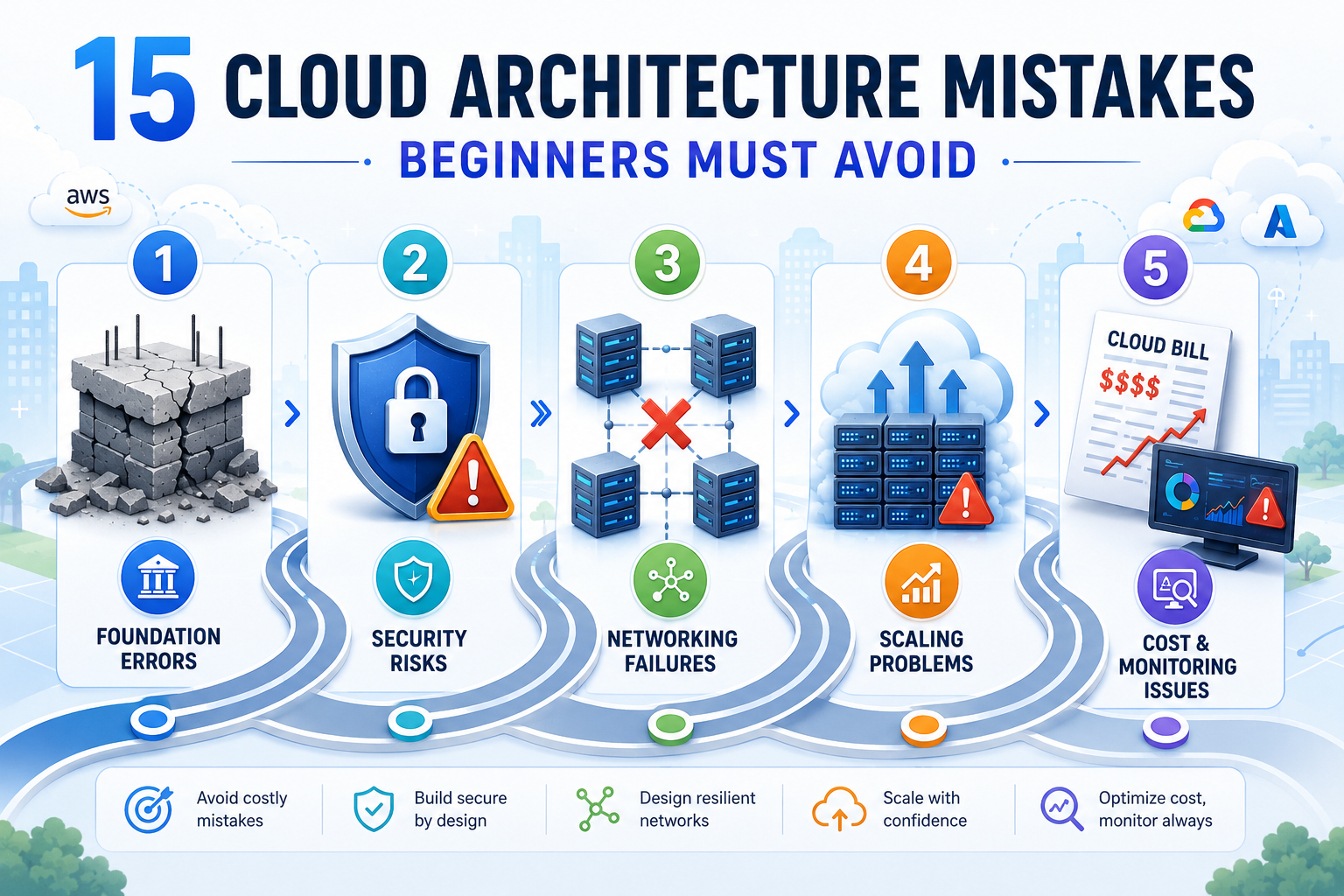
Mistake #13–15 — Cost and Monitoring Blind Spots That Turn Cloud Bills Into Nightmares
Mistake #13: Deployment Without Cost Awareness
The next frequent mistake made by novices is starting up services without knowing the cost associated with them. The deployment of cloud infrastructure is rather simple, however, costs can increase rapidly if resources will not be shut down if no longer required. Small bills may not appear as costly at the beginning but can skyrocket when you have scaled up your environment. Managing your budget starts with monitoring and being aware of how much you spend and on what.
Mistake #14: Not Monitoring Your Environment
Another common mistake is the focus on deployment while forgetting about monitoring. Without knowing the performance, availability, and other parameters of your environment, you will find out only after someone reported problems with the system. In order to solve any issues, you need to get all relevant details and monitoring helps with that. Cloud environments gather huge amounts of useful information regarding operational parameters of the system.
Mistake #15: Never Checking for Unused Resources
When studying course and working on aws cloud certification internship project, students quickly realize that resource optimization should be a constant process. Optimized environment will not only provide good performance and stability but also minimize your expenses. One needs to regularly review usage of different services and eliminate unused applications in order to stay efficient.
Why These Mistakes Happen — The Real Reason Beginners Miss What Experienced Engineers Catch Instantly
But beginners don’t usually commit all these errors due to their technical ineptitude. Instead, they do because they have insufficient experience working within the production environments and real-world situations. Learning platforms often emphasize teaching about each individual service without explaining what happens to a fully operational system under stress. This leads to a disconnect between the theoretical learning and its practical application. Only experience can provide an opportunity to bridge that gap.
The Most Common Reasons Beginners Don’t See All of These Challenges:
- Insufficient experience with the actual production environments
- Pay too much attention to deployments than the architecture of a solution
- Learn the individual services and not the complete architecture
- Inexperienced with troubleshooting
- Novice when it comes to scalability and resilience
- Limited knowledge of cloud security and governance
- Unfamiliar with actual business needs
- Tutorial-based learning cloud computing without implementing them in the real world
That’s why it’s important to learn the practical part as well. High-end Cloud Computing Architecture and Cloud Engineer Courses don’t only teach technical skills but also develop a sense of architectural judgment. The idea is for learners to gain an understanding of the reasons behind certain choices instead of just the configuration process itself. Good judgment will enable cloud engineers to foresee issues, make proper decisions, and create a production-quality system.
How to Stop Making These Mistakes — The Training Path That Builds Real Architecture Judgment
To avoid Cloud Computing Architecture mistakes, however, it is necessary not only to study the documentation and pass certifications. Expertise comes from practicing, mentoring, and constant confrontation with real deployment situations. Practice makes perfect – engineers learn best when they create, fix and optimize systems for themselves.
What Is Included in a Solid Program:
- Cloud basics and architecture design
- Security, and access management
- Networks, and connectivity design
- Monitoring and observability practices
- Architecture scalability and resilience
- Real deployment experience
- Production troubleshooting scenarios
- Certification prep
Many aspiring engineers find it easy to fast track their way into the field using cloud engineer course with placement. The practice experience gained while working on actual industry projects is invaluable, and the journey towards developing good architecture sense becomes much shorter. Familiarization with real-life Cloud Computing Architecture issues can become the tipping point of successfully passing interviews.
Learn It Right the First Time — Join Grras Solutions
One can only prevent making expensive errors in Cloud Computing Architecture if he or she learns from people who have already dealt with such challenges successfully. Indeed, Cloud Computing Architecture still provides numerous career opportunities, but companies today tend to hire people who are versed in cloud architecture, its security, networking, scalability, and other related issues. Thus, the right way to avoid wasting several years will be gaining valuable experience at once.
At Grras Solutions, people receive access to a number of interesting options ranging from working on real-world projects and doing practical lab sessions to taking courses aimed at preparing for cloud computing architecture or a cloud computing certification based on industry requirements. No matter if one would like to learn more about advanced solutions for the cloud or enroll now at Grras Solutions in an azure cloud course Jaipur with placement, structured training will definitely help to reach one’s goals and succeed in cloud engineering.





 Whatsapp us
 Call us
 Enquire Now