Everyone talks about Cloud Computing Architecture like it’s a mystical discipline only senior Google and Microsoft engineers truly understand. Here’s the truth nobody tells beginners — real production cloud architecture is not magic. It’s a disciplined, structured, repeatable set of decisions made in a specific order using proven patterns tested at scale across thousands of real projects. The gap between someone who just cleared their first Cloud Computing Courses For Beginners and an engineer confidently architecting production systems isn’t raw talent — it’s pattern recognition built through real hands-on practice. This guide pulls back the curtain completely. By the time you finish reading, you’ll understand exactly how and when projects are built and what skills are necessary to get in the job.
What Cloud Architecture Actually Means — And Why Most Beginners Get It Completely Wrong
Many newbies often believe that cloud computing architecture includes nothing but launching virtual machines, setting up storage accounts, and developing apps. Although such actions are indeed performed while creating an infrastructure, they comprise just a tiny fraction of activities that an architect is supposed to perform. Cloud Computing Architecture is a plan according to which each element in the cloud interacts and cooperates to meet business objectives effectively.
One of the main misconceptions about architecture is that it comes next after deployment. However, professional cloud specialists usually spend much time on planning their solutions. Before implementing anything, users should determine their requirements, the amount of protection needed, the expected scalability, as well as all aspects of compliance. Each architectural solution depends on a certain business requirement, thus supporting business processes.
Furthermore, beginners have problems with understanding the principles of architectural designing due to the nature of cloud tutorial materials. The vast majority of articles provide information about single resources instead of a whole production environment. Hence, learners become proficient in resource creation and deployment, but not in interrelation between resources, which requires the skills of a real professional certified with azure developer associate course.
The Foundation Layer — How Production Teams Design Their Core Cloud Infrastructure
Each production-ready cloud environment always begins with a robust foundational layer. Prior to application deployment, database deployment, and even service deployment, engineers establish an infrastructure that allows for governance, security, monitoring, and scaling. Without this foundational layer, cloud environments become increasingly challenging to manage as they grow in size.
Elements of the Foundation Layer Include:
- Resource groups and subscriptions
- Planning compute/virtual machines
- Storage design
- Identity and access management
- Governance and compliance mechanisms
- Monitoring systems
- Automation of infrastructure
An early step taken by teams involves choosing the appropriate Cloud Computing Provider, taking into account business needs, scalability requirements, regulatory compliance, and budget concerns. With the proper foundation in place, companies are able to deploy their workloads much quicker and more efficiently and develop infrastructures that accommodate growing business needs without constantly changing their designs.
Security, Identity and Access — The Layer That Determines Whether Your Architecture Survives Contact With Reality
Many cloud projects are doomed to fail not due to the lack of a good technology stack but due to overlooking the issue of security in the process of designing cloud infrastructure. In today’s cloud world, there is a constant threat, meaning that identity management and access control should become a key aspect of any design decision.
Production environments today are characterized by using identity-based security models. The approach implies securing users’ identities, permissions, workload, application programming interfaces, and cloud services. This can be achieved using multi-factor authentication, role-based access controls, and other practices that allow securing cloud assets without impeding the company’s productivity.
It goes without saying that for those willing to take a Cloud Computing Certification, it becomes immediately clear that the security aspect plays a very important role in any cloud environment. Today, security has nothing to do with being an individual task. On the contrary, it is deeply integrated into cloud computing and greatly affects such aspects as continuity, compliance, and customer trust.
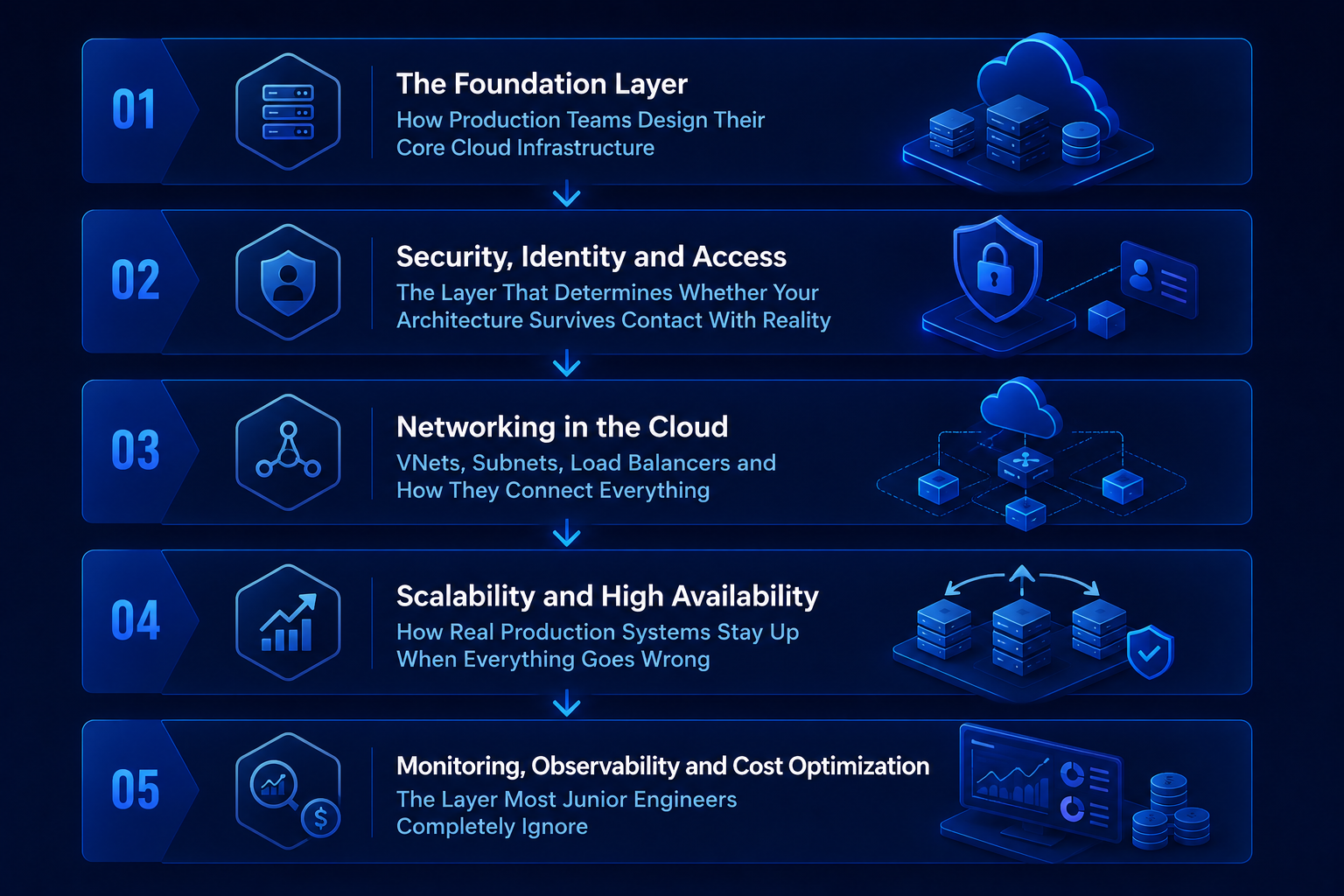
Networking in the Cloud — VNets, Subnets, Load Balancers and How They Connect Everything
Networking is essentially the means of communication for all cloud ecosystems. There are different aspects of networking that support secure communication for applications, databases, API, users, and even cloud-based solutions. Poor networking causes performance issues for cloud-based infrastructures. Production-based networking architecture relies on components such as virtual networks, subnets, firewalls, virtual private gateway connections, DNS services, routing tables, and load balancers.
This Cloud Computing Architecture ensures proper workload isolation as well as communication between components through a secure network. Network segmentation further enhances security while streamlining the operation. Large enterprises have an even greater need for networking due to the fact that many applications operate in different regions as well as different cloud ecosystems.
Networking engineers should carefully consider connectivity, routing, and traffic management to ensure consistent performance and create an optimal experience for teams and customers. Networking is particularly crucial for people planning to earn an aws cloud developer certification. Cloud-based applications require optimized and effective communication infrastructure. Networking professionals can design efficient cloud ecosystems that meet the needs of modern business applications.
Scalability and High Availability — How Real Production Systems Stay Up When Everything Goes Wrong
One significant difference between learning environment and production environment is that the system needs to keep running despite the presence of failures. There are cases where hardware would fail, there will be an outage in services, and users would have spikes in demands. Designers need to create a system that still runs despite all these problems.
Production Systems Utilize:
- Automated scaling services
- Load balancers
- Multiple zones deployment
- Backup and recovery solutions
- Disaster recovery solutions
- Databases replication
- Multiple redundant infrastructures
Most cloud computing programs focuses on the significance of scalability and high availability because these are vital concepts for real-life deployment. The corporation expects the software solution to be available despite any possible faults. People with knowledge in this area become more valuable for companies. High Availability itself is not merely a technical concept but a mandatory need of the company that impacts sales.
Monitoring, Observability and Cost Optimization — The Layer Most Junior Engineers Completely Ignore
One of the common mistakes of young engineers is that they consider deployment to be the final phase. But the cloud engineer knows that there are still a lot of things to be completed. Regular monitoring is necessary for infrastructure & application to ensure high performance, security, reliability, and availability. An immense quantity of data is generated during production, which requires adequate management.
Areas for Monitoring in Production Environments:
- Application performance
- Health of infrastructure
- Use of resources in the infrastructure
- Logging and log analysis
- Alerts and incident management
- Monitoring of security issues and potential threats
- Financial monitoring
- Capacity and workload optimization
People who have attended a cloud engineer online course already gained experience with monitoring applications and infrastructure, using various dashboard solutions, observability, alerting tools, etc. Cost optimization is another critical area because one can incur huge expenses without proper management of cloud resources. The most successful cloud engineering teams spend a lot of time analyzing the use of cloud services and optimizing the way applications run. Cloud engineers who are capable of monitoring, optimizing costs, and ensuring observability will always be highly valued.
How to Build Real Cloud Architecture Skills — The Learning Path That Actually Gets You Hired
Cloud engineers-to-be tend to concentrate only on gaining certificates yet find themselves at a loss if asked to design or fix production infrastructure. The employers look for people capable of utilizing their cloud engineering know-how to solve practical tasks, not just people who are good in exams. Architecture skills have to be formed with the help of systematic education combined with practical application.
The Practical Learning Strategy Looks Like That:
- Learning cloud basics
- Studying Cloud Computing Architecture
- Building your networking knowledge
- Learning cloud security principles
- Doing deployment tasks
- Specializing in azure developer certification
- Troubleshooting practices
- Putting together a portfolio of projects
Many people gain experience necessary to become successful in a matter of weeks by taking Cloud Engineer Courses that emphasize practical work. It is by means of practical work that you learn problem solving, architecture mindset and technical skills. These are exactly those qualities that make up what employers need in cloud experts.
Start Building Real Cloud Skills at Grras Solutions Today
Cloud migration is continuing to increase across all industries resulting in the need for professionals who can manage production-grade clouds. There is a need for cloud professionals who have the skill sets required for designing secure, scalable, and robust architecture that is able to meet the current business needs of organizations.
In order to become successful in your chosen career in cloud computing at Grras Solutions offers courses that will enable learners to gain practical experience through lab work, mentoring, project work, and industry-related training. Regardless of whether you are taking up Cloud Computing Courses For Beginners or aiming for a specific cloud job role, a structured learning process will allow you to apply the knowledge learned.
Courses such as Azure Infrastructure Solutions Course In Jaipur, along with other relevant cloud computing courses, enable learners to acquire job-related skills.





 Whatsapp us
 Call us
 Enquire Now