Cybersecurity has been entering a new era in the last few years as par technology advances, everyday .every pople and organization is facing multiple cyber attacks, which use AI systems and tools, launch smarter, faster and more convincing scams than before.
Among the biggest concerns today are AI generated Cyber threat and scams in rapidly rising, just like deepfake videos, mages etc.
Imagine getting a phone call from your bank, only it isn’t really them. Or receiving an email that looks and sounds exactly like your bank employee, asking you to transfer money.
These real-world scenarios are happening multiple times, and these types of AI-powered cyberattacks become nearly impossible to detect.
These topics we discussed about here :
- cybersecurity trends in 2026
- Which type of cybercrime is changing AI
- deepfake attacks
- Real-world impacts of these things
1. Evolution of Cybersecurity in the current time
Cybersecurity is not a protection of your password and device, but also about using antivirus software, etc. in 2026. These are the big threats
- Automated
- AI-powered
- Highly personalized
- Harder to detect
- More financially damaging
Modern cyberattacks can now:
- Mimic human behavior
- Create fake voices and videos.
- Bypass traditional security systems.
- Target individuals with precision
As AI technologies become more accurately perform cybercrime and creating phishing websites.
2. Why AI is Changing Everything in Cybersecurity
Artificial Intelligence has been used in both types of cybersecurity defence and cybercrime.
AI in Cybersecurity Defence:
Organizations now use AI for:
- Threat detection
- Malware analysis
- Fraud prevention
- Network monitoring
- Automated incident response
Ai- powered cyber threats and crime are frequently rising :
Cybercriminals are increasingly uses for ai powered trapes and sophisticated attacks.
AI-Generated Phishing Emails
In the last few years, traditional phishing emails often contained mistakes and suspicious language, but in 2026, AI tools generate :
- Perfect grammar
- Personalized messages
- Human-like communication
- Context-aware scams
Cybercriminal is give times in collection information and data for targeted persons and companies.
3. Why It’s Dangerous
These types of attacks are more efficiently accurate than their very head to identify the attacks.
AI-powered Malware: AI-powered malware can do this:
-
- Adapt its behavior
- Avoid detection
- Learn from security systems.
- Change attack patterns automatically
This type of traditional antivirus software is less effective in detecting this type of advance malware and phishing traps.
Key Concern: During this AI era, self-learning malware can evolve during an attack, making it harder to detect and stop
Deepfake Attacks: at this time, The Biggest Cybersecurity Threat of 2026
- At this time, cybercriminals can use Deepfake technology to create realistic fake:
- Videos
- Voice recordings
- Images
- Live video impersonations
- In 2026, deepfake attacks are becoming one of the most dangerous criminal these types of criminal doing blackmail and threaten to viral the video and photo etc.
Automated Hacking Tools: AI-powered hacking tools can do :
- Scan vulnerabilities automatically
- Crack passwords faster
- Launch attacks at scale
- Identify weak systems within minutes.
4. What is a Deepfake Attack?
A deepfake attack involves using AI-generated media tools to impersonate a real person.
Attackers can clone:
- CEOs
- Politicians
- Family members
- Celebrities
- Company executives
The goal is often:
- Financial fraud
- Identity theft
- Reputation damage
- Political manipulation
- Social engineering
5. Real-World Deepfake Threats
- Voice Cloning Fraud: In 2026, AI can now clone a person’s voice using only a few seconds of audio and voice.
For example, A finance employee receives a phone call that sounds exactly like the company employee, manager, or CEO requesting an urgent money transfer. - Fake Video Meetings: In 2026, technology can now create realistic fake video calls and meetings, with realistic voices during online meetings. Attackers may impersonate:
- Business executives
- HR managers
- Government officials
Risks
-
- Fake approvals
- Data theft
- Internal fraud
Political and Social Manipulation: These types of videos are spreading fake news and misinformation to change public opinion, etc.
-
- Fake speeches
- Election misinformation
- Social unrest
- Public panic
6. Cyber Security Trends in 2026
- Zero Trust Security: Organizations are adopting the “Never Trust, Always Verify” model.Key Features
-
- Continuous authentication
- Multi-factor verification
- Strict access control
- Device monitoring
AI-Powered Threat Detection: AI-based cybersecurity systems can:
-
- Detect unusual behavior
- Monitor network activity
- Predict attacks before they happen.
- Respond automatically
Benefits: Easily detect, fast response and improved protection against all types of modern threats.
- Biometric Security Growth: Passwords alone are becoming outdated.
- Businesses now increasingly use:
- Face recognition
- Fingerprints
- Retina scans
- Challenge: Deepfake technology is also targeting biometric systems.
- Cloud Security Expansion
- Focus Areas
- Face recognition
- Fingerprints
- Retina scans
- Focus Areas
- As businesses move to cloud platforms, cloud security becomes critical.
- Quantum Computing Threats: Quantum computing could eventually break current encryption methods.
- What Companies Are Doing
- Organizations are researching:
-
-
- Quantum-resistant encryption
- Next-generation cryptography
- Secure communication protocols
-
7. Industries Most Targeted by AI Cyber Threats
- Banking & Finance
- Fraud attacks
- Deepfake payment approvals
- Identity theft
- Healthcare
- Patient data theft
- Ransomware attacks
- Medical identity fraud
- Education
- Student data breaches
- AI-generated scams
- Research theft
- Government
- Espionage
- Misinformation campaigns
- Infrastructure attacks
- E-commerce
- Fake customer support scams
- Payment fraud
- Account takeovers
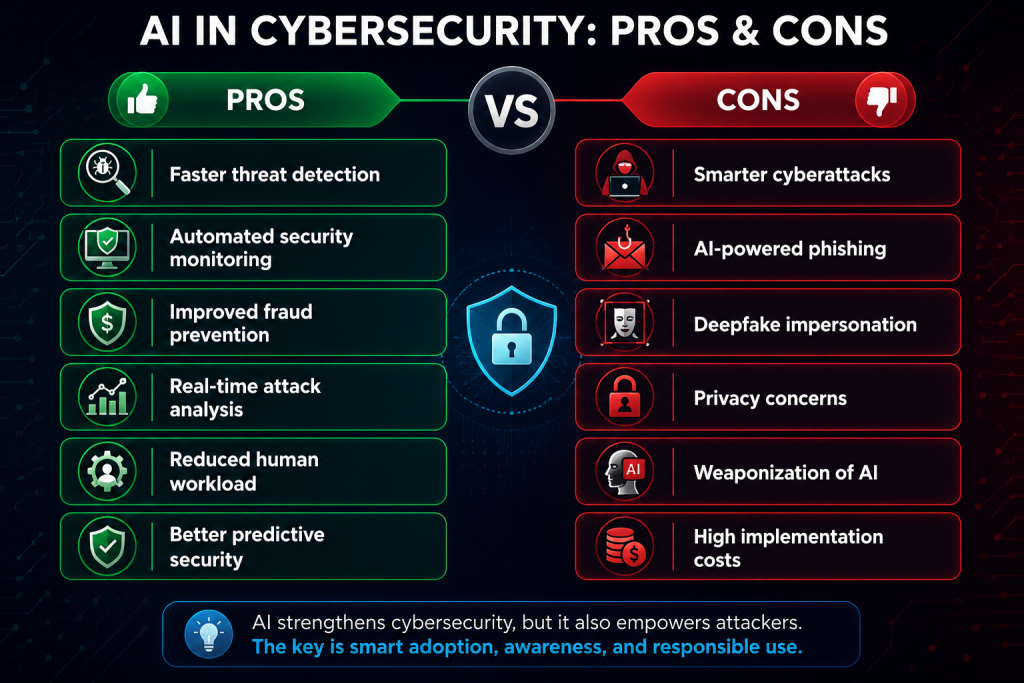
8. Pros and Cons of AI in Cybersecurity:
9. How Businesses Can Protect Themselves
- Employee Awareness Training: Employees should learn to:
- Identify phishing attempts
- Verify suspicious requests
- Detect fake communications
- MFA adds extra security layers using:
- OTP verification
- Biometric authentication
- Security apps
- Deepfake Verification Systems: Organizations are now implementing:
- Voice authentication
- Video verification tools
- AI deepfake detection systems
- Regular Security Audits: Companies should frequently test:
- Network vulnerabilities
- System weaknesses
- Access permissions
- AI-Based Security Tools: Modern security platforms use AI for:
- Threat intelligence
- Fraud detection
- Behavioral monitoring
- Automated response systems
- How Individuals Can Stay Safe: don’t use unwanted apps and don’t click unwanted links, etc.
- Verify Before Trusting: When you receive this type of call, consider whether others think it’s genuine or not.
- Protect Personal Information: don’t share your personal details like account numbers, important documents, etc.
- Use Strong Passwords: Always use strong passwords for all types of things, just like devices, Atm pin, etc.
- Enable MFA Everywhere: Especially for:
- Banking apps
- Email accounts
- Social media
10. Cybersecurity future: Cybersecurity in the future will become a constant battle between:
- AI-powered defense systems
- AI-powered attackers
Experts predict:
- More automated cyber warfare
- Smarter deepfake scams
- AI security assistants
The organization that survives the future cyber threats will be those types of things that quickly adapt to security systems.
FAQs For Cyber Security Trends in 2026: AI Threats & Deepfake Attacks
1. What are the biggest cybersecurity threats in 2026?
The biggest cybersecurity threats in 2026 include AI-powered phishing attacks, deepfake scams, automated hacking tools, ransomware, and self-learning malware that can bypass traditional security systems.
2. How is Artificial Intelligence changing cybersecurity?
Artificial Intelligence is transforming cybersecurity by improving threat detection, fraud prevention, malware analysis, and automated incident response. At the same time, cybercriminals are also using AI to create smarter and more convincing cyberattacks.
3. What is a deepfake attack in cybersecurity?
A deepfake attack uses AI-generated videos, voice recordings, or images to impersonate real people such as CEOs, employees, celebrities, or politicians for fraud, identity theft, blackmail, or social engineering scams.
4. Why are AI-generated phishing emails more dangerous?
AI-generated phishing emails are more dangerous because they use perfect grammar, personalized messaging, and human-like communication, making them harder to identify than traditional phishing scams.
5. Can traditional antivirus software stop AI-powered malware?
Traditional antivirus software often struggles against AI-powered malware because modern malware can adapt its behavior, avoid detection, and change attack patterns automatically during an attack.
6. What cybersecurity skills will be most important in 2026?
Important cybersecurity skills in 2026 include cloud security, threat intelligence, network security, SOC operations, AI-powered security systems, and ethical hacking. Certifications like CEH, CISSP, and CISM are also highly valuable.
Conclusion :
The cybersecurity landscape in 2026 is more advanced, more dangerous, and more unpredictable than ever before. Artificial Intelligence is creating powerful opportunities for innovation, but it is also enabling cybercriminals to launch highly sophisticated attacks.
Deepfake technology, AI-powered phishing, automated malware, and intelligent hacking tools are changing the nature of digital threats worldwide.
However, awareness, education, and modern security practices can help businesses and individuals stay protected.
The future of cybersecurity will not depend solely on technology — it will depend on how intelligently humans use it.



 Whatsapp us
 Call us
 Enquire Now