1. Introduction: Why 2026 Is a Turning Point for Data Science in India
Think about every time a company recommends a product to you, a hospital predicts a patient’s risk before symptoms appear, or a bank flags a suspicious transaction within seconds. Behind all of that is data science. And in 2026, this isn’t just a tech-sector story anymore — it’s happening across every industry in India.
India’s technology sector is on an extraordinary growth curve. Industry reports suggest the country’s tech ecosystem will cross ₹300 billion in revenue this year, with close to 9.5 million people employed in tech roles. But here’s the part that most people overlook: despite all that growth, over 82% of Indian companies say they cannot find data professionals who are truly job-ready.
That gap is your opportunity — especially if you’re a student, a fresh graduate, or a working professional thinking about a career shift. But seizing it requires more than just watching tutorials. It requires the right roadmap, the right skills, and the right training environment.
That’s exactly what this guide is about.
2. Data Science: Why It’s More Relevant Than Ever in 2026
Over the last few years, the role of data scientist has radically changed. These folks have traditionally been the ones cleaning up legacy data and creating backwards-looking spreadsheets. In 2026, the corporate expectations are entirely different.
Data scientists today are expected to design predictive systems, build autonomous software agents, and fine-tune large language models (LLMs) to automate complex tasks. Three major tech shifts are driving this transformation:
1. The Generative AI Scale-Up:
Companies have moved from experimenting with Generative AI to deeply integrating it into their operations. From customer support bots to AI-generated reports and code, GenAI tools require high-quality, structured data to function well. Data scientists are now the people who make that happen — cleaning, structuring, and pipeline-building that feeds these systems.
2. Agentic AI Systems:
Software is becoming increasingly autonomous. Agentic AI systems can analyse data in real time, plan multi-step actions, and execute decisions without constant human input. Building and maintaining these systems requires professionals who deeply understand data flows, model reliability, and system design.
3. The Rise of Regional IT Hubs:
Bengaluru and Hyderabad are no longer the only cities driving India’s tech growth. Jaipur is establishing itself as a genuine regional IT hub, with clusters forming in Malviya Nagar, Mansarovar, and Sitapura Industrial Area. Both national and local companies are actively hiring data professionals who can hit the ground running.
3. The Current Data Science Landscape in India
Here is the reality of the Indian data job market in 2026: there are more open positions than there are qualified people to fill them.
Industry research indicates a skills shortfall of 60–73% in Machine Learning and Data Science roles. Companies have responded by changing how they hire. Today, 80% of Indian tech firms prioritise demonstrated technical skills and real-world project experience over academic credentials and degrees.
What that means in practice: a candidate with a strong GitHub portfolio, hands-on project experience, and the ability to deploy a machine learning model on cloud infrastructure is far more hireable than someone with a prestigious degree but no practical output.
Entry-level salaries reflect this, too. Companies are willing to pay a premium on day one for people who are genuinely ready to work, not those who need six months of internal training before they can contribute.
4. Step-by-Step Data Science Career Roadmap
Becoming a data scientist is not about memorising algorithms. It’s about building a layered set of skills — mathematical reasoning, programming fluency, domain knowledge, and engineering discipline — that come together to solve real business problems.
Here is a structured four-phase path that takes you from beginner to job-ready professional.
Phase 1: Introduction to Statistics, Maths & Databases
Before complex algorithms are employed, a practitioner needs to understand how the data behaves. Here is the beginning of developing mathematical fluency:
1. Linear Algebra & Calculus:
Necessary for understanding optimisation algorithms like gradient descent used in neural networks. You need to know about matrix transformations, vector spaces and partial derivatives.
2. Inferential Statistics:
Learn to draw correct inferences from noisy data. Understand hypothesis testing, p-values and confidence intervals, and probability distributions.
3. SQL & Relational Databases :
Enterprise data is never clean, never well-structured. Professionals need to understand how to write optimised SQL queries, handle complex joins, use Technicalwindow functions, and effectively manage database schemas.
Phase 2: Core & Data Management Building
Programming is the primary method of handling data. At this phase, data storage moves to active manipulation.
Python is the universal language of data science. Focus on writing clean, readable code. Understand object-oriented programming principles and how to structure scripts for real-world use.
2. Data Manipulation Libraries:
NumPy handles numerical operations efficiently. Pandas is your primary tool for data cleaning, filtering, reshaping, and merging datasets. You will use these libraries every single day.
3. Exploratory Data Analysis (EDA) & Visualisation:
EDA is the practice of deeply understanding your dataset before modelling. Use Matplotlib and Seaborn for in-code visualisation, and tools like Power BI and Tableau for building dashboards that communicate insights to non-technical stakeholders.
Phase 3: Machine Learning & Deep Learning in Action
Once you get your head around data management, the next level is to create systems that learn from historical data by themselves:
1. Supervised Learning:
Master regression algorithms like Linear and Polynomial Regression for numerical predictions, and classification algorithms including Logistic Regression, Decision Trees, and Gradient Boosting Machines for categorical outcomes.
2. Unsupervised Learning:
Learn clustering techniques like K-Means and dimensionality reduction methods like Principal Component Analysis (PCA) to find hidden patterns in unlabelled data.
3. Metrics for Model Evaluation:
Knowing how to build a model is only half the job. Knowing when to use Precision vs Recall, F1-Score, ROC-AUC, or Mean Absolute Error (MAE) based on business context is what separates good data scientists from great ones.
4. Deep Learning Foundations:
Get hands-on with Neural Networks using PyTorch and TensorFlow. Understand how layers, activations, and backpropagation work before moving to advanced architectures.
Phase 4: Modern Data Engineering and MLOps/LLMOps
In 2026, it’s uncommon for data professionals to have the opportunity to have models sit on a local machine. Models need to be deployed in live, scalable environments.
1. Version Control:
Every professional data team uses Git. Learn to track changes, collaborate on branches, manage pull requests, and maintain a clean, documented GitHub portfolio.
2. Cloud Infrastructure & Containers:
Containerise applications using Docker and deploy them on cloud platforms such as AWS, Azure, or Google Cloud Platform. These are standard requirements in job descriptions today.
3. Machine Learning Operations (MLOps):
MLOps tools like MLflow help you manage the full machine learning lifecycle — experiment tracking, model versioning, and building CI/CD pipelines for continuous deployment.
5. Data Science jobs, salary and market demand
The Indian data job market is competitive but rewarding. Here is a breakdown of what different roles pay at various experience levels, along with the core technologies each requires:
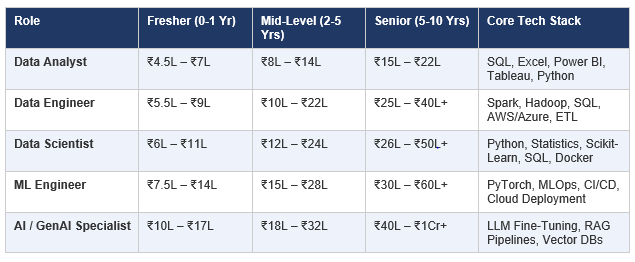
One thing worth noting: the gap between roles is closing at the senior level. A senior ML Engineer or GenAI Specialist with strong deployment skills now routinely commands packages that were once reserved for engineering leadership. In Rajasthan specifically, Data Engineers and Data Analysts are among the most in-demand roles as local industries — from manufacturing to logistics — begin automating their data operations.
6. The Data Science Job Market: A Guide for Different Audiences
One of the most common misconceptions about data science is that it’s only for computer science graduates. The reality is very different. Here is how people from various starting points can enter the field:
College Students & Freshers (BCA, B.Tech, B.Sc):
Fresh graduates face one clear challenge: a gap between academic learning and industry expectations. The curriculum at most colleges covers theory, but companies want proof of practical ability. To stand out, freshers should focus on building projects they can host on GitHub, participating in data competitions (Kaggle is a great starting point), and pursuing internships that simulate real work environments.
Working professionals and career switchers :
If you come from fields like quality assurance, core engineering, finance, or manufacturing, you already have something many pure data science candidates lack — domain expertise. The ability to understand a supply chain, a production process, or a financial system is genuinely valuable when combined with Python, SQL and machine learning skills. Career switchers who build this combination often find themselves in very strong positions for industry-specific data roles.
Career Returns & Homemakers
The data profession is one of the most flexible in tech. Freelance and remote work are now mainstream, and many organisations are actively building distributed data teams. For professionals returning to the workforce after a break — whether to raise a family or for any other reason — data science offers a structured, learnable path back into a high-demand career.
7. How GRRAS Helps You Build a Real Data Science Career
Watching videos online can teach you concepts. But getting hired requires something more: structured mentorship, real project experience, and an understanding of what the job market actually looks for. That is the gap GRRAS Solutions Private Limited has been bridging for students and professionals across Rajasthan and North India.
GRRAS doesn’t just teach data science — it trains people to work in it. Every program is built around what companies are actively hiring for in 2026, not what was relevant five years ago.
1. Hands-On Project Design:
At GRRAS, you don’t just read about algorithms — you use them. Students work with real-world datasets, build automated data pipelines, and deploy machine learning models on cloud infrastructure. By the time you complete the program, you will have a professional GitHub portfolio with tangible projects that you can walk a hiring manager through.
2. Complete Classroom and Digital Learning:
GRRAS understands that every learner has different constraints. The institute offers offline classroom sessions at its centres in Gopalpura Bypass and Amrapali Marg, Vaishali Nagar in Jaipur, as well as live online training for working professionals and students who cannot commute. Weekend and weekday batches are available.
3. Mentorship and Placement Ecosystem
The technical skills are only part of what employers evaluate. GRRAS runs a dedicated placement cell with active connections to IT companies, manufacturing groups, and startups across Jaipur, Delhi-NCR, and other tech corridors. Students receive structured career guidance, including professional resume building, GitHub profile optimisation, and regular mock technical interviews — so they walk into the hiring process prepared, not nervous.
8. FAQs – Frequently Asked Questions
Q1: Can someone from a non-technical background learn Data Science?
Answer: Absolutely. Data Science is not exclusive to computer science graduates. People from commerce, economics, engineering, and business backgrounds have gone on to successful data careers. The key is a willingness to learn statistics, Python programming, and analytical problem-solving — and to combine that with the domain knowledge you already have.
Q2. How long does it take to become job-ready in Data Science?
For someone starting from scratch, consistent daily study over 6–9 months is typically enough to reach a job-ready level. That timeline covers statistics, Python and SQL programming, machine learning fundamentals, and building a portfolio of real projects. The more structured and hands-on the training environment, the faster the progress.
Q3:Why do companies prefer portfolios over certifications?
A certificate tells an employer you attended a course. A portfolio tells them you can actually solve problems. In 2026, technical hiring at most Indian companies includes reviewing a candidate’s GitHub, assessing how they handle unstructured data, and running them through live coding challenges. A certificate helps, but a strong portfolio is what actually opens doors.
Q4. What is the difference between a Data Analyst and a Data Scientist?
A Data Analyst typically works with structured data using tools like SQL, Excel, and Power BI to explain what has already happened in a business. A Data Scientist goes further — using Python programming, advanced statistical models, and machine learning to predict future outcomes, automate decision-making, and build intelligent systems.
Q5.Are there good Data Science job opportunities in Jaipur?
Yes, and they’re growing. Jaipur’s tech ecosystem has expanded significantly, with analytics firms, digital transformation agencies, and startups setting up in areas like Sitapura Industrial Area, Mansarovar, and Malviya Nagar. Beyond local hiring, many Jaipur-based data professionals also work remotely for companies across India and abroad. The city is no longer just a stepping stone — it is a destination in its own right.
9. Conclusion
Data science in 2026 offers something rare: a career path that is both in high demand and genuinely future-proof. The convergence of Generative AI, Agentic AI systems, and cloud-native infrastructure means that skilled data professionals will only become more valuable in the years ahead.
But the keyword is skilled. A degree alone will not land you the job. What companies want — and what they are willing to pay well for — is someone who can build, deploy, and improve real systems. Someone who can hand over a working model, not just a certificate.




 Whatsapp us
 Call us
 Enquire Now