In the modern digital landscape, data has become one of the most valuable assets for organizations across the globe. Businesses are generating massive volumes of data every day, and the ability to extract meaningful insights from this data has become a critical competitive advantage. This is where Data Science and Machine Learning come into play.
From personalized recommendations on streaming platforms to predictive analytics in healthcare and finance, these technologies are reshaping industries and redefining how decisions are made. As a result, Data Science and Machine Learning have emerged as some of the most sought-after fields for students and professionals alike.
1. Understanding Data Science:
Data Science is an interdisciplinary field that combines statistics, computer science, and domain knowledge to analyze and interpret complex data. It involves a series of processes that transform raw data into valuable insights that can guide strategic decisions.
The key stages of Data Science include:
- Data collection from various sources such as databases, APIs, and web scraping.
- Data cleaning and preprocessing to ensure quality and consistency.
- Exploratory Data Analysis (EDA) to understand patterns and trends.
- Data visualization to communicate findings effectively.
- Model building and evaluation.
2. Understanding Machine Learning:
Machine Learning is a subset of Artificial Intelligence that focuses on building systems capable of learning from data and improving their performance over time without being explicitly programmed.
Instead of relying on predefined rules, Machine Learning models identify patterns within data and use them to make predictions or decisions. These models are trained using historical data and can generalize their learning to new, unseen data.
Machine Learning can be broadly categorized into:
- Supervised Learning: Models are trained on labeled data (e.g., regression and classification).
- Unsupervised Learning: Models identify patterns in unlabeled data (e.g., clustering).
- Reinforcement Learning: Models learn through interaction with an environment.
3. Relationship Between Data Science and Machine Learning:
While Data Science and Machine Learning are often used interchangeably, they serve different but complementary purposes.
- Data Science focuses on data processing, analysis, and interpretation.
- Machine Learning focuses on building predictive models using that data.
4.Essential Skills for Data Science and Machine Learning:
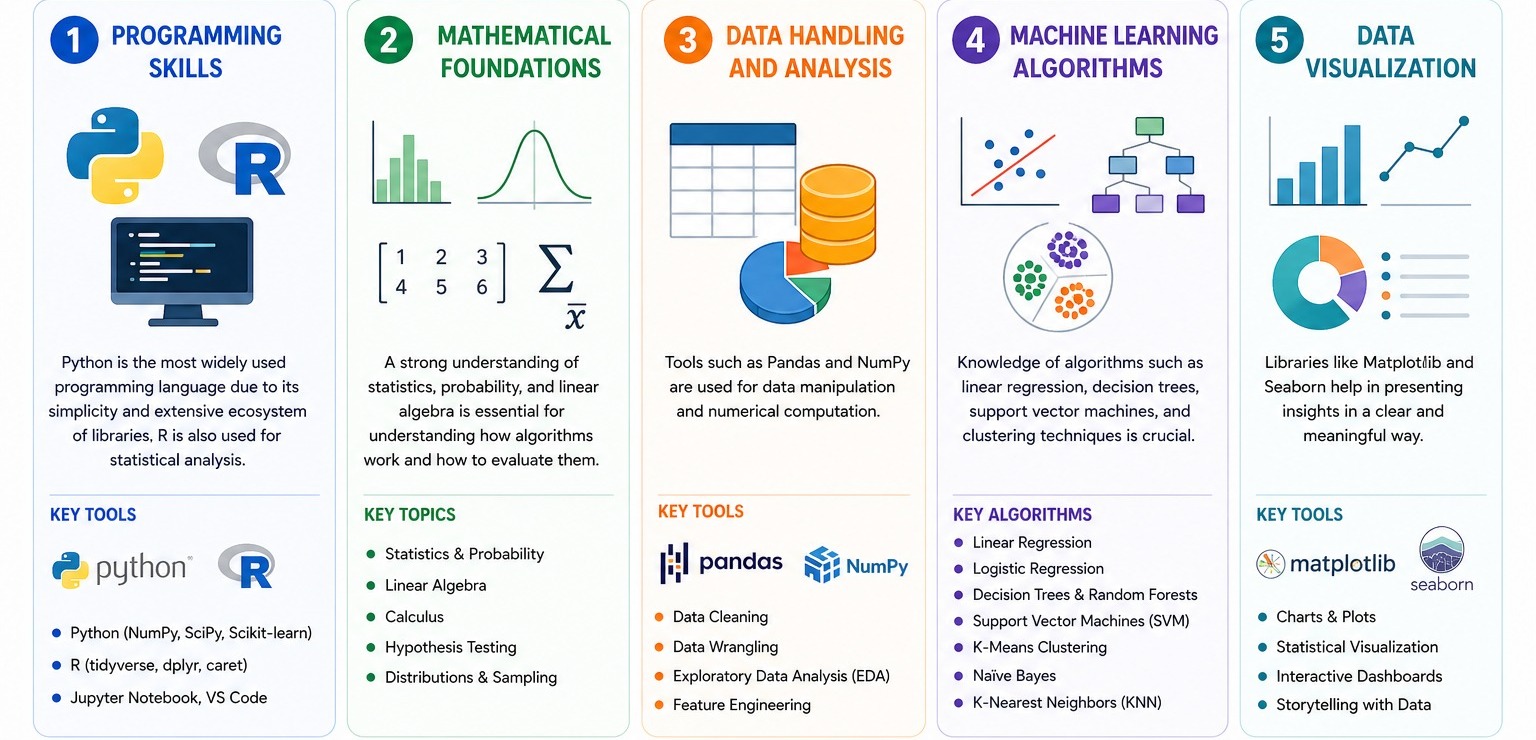
5. Practical Learning and Industry Exposure
One of the most important aspects of mastering Data Science and Machine Learning is hands-on experience. Practical exposure allows learners to understand real-world challenges and apply theoretical concepts effectively.
A well-designed learning program generally includes:
- Working with real-world datasets.
- Performing data preprocessing and feature engineering.
- Building and training machine learning models.
- Evaluating model performance.
- Deploying models into production environments.
6. Tools and Technologies Used:
Professionals in this domain use a wide range of tools and technologies, including:
- Python and Jupyter Notebook for coding and experimentation.
- Pandas and NumPy for data manipulation.
- Scikit-learn for implementing machine learning algorithms.
- TensorFlow and Keras for deep learning applications
- Visualization tools such as Matplotlib, Seaborn, and Plotly.
- Deployment tools like Flask and Stream-lit.
7.Career Opportunities in Data science in Data science and machine learning:
The demand for skilled professionals in Data Science and Machine Learning continues to grow rapidly across industries such as healthcare, finance, retail, and technology.
Some of the most popular career roles include:
- Data Scientist
- Machine Learning Engineer
- Data Analyst
- Artificial Intelligence Engineer
- Business Intelligence Analyst
8. Importance of Internship and Structures Programs:
Internships play a crucial role in bridging the gap between theoretical knowledge and practical application. A structured Data Science and Machine Learning internship typically provides:
- Hands-on training with real-world projects
- Guidance from industry experts
- Exposure to industry tools and workflows
- Certification that adds value to a professional profile
- Placement assistance and career support
9. Conclusion:
Data Science and Machine Learning have become integral to modern technology and business operations. They enable organizations to make smarter decisions, automate processes, and deliver personalized experiences.
For individuals, this field offers a dynamic and rewarding career path with immense growth potential. By acquiring the right skills, gaining practical experience, and working on real-world projects, anyone can build a successful career in Data Science and Machine Learning.
Whether you are a student, a fresher, or a working professional looking to upskill, now is the perfect time to explore this field and take advantage of the opportunities it offers.





 Whatsapp us
 Call us
 Enquire Now