In the modern digital era, mobile applications have become an essential part of business growth and user engagement. From startups to large enterprises, organizations are constantly investing in mobile solutions to enhance their reach and improve customer experience. However, developing separate applications for Android and iOS platforms can be time-consuming and expensive. This challenge has led to the rise of cross-platform frameworks, and among them, Flutter has emerged as one of the most powerful and efficient solutions.
1.What is Flutter?
Flutter is an open-source UI software development kit (SDK) developed by Google. It enables developers to create high-performance, natively compiled applications for mobile, web, and desktop platforms using a single codebase. Unlike traditional frameworks that rely on native components, Flutter uses its own rendering engine to design user interfaces, ensuring consistency across different platforms.
Flutter is powered by the Dart programming language, which is optimized for building fast and scalable applications. The framework is built around the concept of widgets, which are the building blocks of a Flutter application. These widgets allow developers to create complex and visually appealing user interfaces with ease.
2.Why Flutter is Becoming the Preferred Choice
Flutter has gained significant popularity in recent years due to its numerous advantages over traditional development approaches. Some of the key reasons behind its widespread adoption include:
- Single Codebase for Multiple Platforms: One of the most important advantages of Flutter is that it allows developers to write a single codebase and deploy it across multiple platforms such as Android and iOS. This significantly reduces development time and cost while maintaining consistency in performance and design.
- Faster Development with Hot Reload: Flutter’s hot reload feature allows developers to instantly view changes made to the code without restarting the application. This accelerates the development process, making it easier to experiment, fix bugs, and refine the user interface in real time.
- Rich and Customizable User Interface: Flutter provides a comprehensive set of pre-designed widgets and tools that enable developers to create highly customizable and attractive user interfaces. These widgets follow modern design principles such as Material Design and Cupertino, ensuring a native-like experience.
- High Performance: Flutter applications are compiled directly into native code, which eliminates the need for an additional bridge between the app and the platform. As a result, Flutter apps deliver smooth animations and fast performance comparable to native applications.
- Strong Community and Ecosystem: Flutter has a rapidly growing community and extensive documentation, making it easier for developers to find resources, plugins, and support. Continuous updates from Google further enhance its capabilities and reliability.
3.Core Skills Required for Flutter Development:
To build a successful career in Flutter mobile app development, developers need to acquire a combination of programming knowledge and practical experience. Some of the essential skills include:
- Proficiency in Dart programming language
- Understanding of Flutter widgets and UI design
- Knowledge of state management techniques such as Provider, Riverpod, or Bloc
- Experience with REST API integration
- Familiarity with backend services like Firebase
- Version control using Git and GitHub
- Knowledge of app deployment processes for Android and iOS
Structured learning programs, such as the Flutter Mobile App Development Internship offered by GRRAS Solutions, are designed to help learners gain these skills through a combination of theoretical knowledge and hands-on practice.
4.Learning Path in Flutter Development:
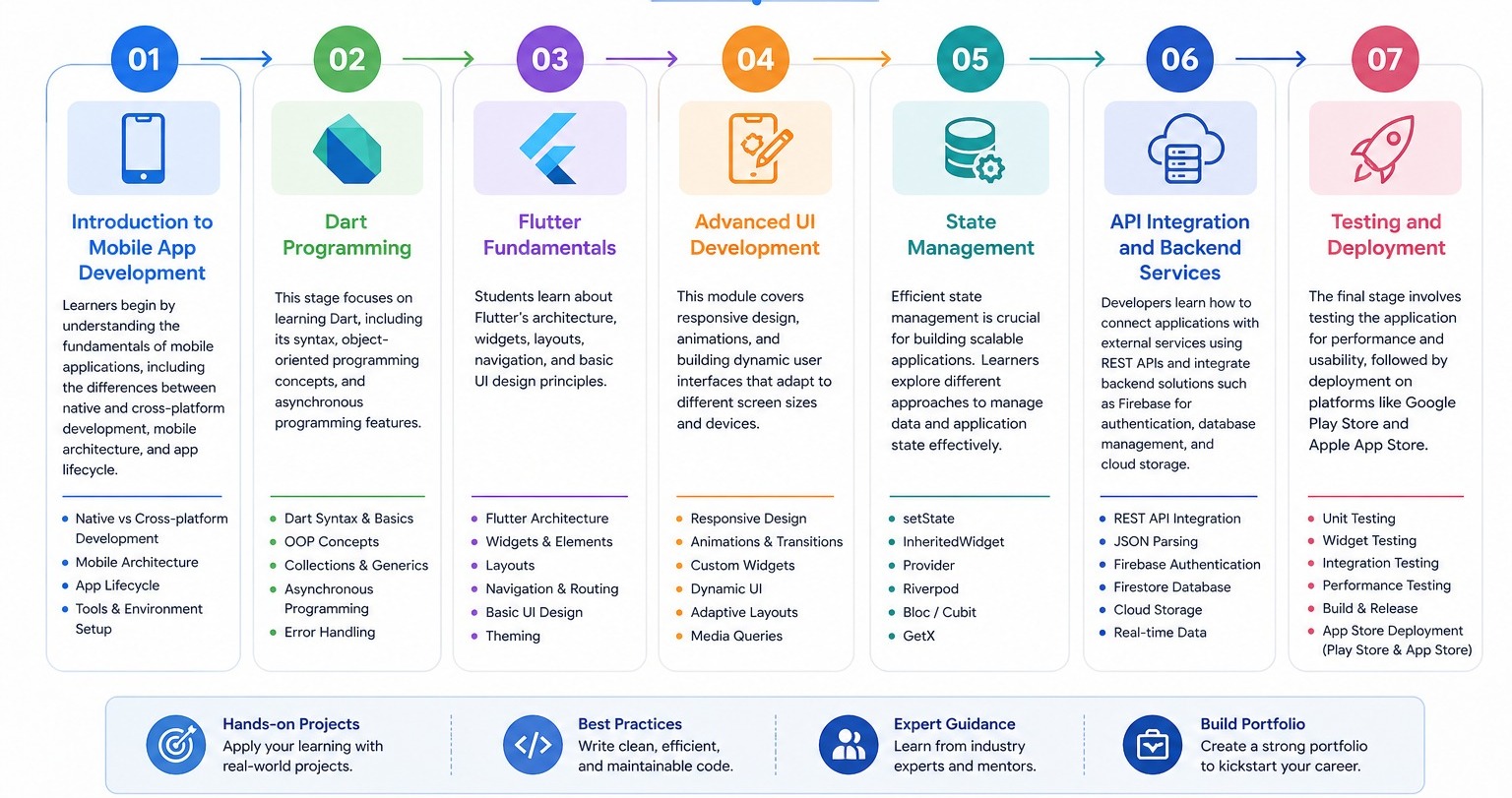
5. Practical Applications of Flutter
Flutter is widely used across various industries due to its flexibility and efficiency. Some common applications include:
- E-commerce platforms with seamless user experiences
- Healthcare applications for patient management and remote monitoring
- Financial technology (FinTech) apps for secure transactions
- Social networking applications with real-time features
- Educational apps for online learning and training
Its ability to deliver high-quality performance and visually appealing interfaces makes it suitable for both simple and complex applications.
6. Importance of Internships in Flutter Development
While theoretical knowledge is important, practical experience plays a crucial role in becoming a proficient developer. Internships provide an opportunity to apply learned concepts in real-world scenarios. A structured internship program offers:
- Hands-on experience with live projects
- Exposure to industry tools and workflows
- Guidance from experienced mentors
- Opportunities to build a professional portfolio
- Improved problem-solving and coding skills
The Flutter internship program by GRRAS Solutions focuses on project-based learning, enabling students to work on real applications and gain industry-relevant experience.
7. Career Opportunities in Flutter
The demand for Flutter developers is steadily increasing as more companies adopt cross-platform solutions. Career opportunities in this field include:
- Flutter Developer
- Mobile Application Developer
- Cross-Platform Engineer
- UI/UX Developer
- Software Engineer specializing in mobile technologies
With the growing adoption of Flutter, professionals with expertise in this framework are highly valued in the job market.
8. Future Scope of Flutter
Flutter is continuously evolving and expanding beyond mobile app development. It is now being used for web applications, desktop software, and even embedded systems. With strong backing from Google and an active developer community, Flutter is expected to play a significant role in the future of software development.
9.Conclusion
Flutter has transformed the way mobile applications are developed by offering a fast, efficient, and cost-effective solution for cross-platform development. Its ability to deliver high performance, combined with a rich set of features, makes it an ideal choice for developers and businesses alike.
For individuals looking to build a career in mobile app development, learning Flutter and gaining hands-on experience through structured training and internships can open the door to numerous opportunities in the technology industry.




 Whatsapp us
 Call us
 Enquire Now