Introduction
Remember the last time you ordered an Uber, looked at your Netflix dashboard, or checked your social media feed? The transitions were smooth, the page didn’t refresh every other second, and the data was live.
These slick digital experiences are driven by Frontend Development, which employs a powerful JavaScript library known as React.js.
Whether you are a student in Jaipur who is looking for a future-proof career, a professional looking to change industries or a fresh graduate trying to make sense of the competitive job market in India, knowing this ecosystem is your ticket to a high-growth career. In this guide, you will learn all you need to know to become a frontend developer with React.js – from the basics to getting a job in the real world.
1. What is front-end development?
Every website or web application has two main parts: the backend and the frontend. The server, the database and the hidden logic are in the backend. The Frontend is the part of the application that the user sees, clicks, touches and interacts with directly in a web browser. It’s the e-commerce site for a company.
Until now, websites were built with just basic HTML ( architecture ) , CSS ( design ) , and simple JavaScript ( simple animations ) . But then users began requesting very interactive web applications (think Google Docs or interactive dashboards), and the traditional tools just became too slow and cumbersome to manage. The complexity gave rise to modern libraries and frameworks.
2. Why React.js is the Standard in Modern Web Development
Meta (formerly Facebook) created React.js in 2013, and it changed the way developers approach designing user interfaces. React doesn’t think of a web page as one big document, but as a collection of small, reusable components.
Core Concepts Simplified
A. Component-Based Architecture (The LEGO Analogy)
Imagine you’re building a toy house out of LEGO bricks. When the roof breaks, you don’t throw out the whole house, you just replace or repair the roof brick.
Exactly the same way React works. A webpage consists of Components (such as a search bar, a login button, a navigation menu). Each part is written independently and could be reused on different parts of the app. This saves time, there are fewer bugs and huge applications are incredibly clean to manage.
B. The Virtual DOM (Velocity & Efficiency)
To know why React is fast, we have to know how browsers render pages. The DOM ( Document Object Model ) is the tree of objects that the browser constructs and uses to display a page.
In traditional development, if even one piece of data changes (say a new comment appears on a post), the browser often re-renders the entire page. This is slow and takes a toll on device performance.
React uses something called the Virtual DOM. Virtual DOM is a lightweight copy of the actual DOM in memory.
[Data Update] —> [Virtual DOM Fast update] —> [Diff] —> [Real DOM change only changed element]
React updates the Virtual DOM when data changes and figures out what changed in which component. It then updates *only* that one item in the real browser DOM. The result? Lightning-fast web apps
C. JSX (JavaScript and XML)
React uses JSX which is a mixture of structure and logic. It allows developers to write HTML-like code in their JavaScript files. This means you can write code much more easily, combining your design and your functional logic.
3. Industry demand & career scope in India
India’s digital economy has grown at a fast pace, and tech hubs have emerged from Bengaluru to local startup ecosystems right here in Rajasthan. Companies are ditching legacy systems and rewriting their front-end apps with React.js.
Market Statistics & Demand
Surveys of developers from all over the world show that React.js is still among the most popular web frameworks and libraries on the planet.
A quick search on the top Indian job portals shows tens of thousands of active openings that specifically mention React.js skills.
Career Paths:
Once you learn React.js, you’ll be able to access many different job titles:
Frontend Developer. Implementation of User Interface and User Experience.
Full-Stack Developer: React frontend with backend technologies like Node.js, Python or Java.
UI Engineer: Specialist in micro frontends, design systems & highly interactive components.
Salary in India (2026)
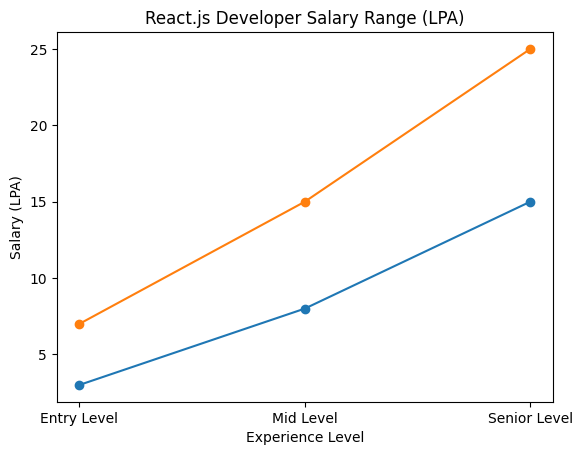
Salaries in the IT industry can be very variable depending on location, skills and experience. Average salaries of React developers in the market are:
Experience:
Fresher / Entry Level (0-1 Years) ₹3.5LPA – ₹6LPA
Mid Level Developer (2-5 Years) 7LPA – 15LPA
Senior Developer / Lead (5+ Years) – ₹16LPA – ₹30LPA+
4. Who Can Learn React.js?
A common misconception with software development is that you need a very technical engineering degree, and a four-year one at that. Now the tech industry values practical skills over credentials: Freshers (B.Tech, BCA, B.Sc, B.Com): If you are a graduate and feel that your college curriculum is not in line with the industry requirements, then learning React can immediately bridge that gap.
- Career Switchers: If you’re in sales, operations, banking or some other field, you can make the transition to tech. React has a large community and a well-defined learning curve, making it an ideal starting point.
- Working Professionals: If you are a backend developer or a traditional HTML/CSS web designer, add React to your skill-set and you can significantly increase your market value and salary brackets.
- Homemakers & Returning To Work: Very flexible in front-end development. Many React developers work remotely from home or take freelance projects from clients worldwide.
5. Building This Career with Assistance from GRRAS
In order to become a frontend developer, you need structured practice, real-life debugging experience, and professional mentorship. For more than a decade now, GRRAS Solutions Pvt. Ltd. has been helping the students of Jaipur and North India to bridge the gap between academic theory and real industry expectations.
Here is the structure of our training methodology to support your success:
- Project-based Approach: No passive video watching or syntax memorisation. Build real-world apps to learn React, like checkouts in e-commerce, real-time dashboards, and more, just like you would in a real tech company.
- Core Foundation Full: Before we get into React, we ensure you have strong core fundamentals in Native JavaScript (ES6+ features like array methods, promises and async/await) and responsive CSS. Without these learnings, React is actually really tough. Blended Learning Environments Students in Rajasthan will enjoy the best of both worlds with fully equipped physical labs at our Jaipur centres for direct face-to-face mentorship, and flexible digital resources to work around their schedule.
- Career Readiness Framework: Our programs include technical source code, but also dedicated interview prep, resume optimisation for automated HR screening tools (ATS), and mock technical evaluations. This is an end-to-end approach that will prepare you to discuss your project architecture in competitive corporate hiring rounds.
6. Concluding Remarks
Front-end development is no longer just about making pretty websites. It’s about building very scalable, high-performance software applications that run right inside the user’s browser. This paradigm shift is still very much the heart of React.js.
If you’re trying to get that first job out of college or make a massive career change, learning the React ecosystem is one of the safest bets you can make for your professional future.
FAQ (Frequently Asked Questions)
Q1. React.js is a library or a framework?
React.js is an open-source JavaScript library and not a framework technically. It only handles the “View” layer of an application (what the user sees). Unlike full frameworks such as Angular, React doesn’t come bundled with routing or state management. You pick your own preferred tools to round out the rest of your application stack.
Q2: Do I need to learn JavaScript before learning React?
“But of course. If you want to learn React without good knowledge on Javascript, this is a common mistake. A working knowledge of the basics of Javascript is required. You should be familiar with modern ES6+ features like Arrow Functions, Destructuring, Modules (import/export) and Array Methods .map(), .filter().
Q3: How long does it take to learn React.js and get a job?
A dedicated newbie usually takes 3-6 months of regular practice to learn HTML, CSS, JavaScript and React.js to the level that they can build confident independent applications and pass entry level frontend developer interviews.
Q4: Do you have demand of React.js developer?
In fact, yes. React.js is still the most used front-end technology in the industry. React is still powering core web interfaces at startups to big enterprises with its huge ecosystem, stability and backing from Meta.
Q5: Is jaipur is good city for frontend job or I need to shift to metro cities?
Definitely you can start your career in Jaipur itself. The city has many IT zones like Malviya Nagar, Mansarovar, Sitapura and the Mahindra World City SEZ which houses many software developing companies and agencies. Many companies also provide talented React developers the opportunity to work remotely on a permanent basis.




 Whatsapp us
 Call us
 Enquire Now