This is a puzzle even for seasoned DevOps experts – when OpenShift is constructed using Kubernetes, why are these two technologies treated separately by the market in terms of expertise? The truth behind this puzzle reveals a crucial point that goes beyond the assumptions people make about enterprise infrastructure in general. Knowing the distinction between kubernetes certifications and red hat openshift course certification is critical not only from a professional perspective but also in terms of your future career growth in the area of DevOps/cloud engineering, because it influences the choice of companies you will be working for and projects you’ll be participating in for the next three years. Here is the clear and most practical comparison in the blog post form.
What Does Kubernetes Mean and Why It Matters
It is the widely used technology in container orchestration is Kubernetes, which makes it works to scale, deploy and manage containerized applications. Kubernetes was firstly developed by Google however, today it is managed by Cloud Native Computing Foundation (CNCF). The main use of the technology is to automate the numerous routine operations performed in the course of application deployment, which makes it an indispensable element of modern cloud native environments. Now, all the companies use Kubernetes for developing reliable, scalable and highly available applications.
Thus, it is not just only another tool for DevOps professionals – it has become an inevitable part of the professional life of a DevOps engineer. For those companies that give microservices and cloud-native architectures, a need arises for certified kubernetes administrator professionals with experience in managing clusters, automation of deployments, workload monitoring and problem-solving in a production environment. Therefore, kubernetes certifications have become increasingly valuable for people who seek to work as cloud engineers, platform engineers or DevOps engineers.
Enrolment in a kubernetes course is the most effective method to learn Kubernetes if you want to build a career in the field of DevOps or simply to enter the cloud world.
What Is OpenShift and How It Different From Plain Kubernetes
OpenShift is a platform for Kubernetes by Red Hat which gives the power of Kubernetes by providing developer tools, enhanced security, monitoring, operations automation and enterprise grade support. Although Kubernetes offers the basic engine for container orchestration, OpenShift offers everything in the form of a full-fledged application platform. One of the most notable distinctions between OpenShift and Kubernetes is that OpenShift takes into account the ease-of-use within enterprises.
With its built-in image registry, CI/CD functionalities, RBAC, logging and monitoring and automated cluster management, OpenShift reduces the need for additional configuration and enables a quicker production setup than a typical Kubernetes set up would. For these reasons of enterprise grade capability, OpenShift is used by many enterprises in finance, health care, telecommunication, manufacturing and government sectors.
Individuals who successfully complete red hat openshift course or openshift certification course will be experts in handling enterprise Kubernetes platforms, thus becoming a very valuable asset in organizations that use Red Hat products. Red Hat Openshift Training may prove to be extremely beneficial for individuals wishing to establish themselves in the field of enterprise cloud infrastructure. For learners seeking classroom-based instruction, a redhat openshift course in Jaipur is a good choice for them.
Difference in Architecture, Features and Flexibility
Even though the OpenShift is a product that co-operates on top of Kubernetes, these two software platforms have different uses. Kubernetes is a container orchestration open-source software that allows the highest level of flexibility and customization. Thus, organizations seeking maximum flexibility of the IT infrastructure use it. In turn, OpenShift is an enterprise-ready platform that provides tools for automated deployment of applications in production environment with minimal setup.
Kubernetes and OpenShift Difference
- Software Type: Kubernetes is an open-source orchestration platform, and OpenShift is Red Hat enterprise version of this.
- Application Deployment: Kubernetes needs manual setting up of monitoring, logging, networking and image registries, while all are included in OpenShift.
- Flexibility: Kubernetes is more customizable than OpenShift that aims at simplification of enterprise deployment of applications through standardization.
- Learning path: professionals usually start with a kubernetes course and then continue with a red hat openshift course.
Kubernetes and OpenShift can be considered as products that have the same base but used in different situations depending on specific requirements.
Security and Compliance — Where OpenShift Pulls Ahead
Another important factor is the high level of security in favor of using OpenShift rather than regular Kubernetes. Although Kubernetes has a number of security features, most of them need to be manually configured. OpenShift offers a variety of enterprise-class security features right out of the box, minimizing efforts and complying with regulations.
One of the key benefits of OpenShift is the ability of being secure by default. The platform automatically implements security policies, role-based access control, container isolation and image security practices that help minimize security risks. That’s why OpenShift is preferred among those industries as banking, medicine, government agencies and telecommunications, where regulations are crucial.
For specialists in enterprise DevOps and cloud security, red hat openshift training can be helpful. Such an experience can also provide more opportunities in terms of a career path since it helps organizations dealing with mission-critical applications comply with regulations.
Deployment and Developer Experience Compared
In this way, both Kubernetes and OpenShift allow making application deployment much easier; however, these solutions provide distinct user experience. In the case of Kubernetes, the technology offers the means for container orchestration, with no restrictions on the creation of custom environment by the users. OpenShift is made upon Kubernetes with additional tools for simplifying development, testing, deployment, and operations.
Comparison of Developer Experience
- Kubernetes: It gives offers of ability to design custom deployment pipelines.
- OpenShift: It gives offers of such features as CI/CD pipelines, developer dashboards, image registries, and automation tools.
- Enterprise Workflows: Kubernetes needs additional integrations with other third-party tools for enterprise workflows, whereas OpenShift already has everything mentioned before implemented.
- Application Deployment: OpenShift eases the deployment process of applications with the help of templates, operators, and automation of configuration management.
- Learning Path: In case when DevOps practices are applied at an enterprise level, it can be useful for developers to combine kubernetes certifications with an openshift certification course to develop both fundamental and advanced skills.
As for developers and DevOps engineers, the choice depends on the kind of organization where they want to work. Kubernetes gives the opportunity to work in a very flexible customized environment, whereas OpenShift makes the process of delivering enterprise applications faster.
Which Industries Use OpenShift vs Kubernetes in India
With the rise in cloud adoption in India, both Kubernetes and OpenShift are becoming vital technologies for those who are trying to modernize their IT Infrastructure. But the use case of each of these technologies varies in different industries due to their varied needs for security, complexity in the infrastructure, and other factors. Knowing the fields that use these technologies will help in choosing the best learning path for your career.
Kubernetes is used extensively by startups, SaaS firms, ecommerce firms, fintechs, and other tech firms. Such organizations have the need to create custom environments and value engineers who are well versed with container orchestration along with their kubernetes certification.
Large organizations like banks, hospitals, insurance companies, telecommunications companies, manufacturing companies, and government agencies make use of OpenShift. These organizations have security requirements and need management and enterprise support, which OpenShift provides very well. Red hat openshift training would make any engineer in high demand in these industries.
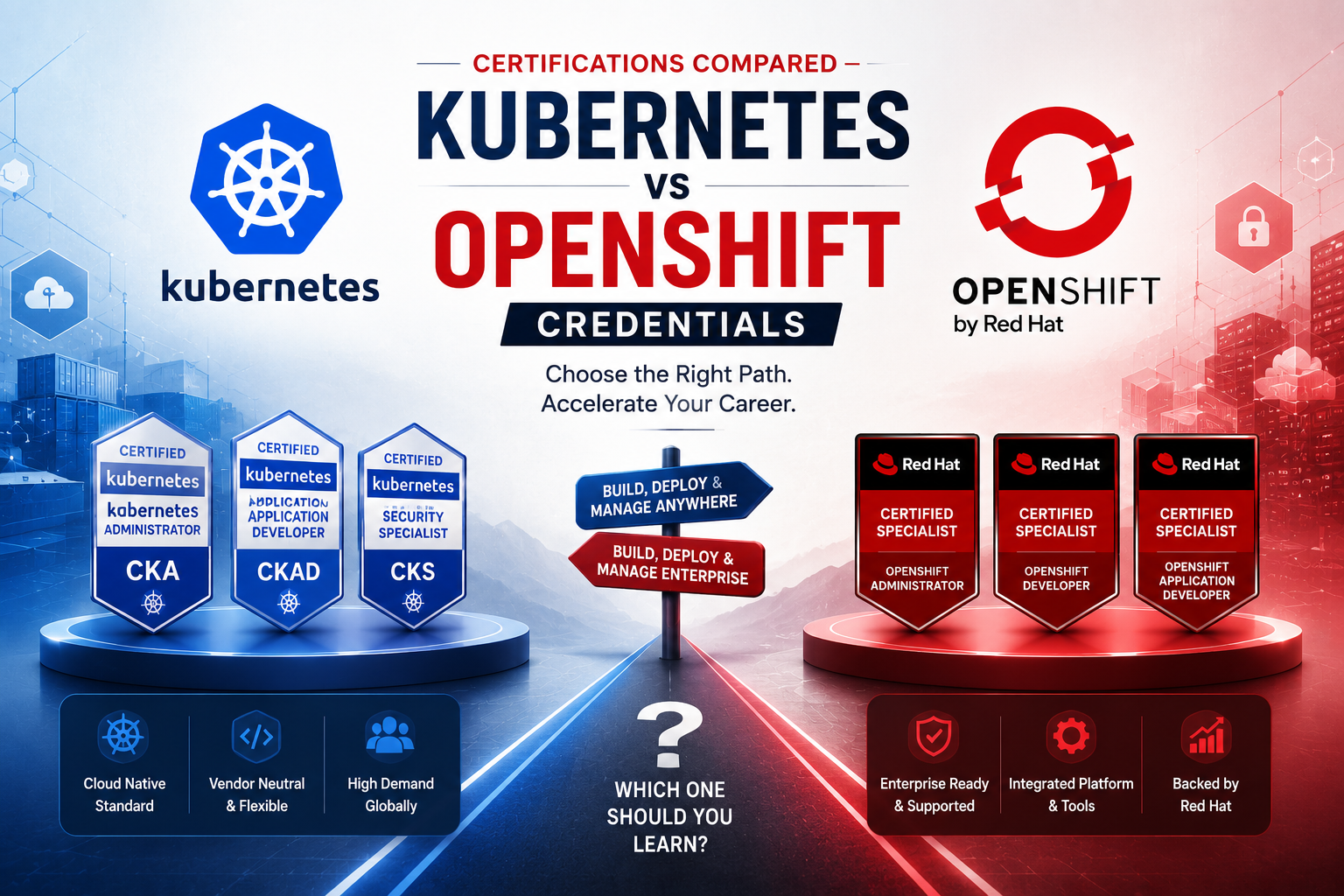
Certifications Compared — Kubernetes vs OpenShift Credentials
The decision of whether to go for Kubernetes certification or OpenShift certification is based on what kind of career path one would like to have in future. The kubernetes course certifications enable one to prove his/her skills in container orchestration in different cloud platforms, while OpenShift certifications enable one to prove his/her skills in managing enterprise Kubernetes on the Red Hat technology.
Kubernetes VS OpenShift Certifications
- Kubernetes Certifications: This certificate is best for DevOps engineers, cloud engineers, and platform engineers working with vendor-neutral Kubernetes.
- Certified Kubernetes Administrator (CKA): It is one of the very popular qualifications among engineers.
- OpenShift Certifications: It is suitable for enterprise administrators and DevOps engineers working on Red Hat technology.
- Openshift Certification Course: Trains people to deploy, protect, and manage enterprise OpenShift clusters effectively.
- Combined Skills: Having an openshift certificate along with Kubernetes certifications can help in building great skills for enterprise cloud and DevOps professions.
In spite of the competitions between the two certifications, most professionals take both of them. It is always better to build one’s Kubernetes expertise first before going into OpenShift because of the versatility of skills in both open-source and enterprise cloud environments.
Cost of Learning Both — Fees, Training and Real ROI
Among the frequently asked queries by learners is whether it is worth spending on both Kubernetes and OpenShift training. While certification and training come at a price that should be considered, the ultimate returns on the investments made are quite promising as there is still high demand for these technologies in various IT careers.
How Much Should You Spend On?
- Kubernetes Certification: Total cost of kubernetes certification, cka certification cost if you intend to take up the certification course.
- OpenShift Training: Determine the cost of undertaking a red hat openshift training course along with the costs of training sessions, hands-on lab, and certification preparation.
- Classroom Training: Training programs like kubernetes training in Jaipur and redhat openshift course in Jaipur come with mentorship, live projects, and exam preparation tips.
- Mode of Learning: Online self-study mode is comparatively cheaper than instructor-led classroom training mode.
- Training Program: Opt for training programs that have hands-on projects over choosing the least expensive program.
Despite the time and financial commitment to learn both technologies, the career advantages offered by these skills are much more than the disadvantages. For anyone who intends to build a career in cloud infrastructure, having skills in both Kubernetes and OpenShift would be very useful because there are good salary packages in such roles.
What should you learn First Kubernetes or Openshift?
If you happen to be a beginner in cloud computing and DevOps, then starting with Kubernetes would suit you best. The reason for this is that since OpenShift is based on Kubernetes, knowledge about Kubernetes will help you familiarize yourself with the enterprise platform. All the topics from pods, deployments, services, networking, storage, and clusters will serve as the base for both these topics.
If you happen to be a beginner in cloud computing and DevOps, then learning about Kubernetes will enable you to acquire the knowledge required for learning about container orchestration, and also help you with getting certified in kubernetes globally. Once you get familiar with Kubernetes clusters, transitioning into OpenShift would become easy for you since you already know its architecture.
While taking decision students must see the kubernetes certification cost and openshift certification cost too. In case you wish to get employed in an enterprise organization, then you should definitely consider taking a red hat openshift course at some point.
Best Kubernetes and OpenShift Training in Jaipur
The choice of the training provider is as significant as the choice of the technology. A good learning program should emphasize practical implementations as opposed to just theoretical principles. Practical labs, actual projects, instructor training, and certification preparation all contribute towards acquiring industry-relevant skill sets.
Aspiring cloud and DevOps professionals can look for an extensive set of industry-relevant training courses offered by Grras Solutions that help bridge the learning-implementing gap. Grras provides training courses for both kubernetes training in jaipur and redhat openshift in Jaipur. Training courses are conducted in live lab environment using industry-specific examples and by experienced industry experts.
Classroom and online training options are available at Grras Solutions. Apart from the expert-guided red hat openshift training, students can prepare themselves for certification exams with mock tests, project implementations, interview preparation and mentoring sessions.
Conclusion
Kubernetes and OpenShift are not rivaling technologies but rather complementing each other. While Kubernetes is providing the highly robust open-source framework of container orchestration, OpenShift is bringing a new level of enterprise-level security, automation, development tools, and simplicity of operation to Kubernetes. Depending on your career aspirations and industry you wish to join, your choice will vary.
As a beginner in cloud technology, the first step to take is mastering the Kubernetes technology and gaining kubernetes certifications. With further progression in your career, gaining expertise in OpenShift either by taking a red hat openshift course or an openshift certification course will provide you with even more opportunities within enterprise IT environment.
Ready to Build Your Cloud & DevOps Career?
Whether it is your first Kubernetes certification exam preparation or you wish to master enterprise OpenShift, Grras Solutions is here to provide you with the right guidance, hands-on training, and industry-oriented curriculum.
At Grras Solutions, learn from industry-certified experts using the practical and hands-on learning approach that goes way beyond just theoretical knowledge. This learning program includes real-life Kubernetes and OpenShift projects, thorough preparation for certification examinations that are recognized worldwide, and classroom as well as online learning classes. Placement support with interview preparation also forms a part of this industry-oriented learning program.





 Whatsapp us
 Call us
 Enquire Now