In today’s digital world, websites and web applications are very important. From online shopping to social media platforms, everything runs on web development technologies. One of the most powerful and easy ways to build websites is using Python with Django.
If you are a beginner and want to learn web development in a simple way, Django is a great choice. In this blog, you will understand what Django is, how it works, and why it is widely used.
1.What is Web Development?
Web development is the process of building websites and web applications. It has two main parts:
- Frontend Development: This is what users see on the screen, like:
- Buttons
- Images
- Forms
- Layout
- Backend Development: This is the logic behind the website. It handles:
- Data storage
- User login
- Server communication
2.What is Python?
Python is a very popular programming language. It is known for:
- Simple and easy syntax
- Easy to learn for beginners
- Powerful features
- Wide use in web development, AI, and data science
3.What is Django?
Django is a high-level Python web framework that helps you build websites quickly and easily.
Definition: Django is a framework that provides ready-made tools and features to develop secure and scalable web applications.
4.Why Use Django for Web Development?
Django is widely used because it makes development fast and simple.
- Key Reasons:
- Fast Development: Django provides built-in features, so you can build websites quickly.
- Secure Framework: Django protects your website from common security problems like:
- SQL injection
- Cross-site scripting
- CSRF attacks
- 3. Scalable: Django can handle small as well as large websites.
- 4. Built-in Admin Panel: Django provides an admin dashboard to manage data easily.
- 5. Clean Structure: Django follows a proper structure, making code easy to manage.
5. How Django Works?

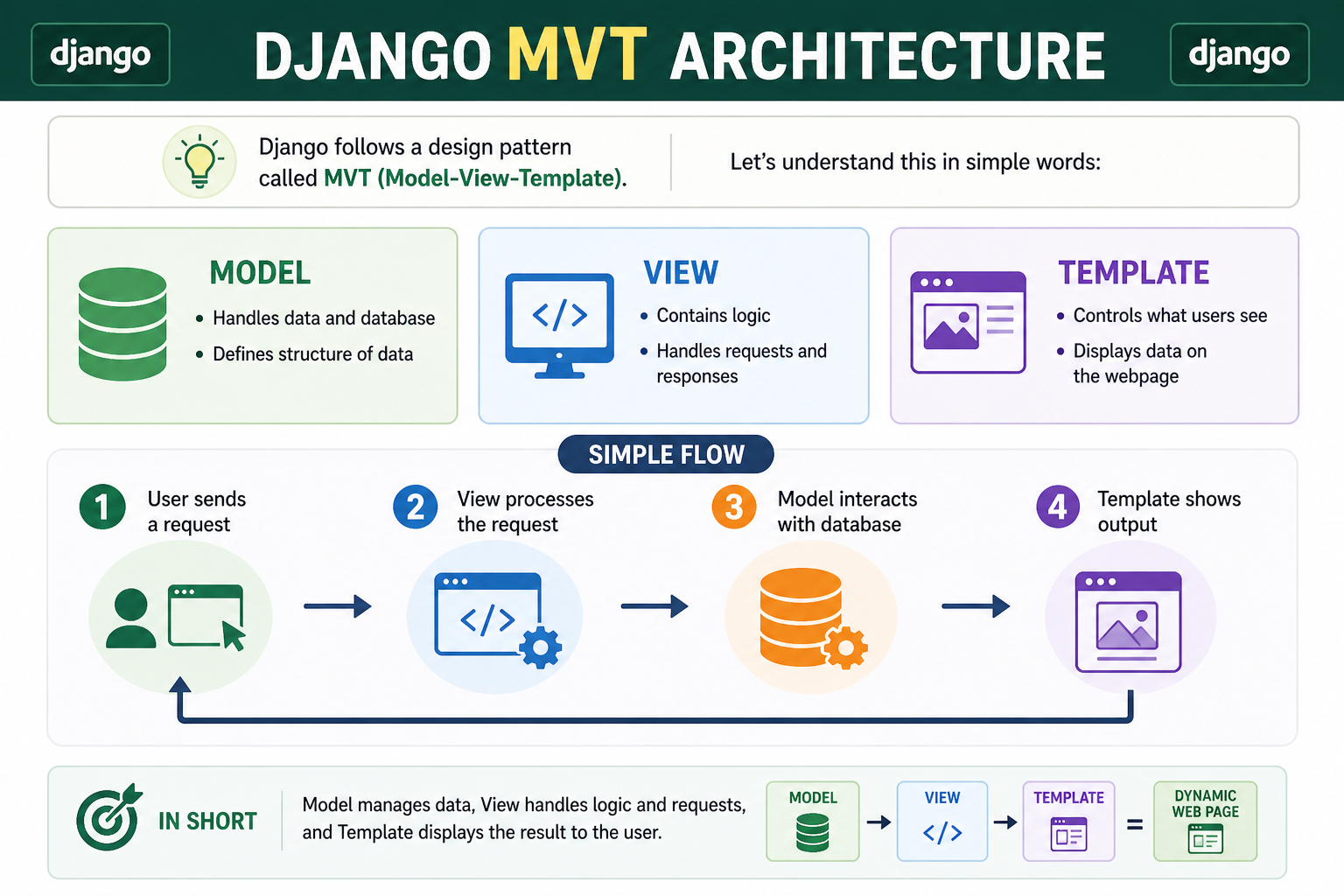
6. Features of Django
Django comes with many powerful features:
- Authentication system (login/logout)
- URL routing
- Form handling
- Database management
- Admin dashboard
7.Django Architecture
Django divides the application into small parts:
- Project: The main container of your application.
- App: A small module inside a project.
- Example:
- Blog app
- User app
- Example:
- URLs: Define paths for different pages.
- Example:
- /home
- /login
- /dashboard
- Example:
- Views: Handle logic and return response.
- Templates: Display content using HTML.
8. Advantages of Django
Here are some important benefits:
- Easy for beginners
- Fast development
- Secure system
- Reusable code
- Strong community support
9. Limitations of Django
Like every technology, Django also has some limitations:
- Not suitable for very small projects
- Can feel heavy for beginners
- Requires understanding of backend concepts
10. Real-World Applications of Django
Many popular websites use Django:
- Mozilla
- Disqus
11.Tools Used with Django
While working with Django, you will also use:
- Python
- SQLite / PostgreSQL (database)
- HTML, CSS, JavaScript
- Git and GitHub
12.How to Start with Django?
Here is a simple step-by-step guide:
- Learn basic Python
- Install Python and Django
- Create a Django project
- Create apps inside the project
- Learn models, views, templates
- Build small projects
13. Beginner Project Ideas
To practice Django, try:
- Blog website
- To-do app
- Login system
- E-commerce website
- Portfolio website
14. Career Opportunities After Learning Django
After learning Django, you can apply for roles like:
- Backend Developer
- Python Developer
- Full Stack Developer
- Web Developer
15. Future of Django
Django is still growing and widely used.
16. Future scope
- Integration with AI
- High demand in startups
- Cloud-based applications
FAQs About Python Web Development Using Django
1. What is Django in Python web development?
Django is a high-level Python web framework that helps developers build secure, scalable, and fast web applications with less coding effort. It follows the Model-View-Template (MVT) architecture and includes built-in tools for authentication, database management, and URL routing.
2. Is Django good for beginners?
Yes, Django is considered beginner-friendly because it offers a clean structure, strong documentation, and many built-in features that simplify web development. Developers with basic Python knowledge can start learning Django quickly.
3. What are the advantages of using Django?
Django provides rapid development, built-in security, scalability, reusable components, and database integration through its ORM system. It also reduces development time with its “Don’t Repeat Yourself” (DRY) principle.
4. Do I need to learn Python before learning Django?
Yes, having a basic understanding of Python programming is important before learning Django. Concepts like variables, functions, loops, and object-oriented programming make Django easier to understand.
5. What projects can beginners build with Django?
Beginners can create blog websites, to-do applications, portfolio sites, authentication systems, CRUD apps, and small eCommerce projects using Django. These projects help improve practical development skills.
6. Is Django still relevant in 2026?
Yes, Django remains highly relevant because businesses continue using it for scalable web applications, APIs, automation platforms, and backend systems. Its strong security features and active developer community keep it in demand.
17. conclusion:
Python web development using Django is one of the easiest and most powerful ways to build websites. It is beginner-friendly, secure, and widely used in the industry.
If you are starting your journey in web development, Django is a smart choice. With practice and projects, you can become a skilled developer.




 Whatsapp us
 Call us
 Enquire Now