In today’s customer-driven business environment, managing relationships effectively is critical for success. This is where Salesforce, the world’s leading Customer Relationship Management (CRM) platform, plays a vital role. It helps organizations streamline sales, improve customer service, and automate business processes.
For individuals looking to build a career in technology without heavy coding requirements—or those who want to combine business logic with development—Salesforce Administration and Development offer excellent opportunities.
This guide provides a comprehensive overview of Salesforce, its key components, career paths, and why it is one of the most in-demand skills in the industry.
1. What is Salesforce?
Salesforce is a cloud-based CRM platform that allows businesses to manage customer data, sales processes, marketing campaigns, and service operations in one centralized system.
Unlike traditional software, Salesforce operates entirely on the cloud, meaning users can access it from anywhere without installing or maintaining hardware. It is widely used by companies of all sizes, from startups to global enterprises.
2. Understanding Salesforce Administration:
A Salesforce Administrator is responsible for managing and configuring the Salesforce platform to meet business requirements. This role focuses more on configuration rather than coding, making it ideal for individuals from both technical and non-technical backgrounds.
Key Responsibilities of a Salesforce Administrator:
- Managing users, roles, and permissions
- Customizing objects, fields, and page layouts
- Creating reports and dashboards
- Automating workflows and processes
- Ensuring data security and integrity
- Supporting end-users and resolving issues
3. Understanding Salesforce Development:
A Salesforce Developer builds custom applications and extends the functionality of Salesforce using programming and advanced tools.
While Salesforce provides many out-of-the-box features, developers create tailored solutions when businesses have complex requirements.
Key Responsibilities of a Salesforce Developer
- Writing code using Apex (Salesforce programming language)
- Building user interfaces with Lightning Web Components (LWC)
- Creating custom integrations with external systems
- Developing APIs and automation logic
- Enhancing platform performance and scalability
4. Key Components of Salesforce Platform
Understanding the core components of Salesforce is essential for both administrators and developers.
1. Sales Cloud: Helps manage leads, opportunities, and sales pipelines, enabling businesses to track and close deals efficiently.
2. Service Cloud: Focuses on customer support, case management, and service automation.
3. Marketing Cloud: Used for creating personalized marketing campaigns and customer engagement strategies.
4. Experience Cloud: Allows businesses to create portals, communities, and customer-facing platforms.
5. Commerce Cloud: Supports e-commerce solutions for online businesses.
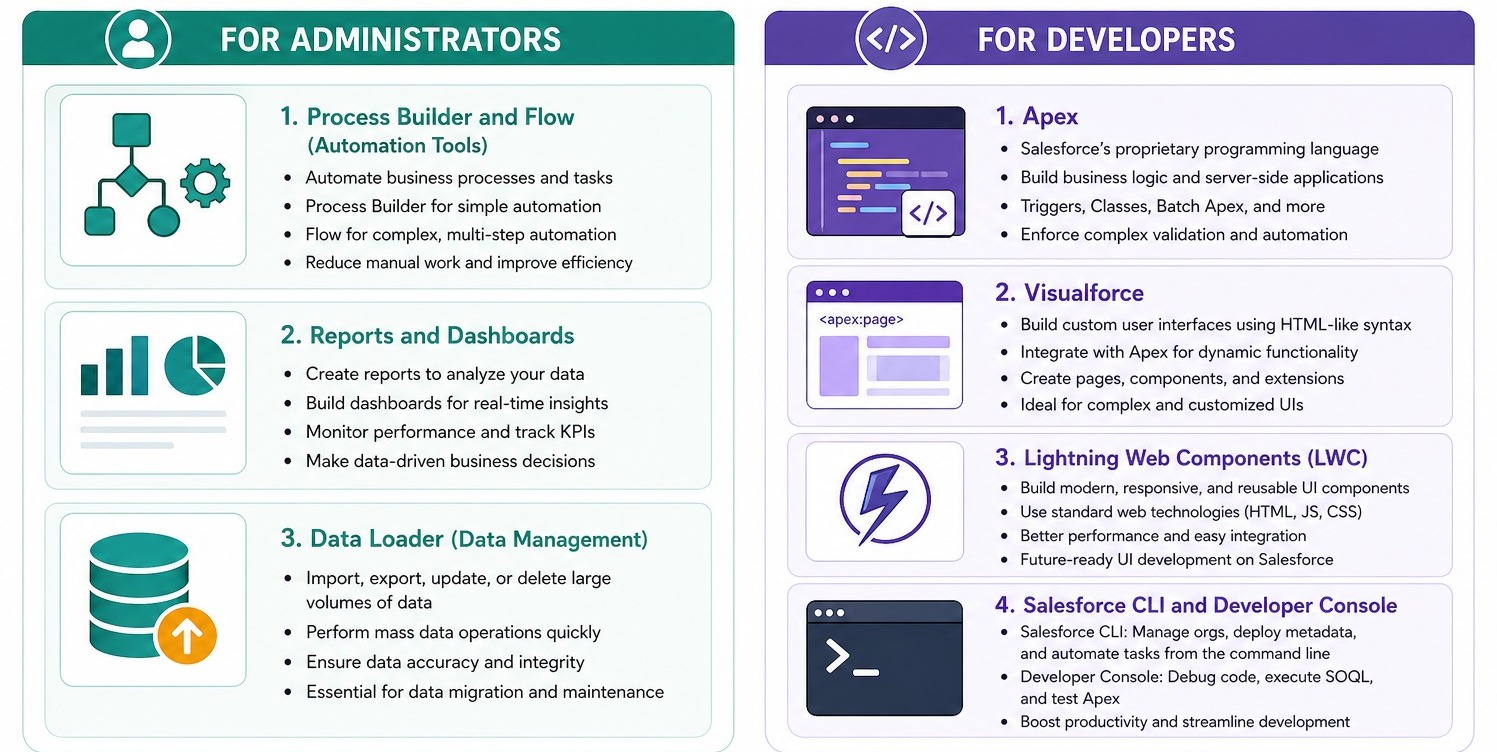
5. Tools Used in Salesforce Administration & Development
6. Benefits of Learning Salesforce:
1. High Demand in the Job Market: Salesforce professionals are among the most sought-after in the IT industry due to widespread CRM adoption.
2. Diverse Career Paths: You can choose between administration, development, consulting, or architecture roles.
3. Attractive Salary Packages: Salesforce professionals often receive competitive salaries due to specialized skill sets.
4. Cloud-Based Skillset: Working with Salesforce provides hands-on experience with modern cloud technologies.
5. Opportunities for Non-Coders: Salesforce Administration is accessible even for those without programming backgrounds.
7. Salesforce Certifications:
Salesforce offers globally recognized certifications that validate your expertise.
Popular Certification Include:
- Salesforce Certified Administrator
- Salesforce Advanced Administrator
- Salesforce Platform Developer I
- Salesforce Platform Developer II
- Salesforce App Builder
8. Career Opportunities in Salesforce:
After learning Salesforce Administration and Development, you can pursue roles such as:
- Salesforce Administrator
- Salesforce Developer
- Salesforce Consultant
- CRM Analyst
- Salesforce Architect
9.Conclusion
Salesforce Administration and Development are among the most promising career paths in the modern IT landscape. With its cloud-based architecture, wide adoption, and continuous innovation, Salesforce provides endless opportunities for growth.
Whether you are starting your career or looking to switch domains, learning Salesforce can open doors to high-paying and future-ready roles. By gaining the right skills and certifications, you can establish yourself as a valuable professional in the CRM ecosystem.




 Whatsapp us
 Call us
 Enquire Now