Artificial Intelligence has changed a lot over time. It used to be an idea but now it is one of the most important technologies we have.
Artificial Intelligence systems can do things like write essays create pictures help scientists with their work and even have conversations that sound like they are with a person.
This did not happen overnight. Artificial Intelligence took years to develop, with discoveries and problems along the way. In this blog, we will look at the history of Artificial Intelligence. From rule-based systems to new, powerful GPT models that are changing how people interact with machines. We will also see how Artificial Intelligence is affecting our lives. Artificial Intelligence is really changing things.
1. The Birth of Artificial Intelligence (1940s–1950s)
The whole idea of Artificial Intelligence started with a question:
“Can machines think?”
This question was asked by Alan Turing, a mathematician. He thought a lot, about Artificial Intelligence.
He wrote about it in a paper called Computing Machinery and Intelligence in 1950.
Alan Turing also came up with the Turing Test.
The Turing Test is a way to see if a machine can think like a being.
Early Concepts
At that time:
- Computers were not very good.
- Researchers thought about how machines could reason.
- People thought that being smart was about solving problems in a logical way.
The term Artificial Intelligence was first used in 1956 at the Dartmouth Conference by John McCarthy, a computer scientist.
This was the beginning of Artificial Intelligence, as a subject that people could study at school.
2. The Era of Rule-Based Systems (1950s–1970s)
The first artificial intelligence systems really depended on rules and logic.
These systems did their job using:
- IF- statements
- Symbolic reasoning
- Handcrafted knowledge
For example:
If a patient has a fever and a cough then it is possible that the patient has the flu.
These artificial intelligence systems were called Expert Systems because they tried to do what human experts do when they make decisions.
Popular Early Systems
ELIZA (1966)
Created by Joseph Weizenbaum, ELIZA was a computer program that tried to act like a psychotherapist. It used pattern matching to do this.
Here is an example:
 User: I feel sad.
 ELIZA: Why do you feel sad?
Even though ELIZA was not very complex lots of people were amazed by it. This was because it could have a conversation, with you. ELIZA talked to people in a way that made them think it really understood what they were saying.
SHRDLU (1970)
SHRDLU was a computer program that could understand commands in a world made of blocks. It could also answer questions about this block world.
Limitations
Rule-based systems had some problems:
- They needed a lot of programming, which was time-consuming and costly.
- They were not good, at dealing with ambiguous things.
- They could not learn from data on their own.
- They only worked within the rules that were programmed into them.
As problems got more complicated researchers started to think that intelligence could not just come from -programmed rules and logic.
3. The AI Winter (1970s–1980s)
The big deal about Artificial Intelligence got people really excited at first.
Artificial Intelligence was supposed to do things.
Governments and investors thought Artificial Intelligence would make progress quickly but Artificial Intelligence systems just did not work well in the real world.
This led to some times for Artificial Intelligence, which people called Artificial Intelligence Winters, where:
- Funding for Artificial Intelligence went down
- Research on Artificial Intelligence moved slower
- People lost interest in Artificial Intelligence
Computers were not strong enough to handle Artificial Intelligence. There was not enough data.
Many people thought Artificial Intelligence was not going anywhere.
Some researchers kept working on new ideas, for Artificial Intelligence even when it seemed like nothing was happening.
4. The Rise of Machine Learning (1980s–1990s)
Instead of explicitly programming rules, scientists began teaching computers to learn from data.
This shift introduced Machine Learning (ML).
What Changed?
Traditional artificial intelligence is when people make the rules for the computer program.
Machine learning is different it learns from the things it sees like patterns in examples.
This was a change the way we do artificial intelligence changed a lot it was a big deal this switch from traditional artificial intelligence, to machine learning.
Neural Networks Return
Researchers looked again at Artificial Neural Networks, which were inspired by the brain.
A neural network is made up of nodes or neurons that are connected and work together to process information.
One big step forward was the Backpropagation Algorithm it helped neural networks learn in a way and it was all, about Artificial Neural Networks.
Notable Milestone
IBM Deep Blue (1997)
Deep Blue beat the world chess champion Garry Kasparov.
This was a deal because it showed that machines can do better than people at things that require a lot of thinking and planning.
Deep Blue and these other systems were good at one thing. They were not smart, in general they were what people call narrow AI, which means they can only do one thing well.
5. The Big Data & Deep Learning Revolution (2000s–2010s)
The internet changed everything fast.
Suddenly companies could get:
- Huge amounts of data
- Computer chips for graphics
- Strong cloud computers
This helped Deep Learning become popular. Deep Learning is a type of network, with many layers. It uses datasets, fast GPUs and powerful cloud computing.
Why Deep Learning Worked
Deep learning systems can find patterns by themselves from really large amounts of data. They do not need people to tell them what to look for.
This resulted in progress in areas like:
- Image recognition
- Speech recognition
- Language translation
- Recommendation systems
Deep learning systems are really good at image recognition. They can look at lots of pictures. Learn to find things in them.
Speech recognition got a lot better too. Now computers can understand what people are saying.
Language translation also improved a lot. Computers can now translate from one language to another better.
Recommendation systems are used by lots of websites. They suggest things you might like based on what you have looked at
Deep learning systems use a lot of data to make these things work. They are really good, at finding patterns in data.
Image recognition helps computers see things. Speech recognition helps computers hear things.
Language translation helps computers talk to people in languages.
Recommendation systems help computers suggest things to people.
Famous Breakthroughs
ImageNet Success (2012)
A special computer system called AlexNet made a difference in recognizing pictures.
This was an important time for Artificial Intelligence.
Virtual Assistants
There are some technologies like:
- Siri
- Alexa
- Google Assistant
These things can talk to us. Help us because of deep learning and AlexNet and other deep learning systems like them. Deep learning is really good, at helping computers understand things so we got Assistants and other things that use deep learning.
6. Natural Language Processing Evolves
Understanding language is a big deal, for AI research.
Earlier NLP systems had a time because language can be really tricky and unclear.
For example:
“I saw her duck.”
Does “duck” mean
* an animal
or
* when someone lowers their head quickly?
Old systems had trouble with this kind of language.
Word Embeddings
Innovations like:
- Word2Vec
- GloVe
helped machines understand how words relate to each other.
For example:
King. Man + Woman is like Queen
Machines were starting to get better at understanding what words really mean not just looking at keywords.
AI was beginning to understand semantics than just keywords.
These innovations, like Word2Vec and GloVe made it possible.
7. The Transformer Revolution (2017)
One research paper changed AI forever:
“Attention Is All You Need” (Google, 2017)
This paper introduced the Transformer architecture.
Why Transformers Were Revolutionary
Previous models processed words sequentially, making training slow and limiting context understanding.
Transformers introduced Attention Mechanisms, allowing models to:
- Process words in parallel
- Understand long-range relationships
- Scale efficiently
This became the foundation of modern language AI.
8. The Rise of GPT Models
OpenAI built upon transformers to create the Generative Pre-trained Transformer (GPT) series.
GPT-1 (2018)
- Demonstrated that pretraining on large text corpora improves performance.
- Relatively small by modern standards.
GPT-2 (2019)
- Generated impressively human-like text.
- Initially considered too powerful for full public release.
GPT-3 (2020)
A massive breakthrough with 175 billion parameters.
Capabilities included:
- Writing essays
- Coding
- Translation
- Summarization
- Conversational AI
People realized AI was moving beyond narrow tasks.
9. ChatGPT and the Mainstream AI Boom
In late 2022, OpenAI launched ChatGPT, bringing advanced AI to millions of users.
For the first time, ordinary people could interact naturally with a powerful language model.
Why ChatGPT Became Popular
It could:
- Answer questions
- Generate content
- Explain concepts
- Write code
- Brainstorm ideas
- Assist businesses
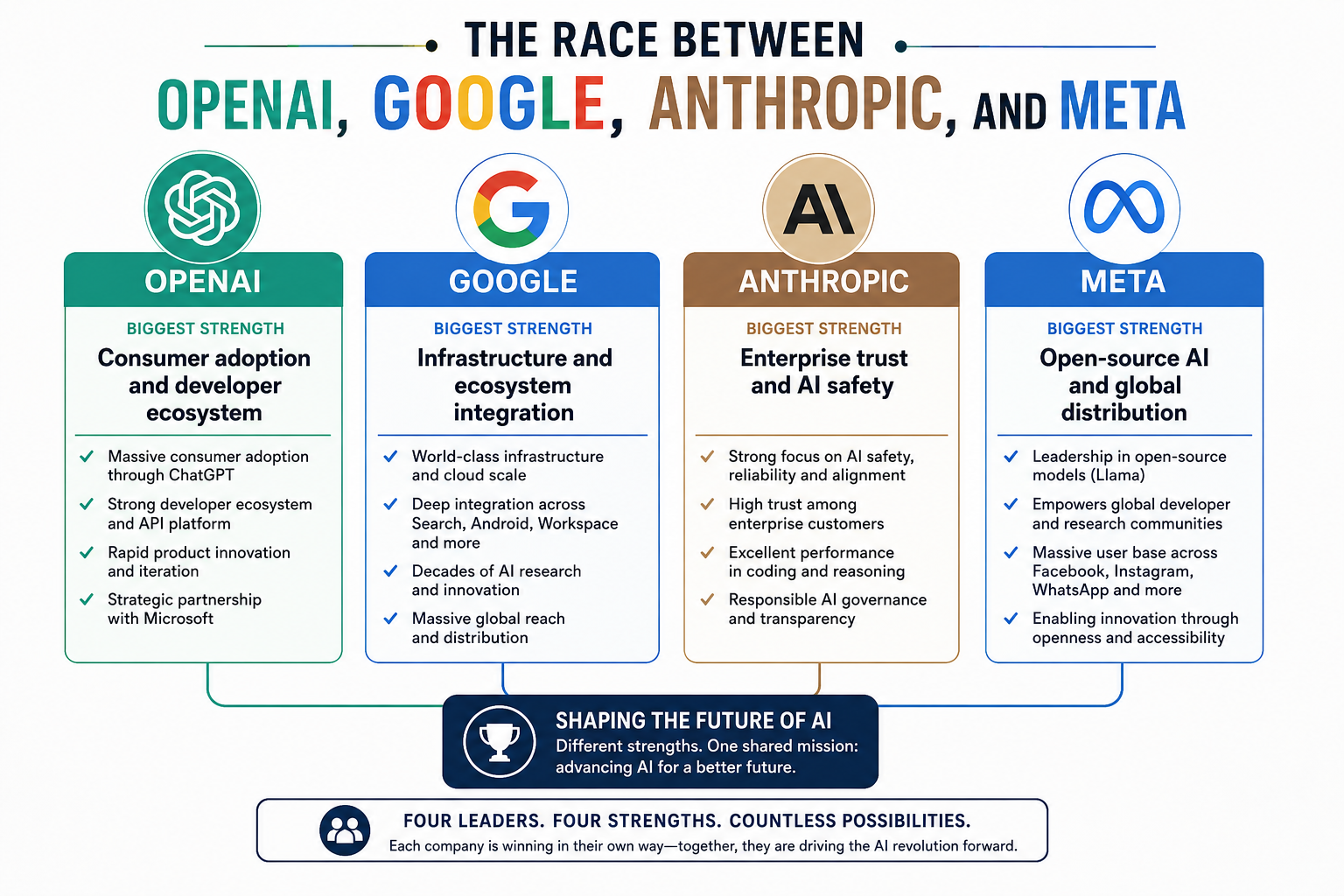
This triggered a global AI race involving companies like:
- Microsoft
- Meta
- Anthropic
- xAI
AI rapidly entered education, healthcare, finance, marketing, and software development.
10. Beyond GPT: Multimodal & Agentic AI
Nowadays Artificial Intelligence models are not just about text anymore.
Today these systems can do a lot of things like work with Images, Audio, Video, Documents and Code.
This is what people call Multimodal Artificial Intelligence.
We are also seeing Artificial Intelligence agents come up. These are systems that can do things like Reasoning, Planning Using tools and Executing tasks on their own without help.
We are moving away from chatbots and towards really smart digital assistants that can help us with lots of things, like intelligent digital assistants that can make our lives easier.
11. Challenges and Ethical Concerns:
Despite progress Artificial Intelligence presents serious challenges:
- Bias and Fairness: Artificial Intelligence systems can inherit biases from the data they are trained on.
- Misinformation: Generative Artificial Intelligence can create content that is very convincing.
- Job Displacement: Automation may. Replace some jobs.
- Privacy: Using amounts of data for Artificial Intelligence raises concerns about ethics.
- AI Safety: Researchers are working to make sure advanced Artificial Intelligence systems match what humans value.
These discussions are now very important, for the future of Artificial Intelligence development.
12. The Future of AI
Artificial intelligence is getting better and better at a fast rate.
Future possibilities include:
- artificial intelligence assistants
- Artificial intelligence is helping us make new scientific discoveries faster
- Robots that can work on their
- Artificial intelligence is helping us make new healthcare discoveries
- Artificial General Intelligence
We are still a way from creating artificial intelligence that is as smart as people but the progress from simple systems to new models, like GPT has been really amazing. Artificial intelligence is moving forward. Artificial intelligence is getting more advanced every day.
The History of Artificial Intelligence: From Rule-Based Systems to GPT Models
FAQs – The History of AI: From Rule-Based Systems to GPT Models
1. What were the first kinds of intelligence.
The first artificial intelligence systems were programs that followed rules and did what they were told to do. These systems could do things but they could not learn or change.
2. How did artificial intelligence change from rule-based systems to GPT models.
Artificial intelligence got better because of ways of learning and new kinds of computer systems. Now we have GPT models that can talk like humans and do things because they use a lot of data and special computer systems.
3. What does machine learning do for intelligence.
Machine learning helps artificial intelligence systems get better at what they do by learning from data. This means they can do things without being told what to do. Machine learning made artificial intelligence smarter and more able to change.
4. What makes GPT models different from artificial intelligence systems.
GPT models are special because they learn from a lot of text and can understand what people mean. They can talk like humans. Help with hard things. GPT models learn from data so they do not just follow rules, like artificial intelligence systems did.
5. Why is it important to know about the history of intelligence.
Knowing about the history of intelligence helps people learn how it started and how it changed over time. It also helps them understand what might happen in the future and what problems we might have to solve when we use intelligence.
Conclusion
The history of AI is a story of persistence, innovation, and transformation.
What began as simple rule-based logic systems evolved into neural networks, deep learning, transformers, and now GPT-powered conversational intelligence.
Each era solved limitations of the previous one:
AI is no longer science fiction — it is shaping the future of humanity in real time.
And this journey is only just beginning.




 Whatsapp us
 Call us
 Enquire Now