Artificial Intelligence is not something we just talk about in research labs anymore. It is the technology fight of the decade. There are four companies in the middle of this fight. OpenAI, Google, Anthropic and Meta. Each of these companies has an idea about how Artificial Intelligence should shape the future.
This all started as a competition to make chatbots.. Now it is a big global fight to be in charge of lots of things like infrastructure, search, software for businesses tools to help with coding, creativity tools, robots and even how countries interact with each other. The Artificial Intelligence race is very important because the company that leads the Artificial Intelligence revolution will decide what the internet will be like in the future.
Nowadays the Artificial Intelligence race is not about who has the most powerful Artificial Intelligence model. It is, about getting Artificial Intelligence to people making sure people trust Artificial Intelligence having computer power making sure developers like working with Artificial Intelligence keeping Artificial Intelligence safe following rules and being able to use Artificial Intelligence in the things people do every day with Artificial Intelligence.
OpenAI: The Platform Pioneer
OpenAI started the artificial intelligence craze when it launched ChatGPT at the end of 2022. Now OpenAI is not a research group it is one of the most important technology companies in the world.
The plan, for OpenAI is simple: OpenAI wants to be the system that runs all intelligence.
OpenAI’s strengths include:
- Massive consumer adoption through ChatGPT
- Deep partnership with Microsoft
- Strong developer ecosystem
- Rapid product iteration
- Leadership in multimodal AI
The company keeps growing. Is now working on more than just chatbots. They are creating coding agents, tools for businesses AI helpers and systems that can work on their own.
There are reports that in 2026 OpenAI will be putting a lot of money into making sure AI is secure and into ways of thinking.
One of the things that makes OpenAI so strong is how many people use it. ChatGPT became really popular really fast. Faster, than any other software. Now millions of developers use OpenAIs tools to build applications. This creates an effect that helps make OpenAI even stronger. OpenAI APIs are being used to build applications.
However, OpenAI also faces challenges:
- Extremely high infrastructure costs
- Increasing regulatory scrutiny
- Growing competition in enterprise AI
- Dependence on Microsoft cloud infrastructure
Critics say that OpenAI is moving fast with its commercial plans. They think it might not be an idea. On the hand supporters believe that OpenAI needs to move quickly in this competitive field.
No matter what OpenAI is still the standard that others are trying to match. OpenAI is the one that everyone else is comparing to.
Google: The Sleeping Giant Awakens
If OpenAI started the AI revolution, Google may be the company best positioned to scale it globally.
Google possesses advantages no competitor can easily replicate:
- The world’s largest search engine
- Android ecosystem dominance
- Massive cloud infrastructure
- Deep AI research history
- Ownership of YouTube, Gmail, Maps, and Workspace
Googles DeepMind division has made a lot of discoveries, in artificial intelligence. They made AlphaGo and transformer architectures that are used in large language models.
For a time people thought Google was not moving fast enough.. Then they launched Gemini and that changed everything.
Gemini is Googles way of putting intelligence into all of its products. Like search, productivity, cloud services and mobile devices. People are starting to use Gemini a lot. It is becoming very popular. This is because Google already has a lot of people using its products.
Google is doing something from OpenAI.
* Google wants to put intelligence into all of its products not just make one big artificial intelligence product.
Imagine:
- AI inside Gmail drafting emails
- AI-generated search summaries
- Real-time translation in Android
- AI-assisted coding in Google Cloud
- Personalised AI agents integrated with daily workflows
The Google ecosystem approach could make Google the difficult competitor for other companies to beat in the long term.
Google still has a job to do. Google has to balance things. The answers that Google gets from intelligence are a threat to the way Google makes money from search advertising, which is the main reason Google has so much revenue.
Google needs to change the way it does search without hurting the way Google makes money because that is what made Google so successful, in the place and that is what makes Google dominant.
Anthropic: The Safety-First Challenger
Anthropic is like the side of the story when it comes to OpenAI.
They were started by people who used to work for OpenAI.
Anthropic became known for making Artificial Intelligence safe and reliable.
Their Claude models are really popular with developers and big companies because they can have conversations and understand a lot of information.
Anthropic did things differently than OpenAI.
OpenAI was trying to get regular people to use their stuff. Anthropic focused on getting big companies to trust them.
It looks like that plan is working out.
There are reports that say Anthropic is growing fast when it comes to big companies using their Artificial Intelligence.
Some people think Anthropic now has a part of the Artificial Intelligence market, for big companies.
Anthropic is doing well. People are starting to take notice of what they are doing with Artificial Intelligence.
Anthropic’s strengths include:
- Strong coding and reasoning performance
- Long-context memory capabilities
- Strong enterprise reputation
- Emphasis on AI safety frameworks
- Rapid growth in developer communities
The company is really big on using intelligence in a responsible way so they have a policy called Responsible Scaling Policy.
But there is a problem that Anthropic is dealing with: they need a lot of computer power.
Anthropic faces this challenge because training the new artificial intelligence models needs a huge amount of hardware and electricity.
The company Anthropic is working with companies that have the computer power they need like the people who own the SpaceX facilities, which shows how much Anthropic wants to get bigger and better.
The company Anthropic may not be well known as OpenAI when it comes to regular people using artificial intelligence or as big as Google, with all the things they offer but more and more it seems like Anthropic is the artificial intelligence company that businesses and people who make things trust the most.
.
Meta: The Open-Source Disruptor
Meta is doing something different.
They are playing a different game when it comes to artificial intelligence.
While OpenAI and Anthropic focus on systems Meta is taking a different approach with its Llama family.
Meta has really been pushing to make its artificial intelligence models open to everyone.
This is a deal and it has changed the artificial intelligence industry.
The Meta strategy has reshaped the industry. Made a big impact.
By sharing its artificial intelligence models Meta has made it possible for startups and researchers and independent developers all around the world to try out advanced artificial intelligence without having to rely on other companies proprietary APIs.
Meta has made powerful models more accessible, to everyone, including startups, researchers and independent developers worldwide which’s really cool.
Meta’s strengths include:
- Massive global scale through Facebook, Instagram, and WhatsApp
- Open-source ecosystem leadership
- Huge AI research teams
- Strong hardware ambitions
- Consumer distribution through social platforms
Meta believes the future of AI should be open and widely distributed.
This approach has several benefits:
- Faster innovation through community contributions
- Reduced dependence on centralized providers
- Broader developer adoption
- Greater flexibility for enterprises
At the time people who do not agree with open models say that they can cause problems with false information, cybersecurity and people using them in bad ways.
Meta also has to answer questions about how they will make money from this. Unlike OpenAI or Anthropic Meta has not shown yet how open artificial intelligence can be turned into money that they can count on for a time.
Still Meta has a lot of power because it is, in charge of the open-source part of the intelligence system the artificial intelligence ecosystem and the artificial intelligence world that people use.
The Real Battlegrounds
The artificial intelligence race is not about how good the models are anymore.
A lot of things are happening at the same time.
1. Computer Power: companies that make intelligence are competing to get the best computers, data centers, electricity and the parts they need to make these computers.
Computer power is really important now it is like the oil.
We see big companies like Microsoft, Nvidia, Amazon, Google Cloud and even SpaceX working together which shows that having infrastructure is crucial for artificial intelligence.
2. Businesses Using Artificial Intelligence: companies are spending a lot of money to use intelligence in their work.
Getting businesses to trust intelligence might be more important than just being popular with regular people.
Anthropic is doing well with businesses and OpenAI is growing fast because it works with Microsoft. Google is using its Workspace and Cloud and Meta is focusing on infrastructure.
3. Artificial Intelligence Safety And Rules: as artificial intelligence gets stronger governments are paying attention.
The big artificial intelligence labs are working with governments and regulators to make sure artificial intelligence is safe.
This is a situation:
- if you move too fast the government might stop you.
- If you move slow your competitors will get ahead.
- Finding a balance between making things and being safe might be what defines the next part of the artificial intelligence industry.
4. Artificial Intelligence For Regular People: the company that wins might be the one that becomes a part of peoples lives.
- Google has its search engine and Android phones.
- Meta has media.
- OpenAI has ChatGPT.
- Anthropic has the trust of businesses.
Each company has its way of getting to people and that often matters more, than just having good technology.
Who Is Winning?
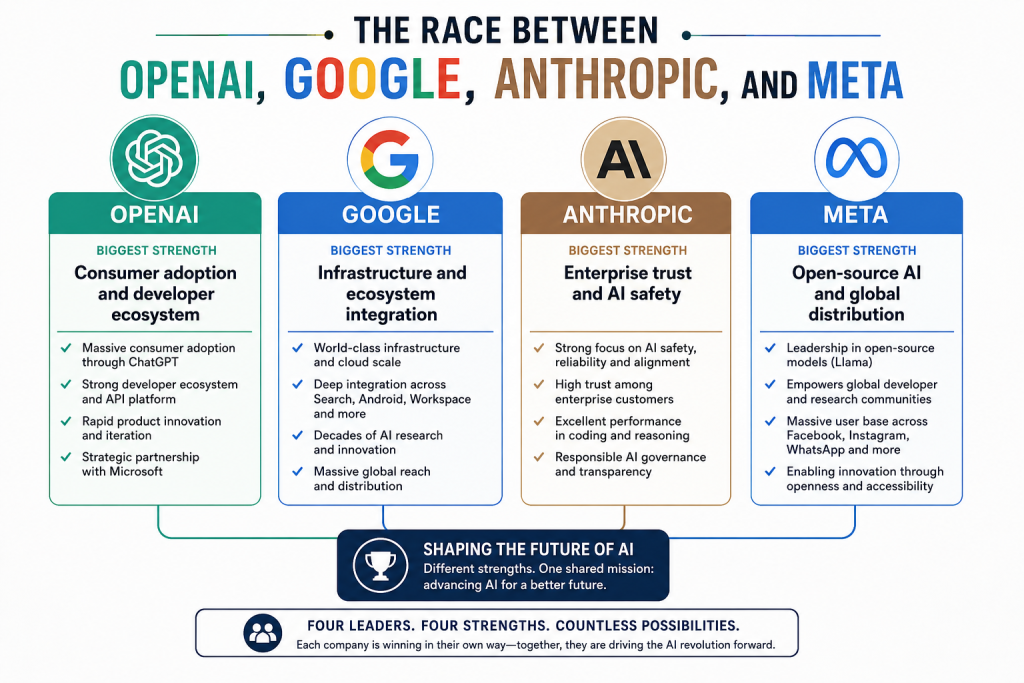
The honest answer is: nobody is winning everything.
Each company dominates different parts of the market.
The race is also evolving faster than expected.
New startups appear constantly.
Chinese AI companies are rapidly improving.
Governments are becoming more involved.
AI capabilities are advancing at an extraordinary pace.
What seems impossible today may become normal within a year.
The Future of the AI Race
The next stage of AI competition will likely move beyond chatbots into:
- Autonomous AI agents
- AI-powered software development
- Robotics
- Scientific discovery
- Personalized education
- Healthcare systems
- Real-time multimodal interaction
Researchers increasingly believe AI systems may eventually automate portions of AI research itself, accelerating progress even further.
That possibility makes this race far more significant than a normal technology competition.
This is not just about apps or software anymore.
It is about who shapes the infrastructure of intelligence itself.
FAQs – The Race Between OpenAI, Google, Anthropic and Meta
1. Why are OpenAI, Google, Anthropic and Meta competing in AI development?
These companies are competing because they want to be the ones to lead the future of intelligence. They are working on making AI models solutions for businesses, new search technologies, tools to help people be more productive and AI ecosystems that will shape what the internet and digital experiences will be like in the future.
2. What makes OpenAI a major leader in the AI industry?
OpenAI is really well known because of ChatGPT and its strong partnership with Microsoft. The company is always coming up with ideas it has a great ecosystem for developers it can do lots of different things with AI and it is focused on making applications that use AI. This is why OpenAI is one of the influential companies in the world when it comes to artificial intelligence.
3. How is Google competing in the AI race?
Google is using intelligence in all of its products like Search, Gmail, Android, Workspace and Cloud. It is doing this through its Gemini AI platform. Google has a lot of resources it is really good at researching intelligence and it has a big advantage because of its ecosystem. This makes Google one of the competitors in the artificial intelligence industry.
4. Why is Anthropic considered a safety-focused AI company?
Anthropic is really focused on making sure artificial intelligence is safe and reliable. The company is also working on developing intelligence in a responsible way. Its Claude AI models are known for being able to reason understand things in context and being trusted by businesses. This is why Anthropic is popular among businesses and developers who work with intelligence.
5. What role does Meta play in the future of AI?
Meta is helping to make artificial intelligence more accessible to everyone through its Llama models. The company is letting developers and researchers from over the world use these models to build their own artificial intelligence applications. Meta wants to make artificial intelligence something that everyone can use it wants to work with the community to develop intelligence and it wants to make sure artificial intelligence is used in a big way across all of its social platforms. Meta and its Llama models are playing a role, in the future of artificial intelligence.
Conclusion
OpenAI started the AI revolution. Google is putting AI into the worlds digital system. Anthropic is gaining trust by focusing on safety and dependability. Meta is making AI available to everyone by being open.
Each company thinks it has the plan for the future.
The truth is, there might not be one winner in the AI race. We could see a future with AI systems working together. Each one suited to different people, businesses and values.
One thing is for sure:
The competition between OpenAI, Google, Anthropic and Meta is changing technology faster than any other competition in recent history.
The AI race, with OpenAI, Google, Anthropic and Meta is moving fast.
These companies, OpenAI, Google, Anthropic and Meta are pushing AI forward.



 Whatsapp us
 Call us
 Enquire Now