In the modern digital era, almost everything we use is connected to the internet. Websites and web applications have become a major part of our daily lives. Whether you are shopping online, watching videos, or using social media, you are interacting with frontend development.
Frontend development focuses on creating the part of the website that users see and use. One of the most powerful and widely used technologies for frontend development today is React.js.
1.What is Frontend Development?
Frontend development is the client-side part of web development. It is responsible for:
- Designing the user interface (UI)
- Creating user experience (UX)
- Making websites responsive and interactive
Key Responsibilities of Frontend Development:
- Structure Creation
Using HTML to define the layout of the webpage. - Styling and Design
Using CSS to make the website visually appealing. - Interactivity
Using JavaScript to handle user actions like clicks, inputs, and animations. - Performance Optimization
Ensuring fast loading speed and smooth user experience.
2.Evolution of Frontend Development
Frontend development has changed a lot over time:
- Static Websites
- Built using only HTML and CSS
- No interaction or dynamic content
- Dynamic Websites
- JavaScript introduced interactivity
- Websites became more user-friendly
- Modern Web Applications
- Use frameworks and libraries like React
- Highly interactive and fast
3.What is React.js?
React.js is a JavaScript library used to build user interfaces, especially for Single Page Applications (SPAs).
Definition: React is a declarative, component-based library that helps developers build fast and scalable web applications.
4. Core Principles of React.js
Understanding these principles is very important:
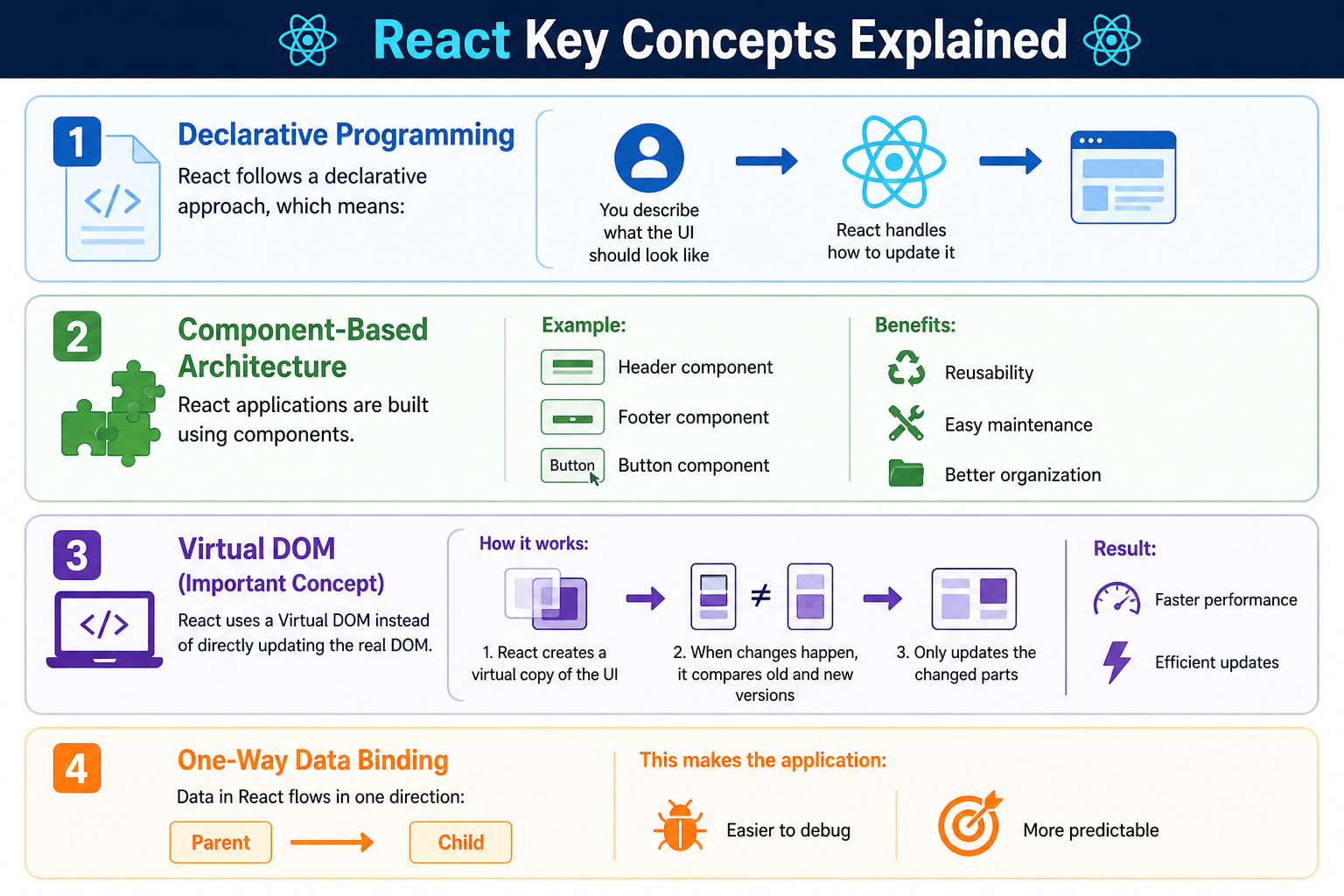
5. Understanding Single Page Applications (SPA)
React is mainly used to build Single Page Applications.
What is SPA?
A Single Page Application loads only one HTML page and updates content dynamically without refreshing the page.
Advantages:
- Faster navigation
- Better user experience
- Smooth transitions
6. Important React Concepts
- JSX (JavaScript XML): JSX is a syntax that looks like HTML but is used inside JavaScript.
- Theory:
- It allows combining UI and logic
- Improves readability
- Theory:
- Components: Components are the building blocks of React.
- Types:
- Functional Components (modern and simple)
- Class Components (older approach)
- Types:
- Props (Properties): Props are used to pass data between components.
- Theory:
- Read-only
- Used for communication between components
- Theory:
- State: State is used to store dynamic data inside a component.
- Theory:
- Can change over time
- When state changes, UI updates automatically
- Theory:
- Hooks: Hooks are functions that allow you to use React features in functional components.
- Common Hooks:
- useState → manage data
- useEffect → handle side effects
- Common Hooks:
7. React Lifecycle (Conceptual Understanding)
Every React component goes through different stages:
- Mounting → Component is created
- Updating → Component data changes
- Unmounting → Component is removed
8. Advantages of React.js (Theory)
- High Performance: Due to Virtual DOM, React is faster than traditional methods.
- Reusability: Components can be reused multiple times.
- Easy Maintenance: Code is structured and organized.
- SEO Friendly: Better performance helps in search engine ranking.
- Strong Ecosystem: Many tools and libraries support React.
9. Limitations of React.js
Even though React is powerful, it has some limitations:
- Only handles UI (needs other tools for full development)
- Learning curve for beginners
- Fast updates require continuous learning
10. Architecture of React Applications
React applications follow a structured architecture:
- Components
- State management
- Routing
- API integration
11. Real-World Use of React.js:
React is used in:
- Social media apps
- E-commerce platforms
- Admin dashboards
- Online tools and services
12. Frontend Development Best Practices
To become a good, React developer, follow these practices:
- Write clean and simple code
- Use reusable components
- Optimize performance
- Follow proper folder structure
- Keep learning new tools
13. Future of React.js
React continues to grow and improve.
Future trends:
- AI integration
- Faster rendering techniques
- Better developer tools
FAQs About frontend web development Using React.js
1. What is frontend web development in React.js?
Frontend web development in React.js focuses on building interactive user interfaces for websites and web applications using reusable components, JavaScript, and modern UI practices.
2. Why is React.js popular for frontend development?
React.js is popular because it offers component-based architecture, Virtual DOM performance optimization, reusable code, and strong community support for scalable web applications.
3. Is React.js suitable for beginners?
Yes, React.js is beginner-friendly for learners who already understand basic HTML, CSS, and JavaScript concepts. Many training programs and beginner guides start from fundamentals before moving to advanced topics.
4. What skills are required to learn React.js?
To learn React.js effectively, beginners should understand HTML, CSS, JavaScript ES6+, basic programming logic, and frontend development concepts like components and state management.
5. What are the benefits of using React.js in web development?
React.js helps developers build fast-loading applications, reusable UI components, maintainable code structures, and responsive interfaces suitable for modern businesses and startups.
6. What career opportunities are available after learning React.js?
After learning React.js, individuals can pursue roles such as frontend developer, React developer, UI developer, full-stack JavaScript developer, and web application developer.
14.Conclusion
Frontend web development is an essential part of building modern websites. React.js makes this process faster, easier, and more efficient.
By understanding the theory behind React—such as components, Virtual DOM, and data flow—you can build strong foundations and become a skilled developer.
If you practice regularly and work on real projects, React can help you build a successful career in web development.




 Whatsapp us
 Call us
 Enquire Now