There’s a big change happening across serious engineering teams right now, and many DevOps engineers are still watching it from the sidelines. Security isn’t something a separate team checks after your work is finished anymore. Instead, it’s built right into the pipeline, automated throughout the CI/CD process, and now seen as a must-have skill for anyone learning the skills required for devops engineer roles in 2026. The people who noticed this shift early and added DevSecOps skills to their existing knowledge are landing promotions, earning better salaries, and becoming some of the most valuable members of their teams. A big advantage. This blog walks you through the DevSecOps skills that matter the most and shows you exactly how you can begin building them today.
What DevSecOps Is and Why Every DevOps Engineer Needs It
A few years ago, software developers, operations and security professionals all operated independently of one another, each playing distinct roles in their respective fields. Developers were primarily concerned with feature creation, operations professionals took care of ensuring the system functioned without issues, and security professionals were usually consulted only during the process of deploying software. This model of operation was not only ineffective but also caused delays in software release and resulted in security risks being discovered much later in the software development process. The DevSecOps model proved to be more efficient because security was built into the development process at every step.
Currently, the companies want everyone to take care of security. The paradigm shift is responsible for the change in the skills required for DevOps engineer by employers when recruiting. Today’s DevOps experts are not expected to just automate deployments and cloud infrastructure, but also know how to code securely, manage vulnerabilities, control identities and accesses, comply with security requirements, and secure the cloud. The professionals who complete a DevSecOps training course are more in demand among the ones with DevOps background as the companies continue to adopt cloud native technologies.
DevSecOps has made its mark on the way professionals choose to get certified. The good devops certification course now features topics related to security like container security, secrets management, IaC scanning, compliance automation, and vulnerability assessment. If you are planning to follow a devops certification roadmap, DevOps training for working professionals, or aws devops certification, knowing about DevSecOps is vital.
Security in the CI/CD Pipeline — The Core DevSecOps Skill
The introduction of CI/CD pipelines has revolutionized software delivery by allowing organizations to deploy updates quickly and regularly. Nevertheless, the faster you deliver, the higher the chances of vulnerabilities being introduced into your systems due to lack of integration of security into the pipeline. The incorporation of DevSecOps helps in automating the security checks within the CI/CD pipeline ensuring that vulnerabilities are identified and addressed in advance, thereby improving software quality while minimizing business risks and security threats.
Security Practices Every DevOps Engineer Should Have Under Control
- Automating the security testing within CI/CD pipelines.
- Conducting source code scanning to detect vulnerabilities at an early stage.
- Incorporating the scanning of container images before deployment.
- Securing secrets, credentials, and API keys.
- Conducting automated compliance and policy checks.
- Monitoring the dependencies for vulnerabilities.
- Use Modern DevOps Tools To Learn including those with inbuilt security features.
- Application of cloud computing best security practices in pursuit of cloud computing certification.
Automation of security is no longer a complex practice but rather one of the devops certification roadmap should have. Whether you are taking part in a devops course with placement or devops training for working professionals, you need to learn about how to integrate security into CI/CD pipelines.
Container and Kubernetes Security — Protecting What You’ve Built
The appearance of containers made application deployment easy, light, and highly scalable. However, along with this innovation came the security challenges that were unknown before. Vulnerable container image, exposed secrets, incorrect configuration of the Kubernetes cluster can provide attackers with an entry point into your system. That is why container security became one of the most useful skills like kubernetes certifications among those that devops engineer professionals should have when working in cloud-native environment.
DevSecOps approach ensures that container images are secured from development stage up to production stage. Developers secure container images while building them, conduct vulnerability scan during the CI/CD process, and monitor images after deploying them. Modern organizations require from engineers’ knowledge in image hardening, secure registries, role-based access control, network policies, workload isolation. Thus, the security of applications is ensured without any impact on speed of delivery.
One more main aspect that professionals first should know is securing Kubernetes clusters. If you are preparing for the certified kubernetes administrator exam or any other advanced kubernetes certification or a course, you will gain knowledge in securing your Kubernetes cluster, enforcing policies, managing permissions. Since Kubernetes becomes more popular among enterprises, combining DevSecOps approach with Kubernetes security became a huge advantage for cloud and DevOps professionals.
Infrastructure as Code Security — Stop Misconfigs Before They Go Live
With Infrastructure as Code (IaC), one is able to make cloud infrastructure using code instead of configuring manually. Although this method increases efficiency, consistency, and scalability, making one single configuration error will expose cloud infrastructures to security threats. Some of the most common reasons why cloud security issues arise include misconfigured storage accounts, too permissive security groups, and publicly accessible databases. The concept of DevSecOps provides solutions to the above challenges by adding security validation automation during Cloud Computing Architecture.
Best Things for Security in Infrastructure as Code
- Secure scanning of Terraform, CloudFormation, and Kubernetes manifests prior to deployment.
- Practicing the principle of least privilege on cloud identities and permissions.
- Automatic detection of configuration errors in the CI/CD processes.
- Eliminating the use of passwords in cloud source codes; encrypting them.
- Implementation of Policy as Code approach to enforce the organization’s security policies.
- Monitoring of the infrastructure continuously to ensure there are no configuration drifts.
- Cloud resource validation before production deployment through automated security.
Implementing security in Infrastructure as Code helps in ensuring that vulnerabilities are detected at the early stages. The skills related to IaC security are useful in developing the skills required for DevOps engineer. Irrespective of whether you follow the devops certification roadmap, or aws devops certification, and Cloud Computing Architecture, Infrastructure as Code security has become essential for a DevSecOps engineer.
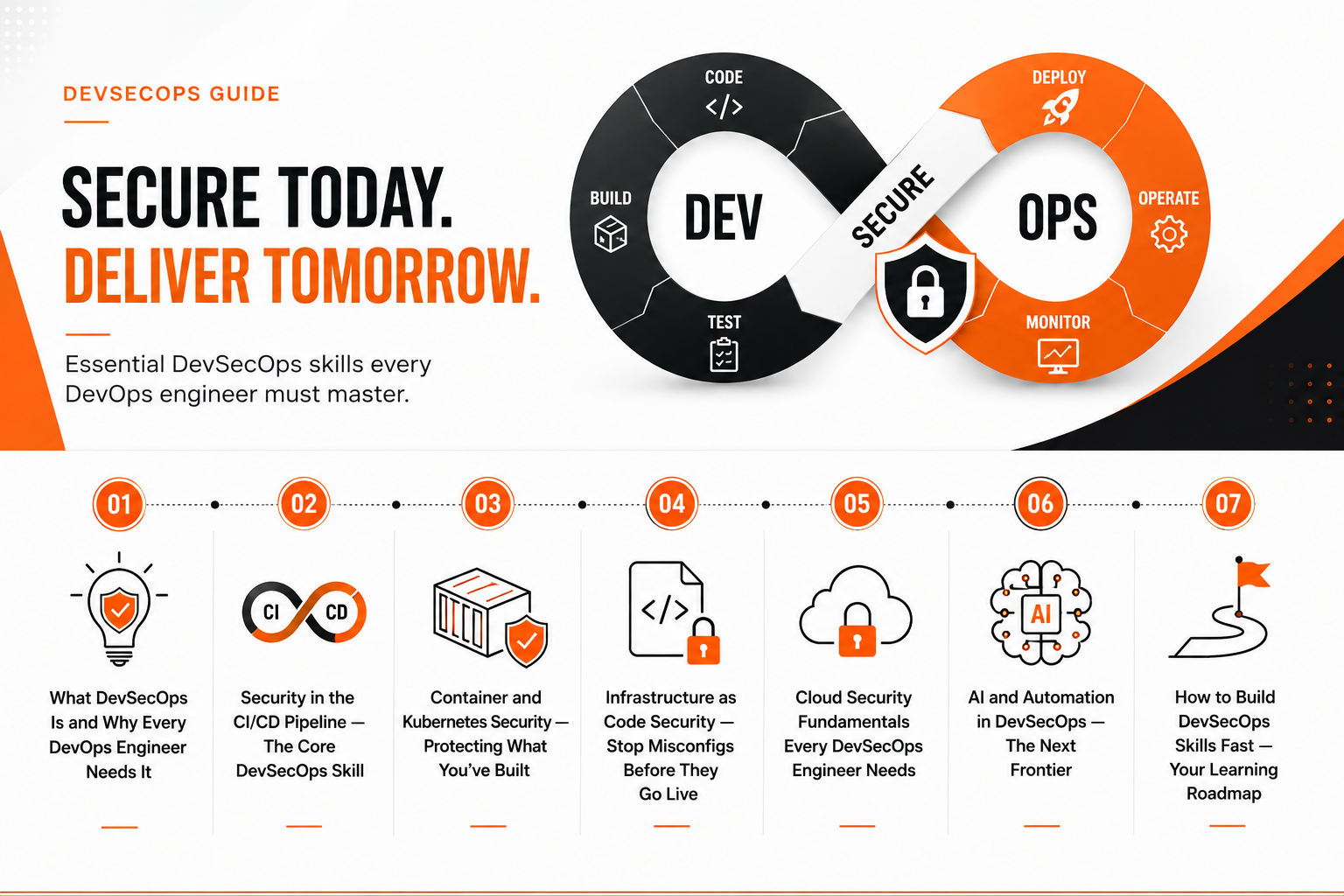
Cloud Security Basics Every DevSecOps Engineer Needs
In the end, all modern apps end up in the cloud, which makes cloud security one of the most essential skill for every DevOps engineer. Regardless of whether you Learn AWS DevOps, Azure, or a hybrid infrastructure, securing the cloud workloads goes way beyond the deployment of virtual machines or applications. Security of cloud workloads presupposes the understanding of the concepts of identity management, encryption, network security, monitoring, compliance, and risk management in order to keep the application safe all along its lifecycle. With the increasing popularity of the cloud, professionals well-versed in cloud security are becoming irreplaceable in any industry.
One of the major pitfalls of a beginner is thinking about cloud security as something different from DevOps. In reality, the security should be integrated into the processes of infrastructure provisioning, app deployment, CI/CD pipeline, and monitoring. For professionals who are going to get a Cloud Computing Certification and learn AWS DevOps, it is crucial to learn how the cloud services interact with such notions as identity, networking, storage, and automation. This is how you will be able to provide proper cloud-native security and ensure faster software delivery.
Also, companies often expect DevOps engineers to understand how the cloud environments are built and secured. Cloud Computing Architecture, secure networking, identity and access management, logging, monitoring, and disaster recovery will help you to build a system that will perform well and be compliant to the regulations. This set of skills will reduce the risk of any harm to your business and increase your value as a professional.
AI and Automation in DevSecOps — The Next Frontier
AI is increasingly playing a huge role in how teams find threats, prioritize them and respond to them. Security experts do not have to go through thousands of alerts daily because they can use AI-powered tools for finding anomalies and misconfigurations as well as for automating security-related tasks. It means that engineers can focus on enhancing their infrastructures instead of doing some tedious manual work every day.
DevSecOps is a development approach where security is automated throughout the software development lifecycle. Automated security means that testing, validation, scanning, review and enforcement of policies can take place within deployment pipelines. Specialists taking devops certification courses and following the devops certification roadmap should know about such automated processes because they are used in the majority of modern engineering teams.
It is time to become a cloud engineer and gain experience in automation, AI and security. Learning Modern skills of DevOps engineer, enhancing your devops engineer skills and learning new AI-powered security tools will definitely pay off because you can learn something useful every year. The engineers who prefer automation will lead cloud transformation projects.
How to Build DevSecOps Skills Fast — Your Learning Roadmap
It is not necessary to master all of the DevSecOps skills at once. The most productive specialists go through a well-organized learning roadmap that begins from the acquisition of solid DevOps fundamentals and then gradually acquires cloud security, automation, containers security, and compliance knowledge. Instead of studying highly advanced security tools right away, one needs to begin from understanding Linux, networks, version control systems, scripting, CI/CD, and cloud platforms. After these fundamentals are acquired, the learning process becomes more rapid since one will understand where the security belongs on each step of the delivery pipeline.
DevSecOps Learning Roadmap
- Gain solid Linux, Git, Docker, and CI/CD fundamentals.
- Learn cloud platforms by taking a structured approach to Learn AWS DevOps.
- Take a practical devops certification course with projects.
- Use a structured devops certification roadmap rather than learn unrelated tools.
- Master security scanning, secrets management, and Infrastructure as Code security.
- Learn Kubernetes security by getting prepared for Certified Kubernetes Administrator certification and advanced kubernetes certifications.
- Go deep with enterprise-grade DevOps Tools To Learn via projects and cloud labs.
Fastest learners build while learning. They create CI/CD pipelines, secure Kubernetes clusters, deploy infrastructure automatically, and add vulnerability scanning to projects. Practical skills not only allow one to get DevOps engineer job and perform on it but also help to pass technical interviews during which future employers assess the skills in solving business tasks.
Start Your DevSecOps Journey at Grras Solutions
As more and more companies implement DevOps practices across their entire software development lifecycle, there will be an increasing demand for experts who will be able to implement all of those practices properly and efficiently. But in order to get those skills, people will have to go through a process of proper learning and then apply what they learned on real projects under professional supervision to be industry ready in a timely manner.
The Grras Solutions provides its learners with a wide range of trainings in which the company will teach industry specific knowledge through live labs, enterprise projects, and expert mentorship. No matter if you want to get aws devops certification, get your Cloud Computing Certification or just need a devops course with placement, the curriculum offered by Grras Solutions will combine all of the relevant information in one learning journey – cloud technologies, automation, security, Kubernetes, Infrastructure as Code, CI/CD etc. The curriculum is relevant both for beginners as well as for experienced professionals who need devops training for working professionals.
If you are interested in acquiring the skills you will need to become a successful devops engineer in the current cloud first industry, then you should start learning right now. Start with building your solid career in DevOps course with placement, acquire practical knowledge of modern security practices and continue learning and improving through industry projects and globally recognized certifications. With Grras Solutions you will have a chance not only to learn on practical cloud environments, but also to prepare for your industry certification and placement.
Learn the skills. Earn the credentials. Build the career. Start today.




 Whatsapp us
 Call us
 Enquire Now